
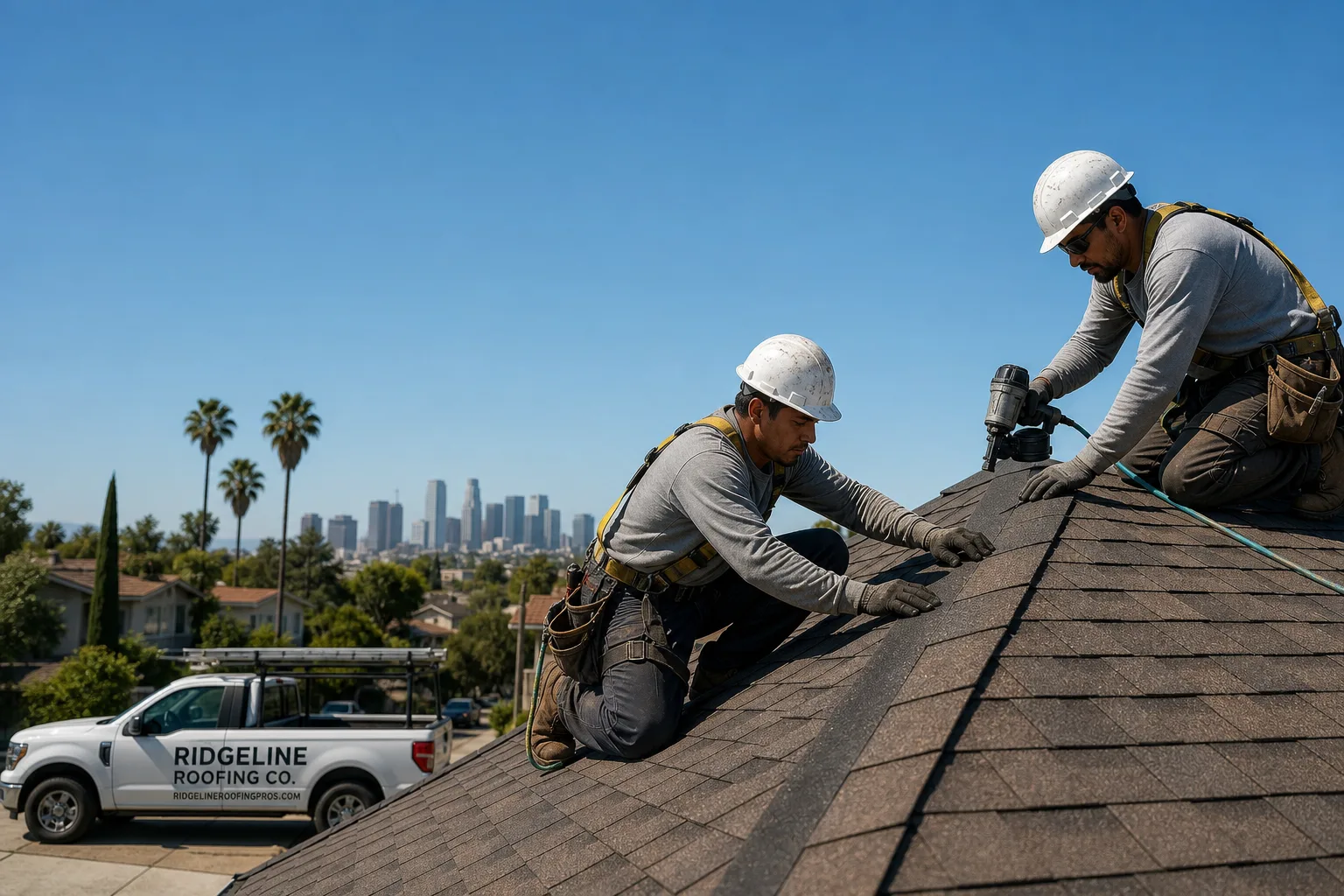
Roof Replacement Cost in Los Angeles: What You’ll Actually Pay in 2026
A full roof replacement in Los Angeles typically runs $12,000 to $28,000 for a standard single-family home, with most Valley and basin jobs landing between $15,000 and $22,000. Hillside properties in fire zones like Topanga, Bel Air, or Altadena start higher because Class A fire-rated assemblies are legally required, not optional. Call (844) 563-1816 for a free, no-pressure estimate with upfront pricing - the number we quote is the number you pay.
We’ve been replacing roofs across Los Angeles since 1984, and we’ve learned that “average cost” articles from national sites rarely match what homeowners here actually see on their invoices. The city’s mix of 1920s Spanish clay tile, mid-century flat roofs, and hillside fire-code requirements creates price ranges that don’t translate well from Phoenix or Chicago. This page breaks down what drives those numbers in the neighborhoods we work.
Why Los Angeles Roof Replacement Costs Vary So Widely
Three forces pull every local estimate in different directions: the roof’s physical geometry, the materials the city or the hillside requires, and the labor needed to handle either one.
Geometry first. A simple 1,500-square-foot gable roof in Van Nuys or Reseda is straightforward - tear-off, deck inspection, underlayment, new shingles, done. That same square footage in the Hollywood Hills, with multiple valleys, dormers, skylights, and a steep pitch requiring staging and safety rigging, can double the labor hours before a single shingle gets nailed.
Materials second. California’s Very High Fire Hazard Severity Zones - which include Topanga, Bel Air, Altadena, Tujunga, and dozens of other hillside neighborhoods - legally require Class A fire-rated roofing assemblies on any permitted re-roof. This eliminates basic three-tab asphalt as an option and makes fire-rated composition, concrete or clay tile, or compliant metal systems the baseline. A homeowner in Pasadena’s flatlands might choose a mid-grade architectural shingle; a homeowner three miles north in Altadena cannot, and that regulatory reality adds $3,000 to $8,000 to comparable footprints.
Labor third. On older Spanish Colonial homes in Los Feliz, Silver Lake, and Eagle Rock - the neighborhood where Pete Navarro grew up - the original 1930s clay tiles often outlast every other component. We regularly perform what’s called a tile-off re-underlayment: carefully removing, sorting, and re-setting those vintage tiles over new synthetic underlayment. It’s standard practice here, virtually unknown in markets without this housing stock, and it runs $8,500 to $14,000 compared to $18,000 to $28,000 for full tile replacement. The savings are real, but the labor is intensive and requires crews who know clay tile systems.
2026 Los Angeles Roof Replacement Pricing by System
These ranges reflect what we’ve quoted and completed in the past eighteen months across Los Angeles County. Every job includes tear-off, deck inspection, proper underlayment, installation, and our 90-Day Done Right Promise.
| Roofing System | Typical Range (1,500-2,500 sq ft) | Best Fit For |
|---|---|---|
| Architectural asphalt shingles (Class A rated) | $12,000 - $18,000 | Valley tract homes, flat terrain, non-fire-zone neighborhoods |
| Concrete or clay tile (new installation) | $22,000 - $38,000 | Mediterranean/Spanish homes, fire zones, 50+ year lifespan |
| Tile-off re-underlayment (re-set original tile) | $8,500 - $14,000 | 1920s-1940s Spanish Colonial with sound original clay tile |
| Low-slope membrane (TPO/PVC/modified bitumen) | $14,000 - $24,000 | Mid-century modern flat roofs, garage additions, ADUs |
| Standing seam metal (fire-rated) | $28,000 - $45,000 | Hillside custom homes, maximum fire rating, 60+ year lifespan |
| Wood shake replacement (Class A composite or tile) | $18,000 - $32,000 | Older homes with original shake, now prohibited in fire zones |
These figures include permits, disposal, and our standard photo-documented inspection. They do not include structural deck repair if we find rot or termite damage - something we encounter on roughly one in four homes built before 1960.
Three Local Scenarios That Shift Your Number
Every estimate we write starts with a roof we can actually see, but these three situations come up often enough that they’re worth understanding before you call.
The 1970s Valley tract home with original composition. These roofs in Woodland Hills, Northridge, or Encino usually have one or two layers of early fiberglass shingles over plywood that has baked in forty-plus years of San Fernando Valley sun. The UV degradation here is severe - LA’s near-total lack of freeze-thaw cycles means shingles don’t crack from cold, but the year-round radiation degranulates and embrittles them faster than in cooler climates. Tear-off is straightforward, deck is often sound, and you’re looking at the lower end of architectural shingle pricing. We install CertainTeed Landmark and Owens Corning Duration lines regularly for these jobs.
The hillside home after Santa Ana winds. Each fall and winter, gusts exceeding 60 mph in canyon areas lift clay tiles, crack corners, and blow flashing loose. We see a predictable surge of calls from Laurel Canyon, Studio City hills, and Beachwood Canyon. Sometimes it’s repairable; sometimes the cumulative damage plus age triggers a full replacement. If you’re in a Very High Fire Hazard Severity Zone, the replacement must meet Class A assembly standards - no exceptions, no grandfathering. This pushes you toward concrete tile, rated composition, or metal, and the permit process adds a week.
The mid-century modern with a dead flat roof. Homes in the Eichler-influenced pockets of Granada Hills, parts of Westchester, or the foothills below the Angeles National Forest often have original built-up roofing or early single-ply that’s reached end of life. These require low-slope membrane systems - TPO, PVC, or modified bitumen - with proper crickets and drainage. The material costs more per square foot than shingles, but the area is often smaller. The real variable is how many penetrations (skylights, HVAC curbs, vent stacks) need custom flashing.
What Our Estimate Covers - And What Some Competitors Leave Out
We’ve reviewed enough competitor estimates to know where corners get cut. Our standard Roof Replacement & Installation in Los Angeles includes:
- Complete tear-off and disposal of existing materials
- Full deck inspection with photos shown to you before we proceed
- Replacement of damaged decking (priced per sheet, disclosed upfront)
- Ice and water shield or equivalent at valleys, penetrations, and eaves
- Manufacturer-specified underlayment system
- Installation per manufacturer requirements (required for warranty validity)
- New flashing at all walls, chimneys, and penetrations
- Final cleanup and magnetic nail sweep
- Photo documentation of completed work
- 90-Day Done Right Promise - written, no paperwork runaround, no arguing
Some bids we’ve seen exclude deck repair as “TBD,” use non-specified underlayment, or skip valley ice-and-water to hit a lower number. Six months later, the homeowner has a leak and a voided warranty. We don’t work that way. The price we quote is the price you pay, and we stand behind it - no paperwork, no arguing.
We’re authorized installers for GAF, CertainTeed, Owens Corning, IKO, Atlas, Tamko, and Boral. That matters because manufacturer warranties are only as good as the installation. A 50-year shingle installed against spec is a 5-year shingle with fine print that won’t pay out.
Permits, Fire Codes, and What Los Angeles Requires
Every roof replacement in Los Angeles requires a permit from LADBS or the relevant city jurisdiction. We pull permits on every job - no exceptions. The permit fee runs $400 to $900 depending on valuation and jurisdiction, and it’s included in our estimates.
For properties in Very High Fire Hazard Severity Zones, the fire-rated assembly requirement is non-negotiable. We’ve had homeowners ask if they can “just do the repair” to avoid triggering a full code-compliant replacement. If the work exceeds 25% of the roof area in any twelve-month period, the entire roof must be brought to current fire standards. We don’t write estimates that put you in violation - it’s not worth your trouble or ours.
Historic Preservation Overlay Zones (HPOZs) like parts of Angelino Heights or West Adams add another layer: materials and colors may require review. We’ve navigated these approvals before and build that time into our schedule.
How Long a Los Angeles Roof Replacement Takes
Most standard replacements we complete in two to four working days. Complex tile jobs, steep pitches requiring scaffolding, or HPOZ review periods can extend to one to two weeks. We don’t rush. A roof doesn’t lie - it just waits until the rain to tell you the truth, and we’d rather take the time to do it right than explain later why we didn’t.
Weather delays are rare in Los Angeles, though we do pause for Santa Ana wind events when working on exposed hillsides. Safety first, schedule second.
Financing, Insurance, and When to File a Claim
We offer financing through a third-party partner for qualified homeowners. Terms vary; we’ll discuss options during your estimate if helpful.
Insurance claims are appropriate for sudden, accidental damage - tree impact, fire, significant wind damage - not for age-related wear. If your roof is twenty-five years old and leaking at the end of its normal lifespan, that’s maintenance, not a covered peril. We’ll document storm damage honestly if we find it, and we’ll tell you straight when we don’t. No inflated claims, no phantom hail damage. That’s not how you build a company that lasts forty-two years.
FAQs
Most Los Angeles homeowners pay between $15,000 and $22,000 for a full replacement, with hillside fire-zone properties starting closer to $18,000 and complex tile or metal systems reaching $35,000 or more. Your specific price depends on roof size, pitch, material requirements, and deck condition. Call (844) 563-1816 for a free estimate - we’ll measure, photograph, and quote with no pressure.
Repairs make sense when damage is isolated and the roof has significant remaining life; replacement is smarter when repairs exceed 30% of replacement cost or the roof is past 80% of its expected lifespan. On a twenty-eight-year-old composition roof in the Valley, patching a few blown-off shingles after Santa Ana winds is throwing good money at bad. We’ll tell you which side of that line you’re on. Call (844) 563-1816 and we’ll walk you through it.
We complete some small, single-story homes in a single day, but most Los Angeles replacements take two to four days due to permit inspection requirements, material staging, and proper installation sequencing. Tile-off re-underlayments and steep hillside jobs typically need longer. We don’t sacrifice the 90-Day Done Right Promise to hit an artificial deadline. Call (844) 563-1816 to discuss your timeline.
If your home is in a Very High Fire Hazard Severity Zone - including Topanga, Bel Air, Altadena, Tujunga, and many other hillside neighborhoods - California law requires Class A fire-rated roofing assemblies on any permitted re-roof. This eliminates standard three-tab asphalt and makes fire-rated composition, tile, or metal your baseline options. We verify your zone during our inspection and specify compliant materials automatically. Call (844) 563-1816 to confirm your property’s requirements.
Get Your Free, Upfront Estimate
We’ve replaced roofs across Los Angeles for over forty-two years - from Eagle Rock to Encino, from flat roofs in Westchester to clay tile in Los Feliz. Every estimate is free, every price is upfront, and every job carries our 90-Day Done Right Promise. A live person answers our phones 24 hours a day, including nights, weekends, and the middle of a storm. Call (844) 563-1816 or visit our home page to learn more about Ridgeline Roofing Co.
Written by Pete Navarro, Owner, Ridgeline Roofing Co. at Ridgeline Roofing Co., serving Los Angeles, CA.