
Tile Roofing in Los Angeles, CA
Tile roofing is one of the most durable and weather-appropriate choices for Los Angeles homes, capable of lasting 40 to 75 years when installed correctly and maintained regularly. Whether you have a clay barrel tile roof on a Spanish Revival in Silver Lake or a flat concrete tile on a ranch home in Woodland Hills, getting the installation right the first time is everything. At Ridgeline Roofing Co., we’ve been setting tile roofs across Los Angeles since 1984 – that’s over 42 years of knowing which products hold, which crews can be trusted, and which shortcuts cost homeowners dearly down the road, making us the best roof replacement & installation in Los Angeles, CA for homeowners who want it done right.
If your current tile roof is failing, aging past its prime, or you’re putting tile on a new or remodeled structure, the conversation starts with a free estimate. Call us at (844) 563-1816 – a real person answers every time, any hour, any day. No voicemail tree. No callback window. Just a straightforward conversation about what your roof needs.
Tile roofing falls under our broader Roof Replacement & Installation in Los Angeles service, where you’ll find information on the full range of materials and systems we work with – from asphalt shingles to flat roofing. This page focuses specifically on tile: what to look for, what the process involves, what it costs in the Los Angeles market, and how we back the work once it’s done.
When You Need Tile Roofing
Tile is a long-lived material, but it doesn’t last forever without attention – and in Los Angeles, a specific set of conditions tends to push tile roofs toward the end of their useful life faster than homeowners expect. Here’s what typically prompts a tile roofing call to our office:
- Cracked or broken tiles from debris impact. Los Angeles’s dry-season Santa Ana winds drive branches, palm fronds, and other debris hard into roofs, especially in hillside communities like Tarzana, La Crescenta, and Altadena. A cracked tile doesn’t always look like a crisis from the ground, but even a small breach can channel water under the underlayment during a January rainstorm.
- Failing underlayment beneath intact tiles. This is the most common problem we find in Los Angeles homes with tile roofs that were installed before 2000. The tiles themselves may look fine, but the 15- or 30-year felt underlayment beneath them has dried out, cracked, and stopped doing its job. In the San Fernando Valley, where attic temperatures routinely exceed 150 degrees in summer, underlayment degrades faster than the national average – sometimes 10 to 15 years faster.
- Lifted or slipped tiles on aging mortar-set ridges. Traditional Spanish tile roofs used mortar to set the ridge and hip tiles in place. That mortar has a lifespan. When it cracks and crumbles – a process we see regularly on homes built before 1980 in neighborhoods like Los Feliz, Eagle Rock, and Highland Park – ridge tiles loosen, shift, and eventually fall. Loose ridge tiles are a hazard and a leak point.
- Water intrusion at valleys, flashings, or chimneys. Tile roofs channel water into metal valleys and around flashings at chimneys, skylights, and walls. When those flashings corrode, separate, or were originally installed incorrectly, water finds its way into the roof deck. If you’re seeing ceiling stains after rain in a room that sits near a chimney or a roof valley, this is usually why.
- Full roof replacement after a re-roof limit is reached. Los Angeles building codes limit most residential structures to two roofing layers. If your home has already been re-roofed once over the original tile, the next step is a full tear-off and reinstall. This is also the point where many homeowners choose to upgrade to a higher-performance tile system rather than match what was there before.
- New construction or major addition requiring tile to match existing. Many Los Angeles homeowners adding ADUs, second stories, or significant additions need tile installed that matches the existing roof – in both profile and color. This is detail work. Getting the profile and color match right on concrete and clay tile requires knowing the product lines and, often, working with multiple suppliers to source a discontinued run.
Our Tile Roofing Process
Every tile roofing job we take in Los Angeles follows the same documented sequence. We don’t skip steps to finish faster, and we don’t substitute materials after the estimate is signed. The price on the estimate is the price on the invoice – full stop.
- Photo-documented inspection from the roof itself. We go up. Our background-checked, uniformed technician walks the roof surface and documents what’s there: tile condition, underlayment age and integrity, deck condition, flashing status at every penetration, and ridge and hip mortar condition. You receive actual photos taken from your actual roof – not a driveway speech based on binoculars. If there are problems beyond the scope you called about, we show you the photos and explain the options. No scary upsell tactics, no manufactured urgency.
- Upfront written estimate with materials specified by brand and product line. Once the inspection is complete, we put the full scope in writing. We specify the tile product by manufacturer and line – Boral’s concrete tile systems, for instance, are a strong choice for many Los Angeles homes because they’re engineered with California’s UV intensity and seismic zone in mind. We also specify the underlayment system, flashing materials, and any decking repair that’s needed. What’s written is what gets installed.
- Permit coordination where required by the City of Los Angeles or applicable jurisdiction. Tile roofing replacement in the City of Los Angeles typically requires a roofing permit through the Department of Building and Safety, particularly for full tear-offs. We handle the paperwork. Los Angeles also has specific requirements for fire-rated roofing assemblies in Very High Fire Hazard Severity Zones – which cover large portions of the hillside communities, the foothill edges of the San Fernando Valley, and areas bordering the Angeles National Forest. We know which products carry the required Class A fire rating and make sure the assembly is compliant before we pull a nail.
- Tear-off, deck inspection, and substrate repair. On replacement jobs, all existing roofing material comes off. The roof deck – typically plywood or OSB in Los Angeles – gets inspected board by board. Soft spots, delaminated sections, and rot from previous leak damage get replaced before anything new goes down. Skipping this step is how a new tile roof develops problems in its first year; we don’t skip it.
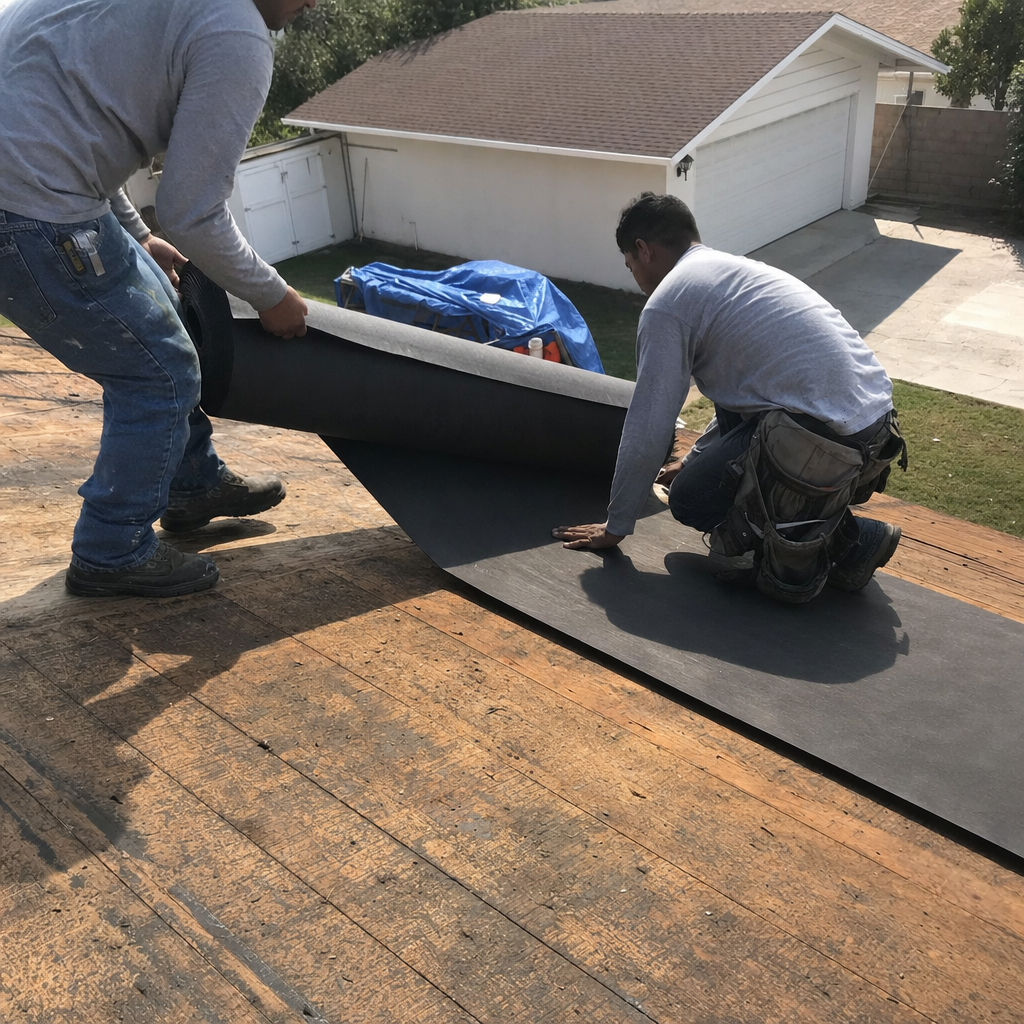
- Underlayment installation to current code. Modern tile roofing in California requires a high-performance underlayment system – not the 15-pound felt that was standard on roofs built 30 and 40 years ago. Depending on slope, exposure, and the tile system specified, we install ASTM-rated synthetic underlayment or a two-layer system per manufacturer requirements. Getting the underlayment right is what separates a tile roof that lasts 50 years from one that leaks at year 12.
- Tile installation, ridge setting, and final inspection with photos. Tile is set to manufacturer specifications and local code, with battens where required by the tile system. Ridge and hip tiles are set in a mortar or foam system as appropriate for the product line. Once the field tile and all trim pieces are complete, we do a final roof-surface inspection, document it with photos, and walk you through what was done. The 90-Day Done Right Promise covers the work from the day we finish: if anything is not right, we come back and make it right. No paperwork. No arguing. No runaround.
Tile Roofing Pricing in Los Angeles
Tile roofing in Los Angeles costs more than asphalt shingles and considerably less than it costs to deal with a roof that was installed wrong. Here are honest ranges based on current Los Angeles market conditions:
| Scope of Work | Typical Range (Los Angeles) | Key Cost Factors |
|---|---|---|
| Concrete tile replacement (underlayment & re-tile, existing tiles reused where sound) | $4.50 – $7.00 per sq. ft. | Roof pitch, tile reuse %, deck condition |
| Full concrete tile tear-off & replacement (new tile) | $12.00 – $18.00 per sq. ft. | Tile product line, roof complexity, permit fees |
| Full clay tile tear-off & replacement (new tile) | $16.00 – $24.00 per sq. ft. | Profile availability, weight considerations, flashings |
| Ridge & hip re-mortar or foam reset only | $800 – $2,500 typical | Linear footage, access, mortar vs. foam system |
| Partial re-tile with underlayment section replacement | $1,500 – $6,000 typical | Affected area size, tile match availability |
A few things drive cost in the Los Angeles market specifically. First, roof pitch matters more here than in much of the country: Los Angeles’s hillside neighborhoods – Bel Air, Mount Washington, Glassell Park, the Hollywood Hills – often feature steep or complex roof geometries that require more labor time and different rigging setups compared to asphalt vs architectural shingles in Los Angeles, CA installations. Second, the Los Angeles Department of Building and Safety permit fee for a full re-roof is based on project valuation and adds to the total. Third, clay tile costs more than concrete tile and is heavier, which sometimes requires a structural assessment of the roof framing before the permit is issued – particularly on older homes in neighborhoods like Hancock Park and Larchmont where the original framing was designed around lighter materials.
If you qualify for our 5% Senior or Veteran discount, mention it when you call – it applies permanently to any job we do for you, and you can combine it with any other current offer. Call (844) 563-1816 for a free estimate; we’ll give you a firm number, not a range with asterisks.
Why the Underlayment Is Half the Conversation
Homeowners in Los Angeles often call about a specific tile that cracked or a ridge that’s lifting – and that’s a fair place to start. But after 42 years of inspecting tile roofs across this city, the thing we find ourselves explaining most often is the underlayment.
Tile is the armor. Underlayment is the waterproofing membrane that actually keeps water out of your home. In Los Angeles, the combination of intense UV exposure, extreme attic heat in the summer months, and sudden, heavy winter rains creates a uniquely harsh environment for felt-based underlayments. The same dry heat that makes Los Angeles pleasant to live in accelerates the breakdown of older roofing materials significantly faster than you’d see in a milder climate like the Pacific Northwest.
On homes built in the 1960s through the 1990s – a large portion of the single-family housing stock in neighborhoods like Reseda, North Hills, Chatsworth, and Granada Hills – the original felt underlayment is almost certainly past its design life. The tiles above may look intact from the street. But when it rains hard in January, water can move under a small crack in the field tile, hit a dried-out underlayment, and find its way to the roof deck and eventually to your ceiling in ways that are very hard to trace without going up and actually looking.
That’s why our inspection process starts from the roof surface, not the driveway. We’ve seen too many Los Angeles homeowners spend money on targeted repairs to tiles and ridge mortar, only to call us two winters later about water intrusion that was always going to happen because the underlayment was never addressed.
Tile Roofing and Los Angeles Fire Zones
This is worth knowing if your home sits in one of Los Angeles’s designated Very High Fire Hazard Severity Zones. Large portions of the foothills, hillside communities, and edges of the San Fernando Valley fall within these zones, which carry specific building code requirements for roofing assemblies. The California Department of Forestry and Fire Protection (CAL FIRE) and the California Building Code both require a Class A fire-rated roofing assembly in these areas.
The good news for tile homeowners is that properly installed concrete and clay tile systems typically qualify as Class A assemblies when paired with the correct underlayment. The underlayment matters here: older felt systems may not meet current Class A requirements on their own, which is one more reason that a full underlayment replacement is often the right call when reroofing a home in the hills or foothills of Los Angeles. We verify the fire rating of every assembly we install against the applicable zone designation before the permit is pulled. We’ve been doing this in Los Angeles long enough to know the zone boundaries, and we don’t guess.
Boral, GAF, and Choosing the Right Tile for Your Los Angeles Home
We’re an authorized installer of seven manufacturer lines, and for tile specifically, the two we work with most often in Los Angeles are Boral and GAF. Both make products specifically engineered for California conditions – Boral’s concrete tile lines in particular are widely used in Southern California and offer a wide range of profiles to match the Spanish, Mediterranean, and Mission-style architecture common in neighborhoods like San Marino, Pasadena, and Rancho Park.
GAF also produces concrete tile systems that carry strong wind and fire ratings suitable for Los Angeles’s exposure conditions. When matching existing tile on an addition or partial re-roof, product line selection can get nuanced – profile dimensions vary by manufacturer and even by production year within the same manufacturer. We’ve tracked down discontinued tile runs before, and when that’s genuinely not possible, we’re honest about it and help you evaluate your options rather than setting a mismatched patch and hoping you don’t notice.
The right tile for your home depends on your existing structure’s load capacity, your architectural style, your local fire zone status, and your budget. That’s a conversation worth having before any material is ordered, and it starts with the inspection.
FAQs – Tile Roofing in Los Angeles
How long does a tile roof last in Los Angeles?
A properly installed concrete tile roof in Los Angeles typically lasts 40 to 50 years; clay tile often lasts longer, with some installations exceeding 70 years when the underlayment is maintained and replaced on schedule. The tile itself is rarely what fails first. In Los Angeles’s climate, the underlayment beneath the tile tends to degrade after 20 to 30 years depending on roof pitch, attic ventilation, and sun exposure. Replacing the underlayment – either on a targeted basis or as part of a full re-tile – is what resets the clock on a tile roof’s effective lifespan. Call us at (844) 563-1816 for a photo-documented inspection that tells you exactly where your roof stands.
How much does tile roofing cost in Los Angeles?
A full tile roof replacement in Los Angeles typically runs between $12 and $18 per square foot for concrete tile, and $16 to $24 per square foot for clay tile, depending on roof complexity, pitch, deck condition, and permit requirements. Homes in hillside communities with steep or irregular roof geometry tend to sit toward the higher end of those ranges due to additional labor time and access requirements. The number we put on the estimate is the number on the invoice; we don’t quote low and adjust later. Call (844) 563-1816 for a free estimate – no obligation, no pressure.
Can tile roofing be repaired instead of fully replaced?
Yes, in many cases. If the underlayment beneath the tile is still sound and the damage is isolated – a section of cracked tiles from a fallen branch, loose ridge mortar, or a failed flashing at a chimney – a targeted repair is often the right call and far less expensive than a full replacement. The honest answer depends on the age and condition of the underlayment, which we assess during the inspection. On roofs where the underlayment is 25 or more years old, we’ll tell you plainly if a repair is likely to buy meaningful time or if it’s patching over a problem that will recur within a year or two. That’s a judgment call we’d rather make with you upfront than let you find out the hard way after writing a second check.
Do I need a permit for a tile roof replacement in the City of Los Angeles?
Yes. A full tile roof replacement in the City of Los Angeles requires a roofing permit through the Los Angeles Department of Building and Safety. Partial repairs below a certain scope threshold may not require a permit, but any job that involves a full tear-off and re-installation does. Homeowners in Very High Fire Hazard Severity Zones also need to verify that the roofing assembly meets Class A fire rating requirements under the California Building Code. We handle permit coordination as part of our process – you don’t need to navigate the LADBS paperwork on your own. If you’re outside the City of Los Angeles in an incorporated municipality like Burbank, Glendale, or Torrance, permit requirements are similar but administered through those cities’ own building departments; we’re familiar with all of them.
Ready to Talk About Your Tile Roof?
If your tile roof is showing any of the signs above – or if you simply haven’t had it inspected in the last few years and want to know what you’re working with – we’re ready to help. Ridgeline Roofing Co. has been serving homeowners across Los Angeles since 1984. We’re not going anywhere, and neither is the work we do.
Call us at (844) 563-1816 for a free estimate. A real person answers, day or night. We’ll schedule an inspection at your convenience, go up on the roof and document what we find, and give you a straightforward written estimate with no surprises on the back end. All work is covered by our 90-Day Done Right Promise: if anything is not right after we finish, we come back and make it right. No paperwork, no arguing, no runaround. That’s been the standard since 1984, and it’s not changing.
Senior and Veteran homeowners receive a permanent 5% discount on all work – just mention it when you call.
You can also learn more about the full range of installation options available to Los Angeles homeowners on our home page, or explore the complete Roof Replacement & Installation in Los Angeles service section for information on other roofing systems we install.
Written by the team at Ridgeline Roofing Co., serving Los Angeles since 1984.