
Last updated July 26, 2026
The Complete Emergency & Storm Damage Guide for Los Angeles Homeowners
In the 2023-2024 storm season, LA County processed more water-intrusion insurance claims than in the previous five years combined. The homes hit hardest weren’t the oldest - they were the ones whose owners assumed “it doesn’t really rain that much here” was a maintenance strategy. Los Angeles roofs face a specific threat profile most guides ignore: atmospheric rivers that dump months of water in 72 hours, El Niño cycles that catch homeowners off-guard after dry spells, and post-wildfire hydrophobic soil that turns modest rainfall into flash flooding against structures never designed for sustained hydrostatic pressure. This guide covers what actually happens when storms hit LA, what to do in the critical first three days, how to protect your insurance claim, and how to spot the contractors who follow the rain.
Quick Answer
Los Angeles homeowners facing storm damage should document everything photographically before touching anything, tarp only active leaks to prevent interior damage, and call a local contractor offering Emergency & Storm Damage services within 24 hours - not to begin repairs immediately, but to create the third-party documentation that insurance adjusters rely on. Most storm damage that looks catastrophic from inside the house starts as a small failure in flashing, a clogged scupper, or a cracked clay tile that went unnoticed for years.
Table of Contents
- Why Los Angeles Storm Damage Is Different
- The First 24-72 Hours: What to Do in Order
- Reading Your Insurance Adjuster’s Report
- How to Spot Storm-Chaser Contractors in LA
- Pre-Season Roof Hardening for LA Homes
- Common Mistakes to Avoid
- When to Call a Professional
- Frequently Asked Questions
Why Los Angeles Storm Damage Is Different
Most storm damage guides assume a Midwest or Gulf Coast context: hail, tornadoes, hurricanes. For LA-specific guidance, see The Complete Guide to Roofing in Los Angeles. Los Angeles presents a distinct profile that compounds damage in ways standard insurance adjusters and out-of-town contractors often miss.
Atmospheric rivers deliver concentrated water loads. A single Pineapple Express event can drop 5-10 inches in 48 hours on a roof system engineered for 15 inches annually. In neighborhoods like Studio City and Encino, we’ve seen clay tile roofs that shed light drizzle perfectly fail catastrophically under sustained deluge because the underlayment had dried and cracked during a decade of drought.
El Niño cycles create a particular psychological trap. After multiple La Niña years of near-drought, homeowners stop checking. The 2015-2016 El Niño caught thousands of LA homeowners with deteriorated flashings, failed sealants at vent pipes, and accumulated debris in valleys that would have been obvious with annual inspection. The 2023-2024 season repeated the pattern.
Post-wildfire hydrophobic soil is the factor almost no homeowner considers. After fires like the 2018 Woolsey Fire or 2025 Palisades Fire, burned soil becomes water-repellent for 2-5 years. Rain that would normally absorb instead sheets off hillsides, overwhelms drainage systems, and creates unusual lateral pressure on foundation walls and low-slope roof areas. In Malibu and Topanga Canyon, we’ve documented cases where water entered through perfectly sound roof membranes because the drainage design assumed permeable soil that no longer exists.
Santa Ana wind preconditioning matters too. The hot, dry winds that precede winter storms desiccate roofing materials. Asphalt shingles become brittle. Tile mortar weakens. When rain follows within days, materials that would normally flex and seal instead crack under thermal shock.
The result: LA storm damage is rarely a single dramatic event. It’s a cascade of preconditioning failures that a generic storm guide won’t help you recognize.
The First 24-72 Hours: What to Do in Order
The sequence matters. Do the wrong thing first and you can void coverage, destroy evidence, or create secondary damage that’s excluded from your claim.
Step 1: Document Before You Touch (Hours 0-4)
- Photograph every interior water mark, stain, or drip from multiple angles with a timestamp. Include a reference object for scale.
- Photograph the exterior from ground level - don’t climb on a wet roof. Capture the full roof plane, gutters, downspouts, and any visible debris.
- Photograph all damaged personal property before moving anything. Insurance covers contents separately from structure, but only with documentation.
- Save weather reports showing the specific event. The National Weather Service issues local storm summaries that become evidence in disputed claims.
Step 2: Mitigate Active Damage Only (Hours 4-24)
Tarp active leaks to prevent interior damage, but do not remove roofing materials or attempt repairs. Use a tarp large enough to extend past the damaged area by at least 4 feet in all directions. Secure with lumber battens, not nails through the roof - nail holes create new leak paths that insurers may classify as homeowner-caused damage.
Place buckets. Move furniture. But leave the roof itself undisturbed until documented by a professional. In Los Angeles, where many homes have finished cathedral ceilings or spray-foam insulation, interior water migration can travel 20 feet from the actual penetration point. Mark where water appears, but don’t assume that’s where the roof failed.
Step 3: Call Your Insurance Company and a Local Contractor (Hours 12-24)
Report the claim. Request the adjuster’s name and expected timeline. Then call a local contractor - not to start work, but to create independent documentation. Insurance adjusters in LA are often managing 40-60 claims after a major event. A contractor’s photos, moisture meter readings, and written assessment provide the detail an overwhelmed adjuster may miss.
At Ridgeline Roofing Co., we document every storm inspection with photos from your actual roof, not a generic report. Our technicians are background-checked, uniformed, and trained to record the specific evidence adjusters need.
Step 4: Preserve Evidence for 72 Hours
Don’t discard damaged materials. Don’t power-wash stains. Don’t let a well-meaning neighbor “take a look” and disturb the failure point. In LA’s insurance market, where carriers have tightened water damage exclusions significantly since 2020, the burden of proving sudden and accidental damage falls heavily on the homeowner. Undisturbed evidence is your best protection.
Reading Your Insurance Adjuster’s Report
LA homeowners routinely leave money on the table by not understanding what they’re reading. Here’s what to look for.
Line item: “R&R shingles, like kind and quality.” This sounds complete. It often isn’t. In Los Angeles, many homes have discontinued tile profiles, custom color blends, or assemblies that require specific underlayment systems. “Like kind and quality” should mean matching existing materials. If your 1980s Mediterranean has Boral Saxony 900 clay tiles in a custom blend, standard-grade replacement creates a visible patch that diminishes value. Request specific manufacturer and product line identification.
Line item: “Detach and reset.” This means removing and reinstalling existing materials. For clay tiles over 30 years old, this is often impossible without 30-50% breakage. The adjuster may not volunteer that full replacement is more appropriate. A contractor’s photo documentation of brittle, crazed, or salt-deteriorated tiles supports your request.
Line item: “Dry out only” for interior damage. After major LA storms, restoration companies flood the market with drying services. But drywall that has wicked water from a roof leak often requires removal to address mold risk in our warm climate. California’s SB 655 sets specific mold assessment standards. If the adjuster approves only drying, request a mold assessment by a certified inspector.
Missing line item: Code upgrade coverage. Los Angeles has adopted increasingly strict Title 24 energy requirements and fire-resistant roofing mandates, especially in Very High Fire Severity Zones. If your 1970s roof is being replaced, current code may require enhanced underlayment, ridge venting, or specific ignition-resistant materials. Standard policies exclude code upgrades unless you carry ordinance or law coverage - but many LA homeowners don’t know they have it. Check your declarations page.
Missing line item: Permits and inspections. The City of Los Angeles and most surrounding municipalities require permits for roof repairs exceeding 100 square feet or involving structural components. Legitimate contractors include permit costs. If the adjuster’s estimate omits permits, the “savings” may come from a contractor who skips them - leaving you with an unpermitted repair that complicates future sales.
We’ve reviewed hundreds of adjuster reports for Los Angeles homeowners. The pattern is consistent: adjusters aren’t malicious, but they’re overworked and working from standardized pricing databases that don’t reflect LA’s specific material costs, code requirements, or labor market. Independent contractor documentation closes that gap.
How to Spot Storm-Chaser Contractors in LA
Every major LA rain event brings them. They appear within 48 hours, often from Florida, Texas, or the Midwest, with out-of-state plates, temporary local phone numbers, and aggressive door-to-door canvassing. Here’s how to verify who you’re dealing with.
- Check the CSLB license immediately. California requires a C-39 Roofing Contractor license for any job over $500. Verify at cslb.ca.gov. Storm chasers often operate under a local licensee’s number without genuine affiliation - call the licensee directly to confirm the relationship.
- Demand a local physical address, not a P.O. box or suite number. Established Los Angeles roofers have yards, shops, or offices you can visit. Ridgeline Roofing Co. has served this community since 1984 - we’re not hard to find.
- Ask where they were six months ago. Legitimate contractors have continuous local presence. Storm chasers have a blank spot before the storm event.
- Refuse pressure to sign now for a “storm price.” This is a classic tactic. There’s no such thing as a storm discount that expires in 24 hours. Our pricing is the same in February as it is in August - a square deal doesn’t fluctuate with your anxiety.
- Verify manufacturer authorization. Major brands - GAF, CertainTeed, Owens Corning - authorize specific contractors by territory. An out-of-state storm chaser claiming to install these products likely cannot offer the manufacturer’s warranty. We’re authorized installers for all seven leading lines, including full replacement and installation in Los Angeles with proper warranty registration.
- Check for local permit history. The City of Los Angeles Department of Building and Safety maintains online records. A contractor with no local permit history in the past two years is a red flag regardless of claims about “30 years in the business.”
The pattern after LA storms is predictable: chasers arrive fast, collect deposits from dozens of homeowners, complete a fraction of the work, and vanish before complaints accumulate. The CSLB and LA County District Attorney have prosecuted these operations repeatedly, but new ones form faster than old ones close. Your protection is verification, not hope.
Pre-Season Roof Hardening for LA Homes
The best emergency is the one you prevent. Los Angeles housing stock has specific vulnerabilities that pre-season inspection can address.
Clay Tile Vulnerabilities
Clay tile dominates LA’s older neighborhoods - Hancock Park, Los Feliz, Pasadena-adjacent areas. It’s durable but not maintenance-free. The failure points we see regularly:
- Broken tiles at hip and ridge lines from Santa Ana wind uplift. One missing tile creates a channel for water directly onto underlayment never intended to be primary waterproofing.
- Failed mortar at apexes and terminations. Thermal cycling degrades mortar in 15-25 years. In dry years, homeowners don’t notice. In a wet El Niño season, degraded mortar washes out and tiles shift.
- Walking damage. Clay tile cannot support foot traffic without breakage. If your last “inspector” walked the roof, they likely created damage they didn’t report.
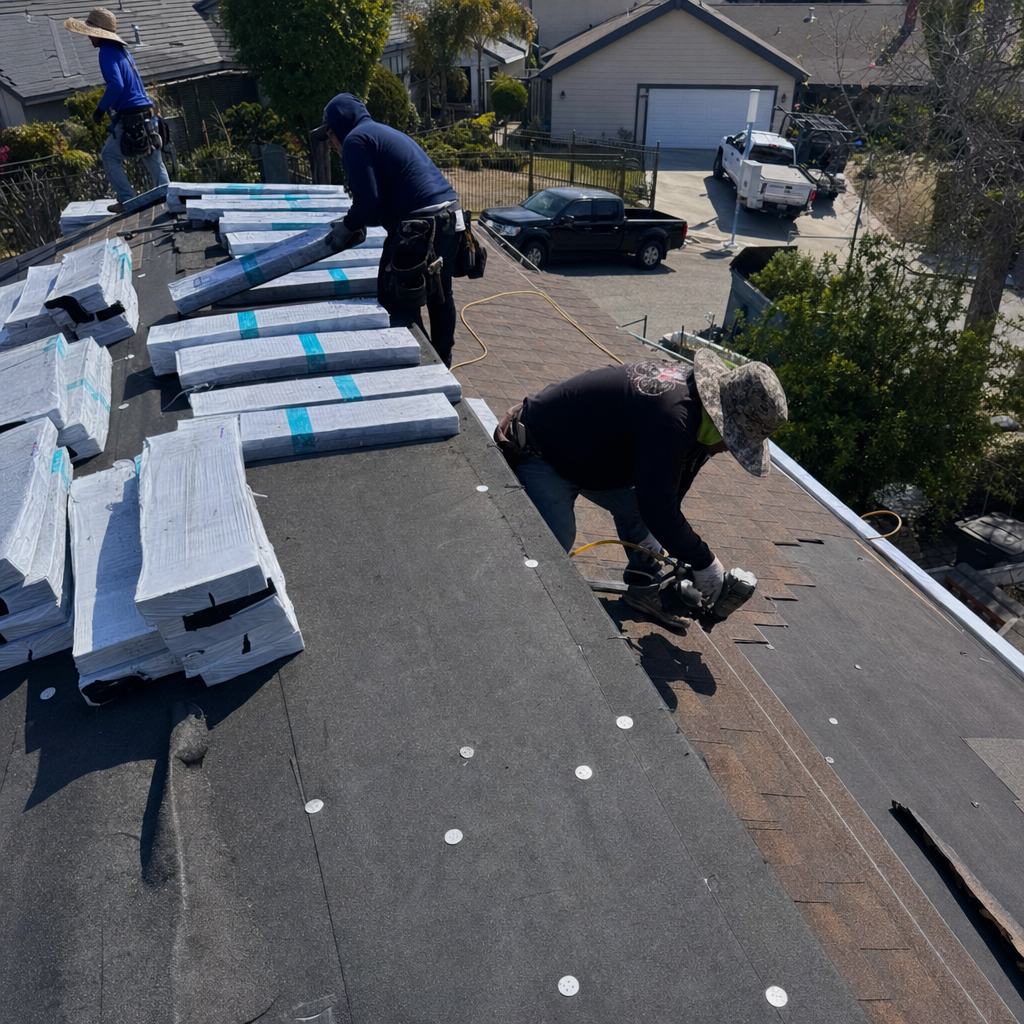
Our roof repair in Los Angeles includes non-destructive inspection from ladders and aerial documentation where appropriate. For clay tile, we specify matching replacement from manufacturers like Boral or specialty roofing in Los Angeles sources, not generic substitutes.
Flat Roof Ponding Risks
Mid-century modern homes in the Hollywood Hills, Silver Lake, and Palm Springs-influenced architecture throughout the Valley depend on flat or low-slope roofing. These systems are designed for positive drainage, not zero slope. After years of slight settlement, debris accumulation, or well-meaning HVAC installations that block drainage paths, ponding develops. An inch of standing water weighs 5.2 pounds per square foot. During an atmospheric river, that becomes sustained load the structure wasn’t designed for, accelerating membrane failure at seams and penetrations.
Pre-season correction: Clear all drains, scuppers, and gutters. Verify positive drainage with a level - water should move to drains within 48 hours of rainfall. For persistent ponding, tapered insulation recovery or crickets may be indicated. We evaluate this during our $89 Seasonal Tune-Up.
Stucco Parapet and Wall Flashing Details
Spanish Colonial and Mediterranean Revival homes throughout LA - Beverly Hills, Bel Air, Hancock Park - feature stucco parapet walls with concealed flashing. The detail fails predictably: stucco cracks at the roof-to-wall intersection, water enters the wall cavity, and the first visible sign is interior plaster damage that looks like a roof leak but originates in wall flashing. Standard roofers miss this. We inspect parapet coping, through-wall flashing, and weep holes as part of storm-readiness evaluation.
Gutter and Downspout Capacity
LA’s standard 5-inch K-style gutters handle normal rainfall. They don’t handle atmospheric river intensity. In hillside areas - Laurel Canyon, Beachwood Canyon, Mount Washington - concentrated roof runoff on saturated slopes creates foundation and basement issues even when the roof itself is sound. Oversized gutters, additional downspouts, or rain harvesting diversion may be appropriate. We assess drainage as a system, not an afterthought.
Common Mistakes to Avoid
- Waiting for “the big one” to inspect. In Los Angeles, the damage accumulates during dry years and reveals itself during wet ones. Annual inspection catches deterioration before it becomes emergency.
- Climbing on the roof yourself after a storm. Wet clay tile, composite shingles, and especially metal roofs are slip hazards. Falls from single-story roofs cause serious injury. Leave roof-level inspection to equipped professionals.
- Accepting the first adjuster estimate without review. Insurance estimates are starting points, not final offers. You have the right to supplement with contractor documentation. Most LA homeowners don’t know this.
- Hiring based on who knocks first. The contractor at your door 12 hours after the storm is often not the contractor you want completing complex repairs. Verify, then decide.
- Ignoring “minor” interior stains. In LA’s warm climate, mold colonizes within 48-72 hours of water intrusion. That small ceiling stain is a mold timer.
- Assuming manufacturer’s warranty covers storm damage. Material warranties cover defects, not weather events. Storm damage falls to homeowner’s insurance. Know which coverage applies before you need it.
- Neglecting to document pre-existing condition. Before storm season, photograph your roof from consistent angles. If a claim arises, you have evidence of prior condition. Without it, insurers may attribute damage to “long-term deterioration” and deny.
When to Call a Professional
Call a roofing professional when you see active dripping, sagging ceiling areas, or exterior damage visible from the ground. Call immediately if you smell mustiness indicating hidden water intrusion, or if your home is in a burn scar area where hydrophobic soil may be redirecting water against your foundation.
Call before you need emergency service - a pre-season inspection from Ridgeline Roofing Co. identifies vulnerabilities while correction is routine, not urgent. Our phones are answered by a live person 24 hours a day, including nights, weekends, and the middle of a storm. A square deal starts with a conversation.
Ridgeline Roofing Co. offers free estimates in Los Angeles - call (844) 563-1816.
Frequently Asked Questions
Emergency tarping in Los Angeles typically runs $200-$500 for a standard residential leak, depending on roof height, pitch, and accessibility. This is usually reimbursable under insurance as “reasonable temporary repair.” Call (844) 563-1816 for exact pricing - estimates are free, and we answer live around the clock.
No. Standard policies cover sudden and accidental damage from wind, falling objects, and rain entering through a breached roof envelope. They typically exclude damage from long-term leaks, maintenance neglect, or earth movement - including hillside sliding in burn scar areas. Read your policy’s water damage exclusion carefully; many LA carriers have tightened this language since 2020.
California law requires insurers to provide at least 12 months from the date of loss to file a claim, but prompt reporting strengthens your position. Delayed claims face greater scrutiny, and evidence deteriorates. We recommend reporting within 72 hours and having contractor documentation within one week.
Usually yes, for exterior work. If interior water damage requires drywall removal or mold remediation, containment and air filtration may make staying uncomfortable. We coordinate with restoration partners when full interior work is needed, and we complete most roof repairs in a single visit to minimize disruption.
Condensation occurs when warm, moist interior air contacts cold roof sheathing - common in LA during winter cold snaps after rain, especially in homes with poor attic ventilation. It appears as uniform moisture or frost on sheathing, not localized staining. True leaks follow specific paths from penetration points. Misdiagnosis leads to unnecessary roof work. Our photo-documented inspection distinguishes the two.
Verify CSLB license status, check for continuous local permit history, visit their physical location, and confirm manufacturer authorization for brands they claim to install. Ask neighbors and your insurance agent - local reputation accumulates over years, not weeks. Ridgeline Roofing Co. has been here since 1984. We’re not hard to verify.
The Bottom Line
Los Angeles storm damage rewards preparation and punishes assumption. The homeowners who fare best are those who inspect before the storm, document thoroughly when damage occurs, verify their contractor’s local legitimacy, and read their insurance estimate with informed skepticism. For more guides & resources, visit our blog. The roof is where your house proves itself - named for the ridge, the line where everything above meets everything below. We’re named for that same line. Done right, and if it’s not, we make it right. No paperwork, no arguing. That’s the promise we’ve kept since 1984.
Written by the team at Ridgeline Roofing Co., serving Los Angeles since 2016.