
Last updated July 26, 2026
DIY vs Professional Specialty Roofing: What’s Safe to Do Yourself
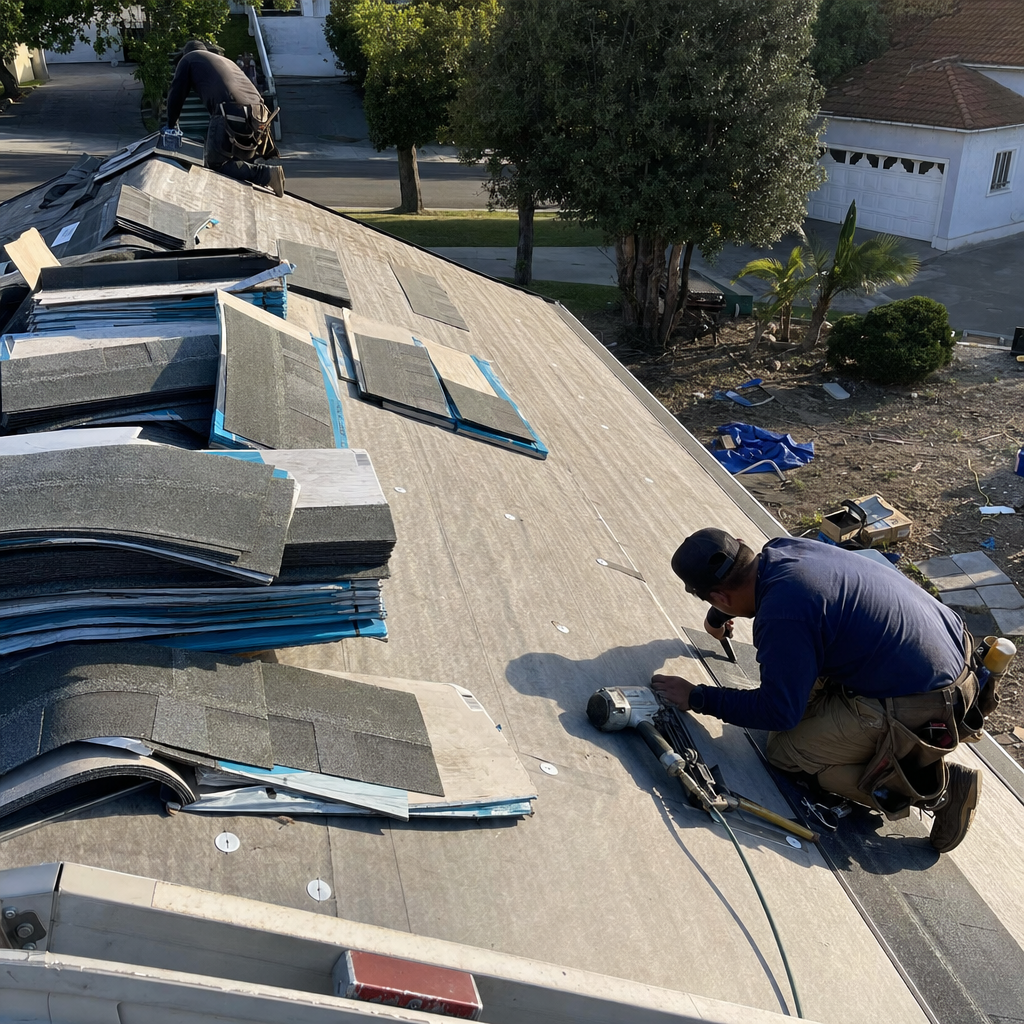
Walking on a clay or concrete tile roof without knowing the load path will crack tiles you can’t see from the ground, turning a free inspection into a $400 repair before you’ve checked a single seal. That’s the low-stakes version of getting Specialty Roofing DIY wrong. In Los Angeles, where clay tile, concrete, metal, and flat membrane systems cover everything from 1920s Spanish Revivals in Los Feliz to mid-century moderns in the Hollywood Hills, the question isn’t whether you’re handy. It’s whether you know which specialty roofing tasks reward a careful homeowner and which ones carry consequences that make DIY the most expensive option in the long run. This guide draws the actual line. No cheerleading for contractors, no false confidence for weekend warriors.
Quick Answer
Homeowners can safely handle ground-level observation, gutter clearing, interior moisture monitoring, and very minor caulking on specialty roofs. Anything requiring ladder work on clay or concrete tile, metal panel handling, torch-applied membrane work, or repairs that touch flashing, underlayment, or waterproofing layers should be left to a licensed professional. In Los Angeles, many specialty roofing repairs legally require a licensed C-39 contractor and permit, and manufacturer warranties on systems like GAF and CertainTeed are voided by unlicensed work. For context on what to tackle yourself, see our Emergency & Storm Damage Maintenance Schedule: What to Do and When.
Table of Contents
- The Three-Category Framework: Where DIY Ends and Professional Work Begins
- The Physical Risks of Each Specialty System
- Warranty Implications: The Hidden Cost of DIY
- Los Angeles Permit Requirements and Code Compliance
- The True Cost of DIY Mistakes vs. Professional Repair
- What Homeowners Can Safely Do Themselves
- Common Mistakes to Avoid
- When to Call a Professional
The Three-Category Framework: Where DIY Ends and Professional Work Begins
Most guides pick a side: either every homeowner should call a pro, or YouTube makes everything possible. Neither matches reality. After 42 years on Los Angeles roofs, we’ve developed a simpler map. Every specialty roofing task falls into one of three categories.
Category 1: Safe for a Careful Homeowner
These tasks stay on the ground or inside the house, involve no structural load decisions, and carry no warranty or permit implications:
- Ground-level visual inspection with binoculars for cracked, slipped, or missing tiles or panels
- Gutter and downspout clearing (on single-story homes with stable, properly angled ladders)
- Interior attic or ceiling monitoring for water stains, musty odors, or daylight penetration
- Photographing problem areas from the ground for a contractor’s preliminary assessment
- Monitoring and recording when problems first appear (season, recent weather, duration)
These tasks gather intelligence. They don’t fix the roof, but they prevent small problems from becoming invisible large ones. A homeowner in Pasadena who checks their clay tile roof from the ground every March after the winter rains, and again after Santa Ana wind events, will catch slipped tiles before the underlayment degrades.
Category 2: Requires Training and Proper Equipment, But Not Necessarily a Contractor License
These tasks sit in a narrow middle band. They can be done by a skilled homeowner who invests in proper safety equipment and accepts the physical risk. But they offer no cost savings over professional work and carry real downside:
- Minor caulking at pipe penetrations or vent flashings on low-slope areas, using compatible sealant
- Light debris removal from flat roof drains and scuppers (not the membrane surface itself)
- Replacement of individual damaged shingles on a composite system, if the homeowner has proper fall protection
The catch: even these tasks require knowing your material. Siliconized acrylic caulk on a TPO membrane will fail. Walking on a clay tile roof in standard work boots will crack tiles. The “savings” here are usually imaginary once you price proper harnesses, anchor points, and material-specific tools.
Category 3: Licensed Contractor Required - Legally, Practically, or Both
These tasks should never be DIY. They void warranties, violate Los Angeles building code, or carry injury risk that no homeowner should accept:
- Any work on clay or concrete tile roofs requiring foot traffic on the tiles themselves
- Metal panel repair or replacement, including fastener replacement and seam work
- Modified bitumen or built-up roof repair involving torches, hot asphalt, or cold-applied adhesives
- Flashing repair or replacement at walls, chimneys, or valleys
- Any repair exceeding 100 square feet, which triggers permit requirements in most Los Angeles jurisdictions
- Emergency tarping that involves penetrating the roof deck or structure
The line between Category 2 and 3 is where most DIY specialty roofing goes wrong. A homeowner in Silver Lake who climbs onto their concrete tile roof to “just check” a suspected leak will likely crack tiles underfoot, creating new leak paths they cannot see. The original problem remains. New problems multiply.
The Physical Risks of Each Specialty System
Standard asphalt shingle work has its dangers. Specialty roofing adds material-specific hazards that most homeowners haven’t encountered.
Clay and Concrete Tile
Clay tiles in Los Angeles, particularly on Spanish Revival and Mediterranean homes from the 1920s through 1950s, are brittle and designed for specific load paths. The tiles themselves are not structural. They rest on battens or direct deck applications that transfer weight in precise directions. A foot placed between battens, or on a tile’s unsupported center, cracks it instantly. The crack may not be visible from below until water has saturated the underlayment for months.
Concrete tiles are harder but heavier. A cracked concrete tile often shears at the nail hole, making it look intact from the ground while the lower portion slips. Walking on either material requires knowing the batten spacing, the tile profile, and how to distribute weight across multiple tiles simultaneously. This is trained knowledge, not intuition.
Metal Roofing
Standing seam and corrugated metal panels have sharp edges, particularly at cut ends and ridge caps. K-style edge profiles can slice through work gloves. The panels themselves expand and contract significantly; a fastener tightened to “feels right” will either back out in summer heat or buckle the panel in winter contraction. Galvanic corrosion between dissimilar metals (aluminum fasteners on steel panels, or vice versa) will create pinholes in 18-36 months.
Metal roofs in coastal Los Angeles neighborhoods like Venice or San Pedro face accelerated salt corrosion. A DIY repair with the wrong fastener material won’t fail immediately. It fails after the homeowner has forgotten they did it.
Flat and Low-Slope Membrane Systems
TPO, PVC, and modified bitumen membranes require heat-welded or chemically bonded seams. Hand-applied sealant at a seam is a temporary patch at best, and at worst it traps moisture beneath an impermeable layer, accelerating substrate rot. Torch-applied modified bitumen carries obvious fire risk on any structure, but particularly on Los Angeles buildings with wood shake underlayment or dried vegetation accumulation.
Chemical exposure is the overlooked hazard. The solvents used to clean membrane surfaces before patching are respiratory irritants and skin sensitizers. Proper application requires ventilation planning and PPE that most homeowners don’t own.
Coating Systems
Reflective roof coatings (common on flat commercial and residential roofs in Los Angeles for Title 24 compliance) seem straightforward. They are not. Surface preparation determines coating adhesion. Applying coating over damp substrate, incompatible prior coating, or insufficiently cleaned membrane wastes material and traps moisture. Silicone coatings, in particular, cannot be recoated with acrylic products; the chemistry repels subsequent layers.
Warranty Implications: The Hidden Cost of DIY
This is the factor almost never included in DIY cost calculations. Manufacturer warranties on specialty roofing systems are conditional on installation and repair by licensed contractors using authorized materials and methods.
GAF’s Golden Pledge and System Plus warranties, CertainTeed’s SureStart Plus, and Owens Corning’s Platinum Protection all require installation by factory-certified contractors. Repairs by unlicensed individuals void these warranties entirely. The homeowner who saves $200 on a DIY flashing repair loses a 25-50 year material warranty worth thousands in future protection.
Even without a premium warranty, standard manufacturer material warranties typically include language requiring “installation in accordance with manufacturer’s published specifications” by “qualified roofing professionals.” A homeowner’s repair, however competent, does not meet this standard.
The math is straightforward but rarely made explicit. A clay tile roof in Los Angeles with a valid 30-year material warranty represents roughly $15,000-$25,000 in future protection (depending on roof size and complexity). Voiding that warranty to save $300 on a repair is not savings. It is an unacknowledged insurance premium paid to avoid a phone call.
Our Specialty Roofing in Los Angeles page details the warranty structures we honor as authorized installers for GAF, CertainTeed, Owens Corning, IKO, Atlas, Tamko, and Boral. We do not substitute materials. The specification in your warranty is the specification on your roof.
Los Angeles Permit Requirements and Code Compliance
Los Angeles building code, following California Building Code Chapter 15, requires permits for roof repairs exceeding 100 square feet or involving structural components, underlayment replacement, or flashing repair in weather-exposed areas. The Los Angeles Department of Building and Safety (LADBS) enforces these requirements, and unpermitted work must be disclosed in real estate transactions.
What this means practically:
- Minor repairs under 100 square feet on existing roofs, using like materials, generally do not require permits. This includes individual tile replacement if done from the underside or with proper walk boards, and small membrane patches.
- Repairs exceeding 100 square feet, or involving underlayment, insulation, or structural decking, require a permit and licensed C-39 contractor.
- Any work on historical or HPOZ-designated properties in Los Angeles neighborhoods like Hancock Park, West Adams, or Angelino Heights requires additional review, regardless of scope.
- Fire-resistant assembly requirements in Very High Fire Hazard Severity Zones (portions of the Santa Monica Mountains, Topanga, and hillsides throughout the basin) mandate specific underlayment and assembly compliance that DIY work cannot self-certify.
Unpermitted work discovered at sale becomes a negotiation point, often requiring retroactive permitting at higher cost than original compliance. The homeowner who DIYs a repair to save money may pay that savings several times over in delayed closing, buyer credits, or forced professional remediation.
Los Angeles also enforces Title 24 cool roof requirements for re-roofing and substantial repair. Reflectance and thermal emittance standards apply to most low-slope and many steep-slope applications. DIY material selection that misses these standards fails inspection and requires removal.
The True Cost of DIY Mistakes vs. Professional Repair
Honest cost comparison requires looking at failure modes, not just price tags. Here are common scenarios we’ve encountered in Los Angeles over 42 years.
| System | Common DIY Attempt | Typical DIY Failure | Cost to Fix DIY Mistake | Professional Repair Cost |
|---|---|---|---|---|
| Clay tile | Walking roof to inspect, cracking tiles | Hidden cracks, underlayment saturation, rafter damage | $800-$2,400 | $350-$800 |
| Concrete tile | Replacing “a few” slipped tiles | Wrong profile, improper fastening, wind uplift failure | $1,200-$3,500 | $450-$950 |
| Standing seam metal | Tightening “loose” fasteners | Over-torque, panel distortion, galvanic corrosion | $1,500-$4,000 | $400-$900 |
| TPO/PVC membrane | Caulking at suspected leak | Trapped moisture, substrate rot, full section replacement | $2,000-$6,000 | $500-$1,200 |
| Modified bitumen | Cold patch at drain detail | Inadequate adhesion, ponding, structural deck damage | $3,000-$8,000 | $600-$1,500 |
The pattern is consistent. DIY “savings” disappear when the repair fails, which it often does because the underlying cause was misdiagnosed. A leak that appears at a ceiling stain in a Los Angeles mid-century modern may originate 20 feet upslope at a failed cricket behind a chimney. The homeowner who patches the ceiling stain location wastes material and delays proper repair while water continues its path.
Our Roof Repair in Los Angeles service includes photo-documented inspection. We show you what we see, where water travels, and why the obvious spot is rarely the origin point.
What Homeowners Can Safely Do Themselves
This section is for the capable homeowner who wants to participate in their roof’s maintenance without crossing into warranty-voiding, permit-violating, or dangerous work. These tasks genuinely help and carry proportionate risk.
Ground-Level Inspection Protocol
- Schedule inspections for March (after winter rains) and October (before Santa Ana wind season) in Los Angeles.
- Use binoculars from the sidewalk or yard, not the ladder. Check for slipped, cracked, or missing tiles; lifted panel seams; ponding on flat areas; and debris accumulation at valleys and drains.
- Photograph anything unusual. Date the photos. This documentation helps contractors diagnose faster and helps you track changes.
- Check interior ceilings and attic spaces during or immediately after rain. Active leaks are easier to trace than dried stains.
Gutter and Drain Maintenance
On single-story homes with stable, properly angled ladders, gutter clearing is legitimate homeowner maintenance. Use a standoff to avoid crushing gutters. For two-story homes or complex rooflines, the fall risk exceeds the savings. Our $89 Seasonal Tune-Up includes gutter clearing, fastener check, and written condition report.
Interior Monitoring
The most valuable homeowner skill is noticing early. Water stains that appear only in heavy rain versus those that persist indicate different failure modes. Musty odors in attic spaces suggest ventilation issues that precede structural damage. Daylight visible through roof boards means immediate professional attention. Recording these observations with dates and photos gives any contractor diagnostic information that speeds repair and reduces exploratory work.
Common Mistakes to Avoid
- Walking on clay or concrete tiles in standard footwear. Even “soft” soles compress at pressure points. Tile load paths require specific foot placement that distributes weight across multiple tiles. One cracked tile underfoot can cascade to adjacent failures.
- Using incompatible sealants. Siliconized acrylic on TPO, petroleum-based products on EPDM, or incompatible coatings on prior coating layers all fail within 6-18 months, often trapping moisture beneath.
- Ignoring Santa Ana wind patterns. Los Angeles homes in canyon-adjacent neighborhoods like Laurel Canyon, Beachwood Canyon, or the Hollywood Hills face directional wind loads that standard fastening patterns don’t address. DIY repairs that don’t account for uplift direction fail in the first strong wind event.
- Repairing only the visible damage. Water travels. The ceiling stain is rarely the leak origin. Patching the symptom while the cause continues degrades the roof system structurally.
- Using pressure washers on any roof surface. The force drives water under tiles, lifts membrane seams, and strips protective coatings. This “cleaning” causes the damage it pretends to prevent.
- Failing to document before-and-after conditions. Without photos, warranty claims, insurance disputes, and resale disclosures become impossible to support. Document everything, even DIY maintenance.
When to Call a Professional
Call when the task requires a ladder on a tile roof, involves membrane seams or flashing, follows storm damage, or when you’ve performed ground-level inspection and found anything you cannot explain. Call when your roof is under manufacturer warranty and you want to keep it valid. Call when Los Angeles building code requires a permit and licensed contractor.
Ridgeline Roofing Co. offers free estimates in Los Angeles. A live person answers every call, 24 hours a day, including nights, weekends, and the middle of a storm. Our background-checked, uniformed technicians document every inspection with photos from your actual roof. The price we quote is the price you pay. And every job is backed by our written 90-Day Done Right Promise: if it’s not right, we come back and make it right, no paperwork, no arguing.
Call (844) 563-1816 for a free estimate. Or visit our Ridgeline Roofing Co. home page to learn more about our 42 years of standing behind local roofs, not chasing storms.
Frequently Asked Questions
Individual clay tile replacement is possible from the roof interior or using proper walk boards that distribute weight across multiple tiles, but most homeowners lack the equipment and knowledge of their roof’s specific batten spacing and tile profile. Incorrect replacement voids manufacturer warranties and often cracks adjacent tiles. Call (844) 563-1816 for an exact quote - estimates are free.
Professional specialty roof repair in Los Angeles typically ranges from $350 for minor clay tile work to $1,500 for membrane section repairs, while common DIY mistakes on the same systems cost $800-$6,000 to remediate. The professional cost includes warranty preservation, permit compliance, and diagnostic accuracy that DIY lacks. Call (844) 563-1816 for an exact quote - estimates are free.
Yes, manufacturer warranties from GAF, CertainTeed, Owens Corning, and other major brands require installation and repair by licensed, authorized contractors using specified materials and methods. Unlicensed homeowner repairs void these warranties entirely, regardless of repair quality. The voided warranty value typically exceeds any DIY savings by a factor of ten or more.
Repairs under 100 square feet using like materials generally do not require permits, but repairs exceeding that threshold, involving underlayment or structural components, or located in historical or high-fire-hazard zones require LADBS permits and a licensed C-39 contractor. Unpermitted work must be disclosed in real estate transactions and may require retroactive permitting at sale.
Repair is cheaper when damage is localized, the roof is under 20 years old, and the underlying structure is sound; replacement becomes more economical when repairs exceed 25-30% of replacement cost, when multiple system layers have failed, or when warranty expiration makes future protection unavailable. A professional inspection with photo documentation provides the data for this decision. Call (844) 563-1816 for a free assessment.
Coating application requires surface preparation, moisture verification, and product compatibility knowledge that most homeowners lack; improper application traps moisture, wastes material, and may void existing warranties. In Los Angeles, Title 24 cool roof standards also apply to many coating applications, requiring specific reflectance and emittance values. Professional application with documented compliance is the sound investment.
The Bottom Line
Specialty roofing DIY is not a binary choice. Ground-level observation, gutter maintenance, and careful interior monitoring are genuine homeowner contributions that protect your investment. But the physical risks of clay tile fragility, metal panel hazards, and membrane system complexity, combined with warranty voidance and Los Angeles permit requirements, draw a clear line. The tasks that save money are on the ground. The tasks that cost money when done wrong are on the roof. Know which is which, and when in doubt, call someone who will still be in town to stand behind the work. Explore our more guides & resources for additional homeowner guidance.
For specialty roofing that requires professional expertise, our Roof Replacement & Installation in Los Angeles team handles full system work with the same no-surprise pricing and written guarantee.
Written by the team at Ridgeline Roofing Co., serving Los Angeles since 2016.