
Last updated July 26, 2026
Roofing Emergency Preparedness Guide for Los Angeles Homes
Most Los Angeles homeowners keep earthquake kits in the garage and know exactly where to stand when the ground shakes. But when an atmospheric river dropped 2.3 inches on the Sepulveda Basin in January 2024, the calls that flooded our office weren’t about structural collapse. They were about water streaming through ceiling drywall, about shingles peeled back by Santa Ana gusts, about ember holes smoldering in composite decks hours after the fire front passed. Roofing emergencies in this city kill no one outright, yet they quietly destroy tens of millions in property every single year. This guide will show you how to prepare before the event, what to do in the first hour, and how to avoid the mistakes that turn a $400 patch into a $14,000 interior rebuild.
Quick Answer
Los Angeles homeowners should prepare for roofing emergencies by completing a pre-season inspection checklist before each fire season and winter storm period, keeping a ground-accessible emergency tarp kit with proper fasteners, and knowing how to document damage for insurance before any repairs begin. When damage occurs, apply temporary tarp protection from ladder height only, never walk a compromised roof, and verify any 24-hour contractor’s CSLB license and insurance before allowing them to start work.
Table of Contents
- Why L.A. Roofs Fail Differently Than the Rest of the Country
- The Pre-Event Checklist: Before Fire Season and Before the First Atmospheric River
- How to Apply Emergency Tarp Protection Without Getting on the Roof
- What to Photograph Immediately After Damage (In Sequence)
- Emergency Patch vs. Actual Repair: Knowing the Difference
- What to Ask a 24-Hour Roofing Service Before They Touch Your Roof
- Common Mistakes to Avoid
- When to Call a Professional
- Frequently Asked Questions
- The Bottom Line
Why L.A. Roofs Fail Differently Than the Rest of the Country
Roofing emergencies in Los Angeles follow three distinct patterns that barely exist together anywhere else in the continental United States. Understanding which threat your home actually faces determines everything in your preparation.
Atmospheric river saturation arrives January through March, when Pacific moisture trains into the basin after months of dry baking. Clay tile roofs common in Hancock Park and the older Pasadena foothills absorb almost no water, but the mortar beds beneath them soften. Wood shake in Topanga and the Santa Monica Mountains swells, lifts fasteners, and opens gaps that don’t close when the wood dries. Composite shingle in the flat Valley subdivisions, baked to brittleness by August, cracks under thermal shock when cold rain hits 140-degree attic temperatures.
Santa Ana wind events peak October through December, with gusts exceeding 70 mph in the passes and canyons. We’ve replaced entire roof sections in Granada Hills after a single November night peeled back three-tab shingles like sardine lids, one of many roofing warning signs Los Angeles homeowners should watch for. The damage pattern is distinctive: uplift starts at ridges and eaves, never the field. Homeowners who understand this know to check those zones first after any wind event.
Fire ember intrusion defines September and October. The 2017 Creek Fire sent embers across the 210 freeway into Sunland-Tujunga roofs that never saw direct flame. Ember holes are needle-small, often invisible from the street, and they smolder in attic insulation for hours. By the time smoke shows inside, the structural member is compromised.
These three threats rarely overlap in time, but they do overlap in geography. A home in La Crescenta faces all three. Preparation must account for each separately.
Local building code reflects this reality. Los Angeles County’s amended Title 24 requires Class A fire-rated assemblies in designated Very High Fire Hazard Severity Zones, which now include portions of 47 neighborhoods. If your home predates 2008 and sits in one of these zones, your roof may not meet current ignition resistance standards regardless of its condition. This affects insurance valuation after any fire-related claim.
The Pre-Event Checklist: Before Fire Season and Before the First Atmospheric River
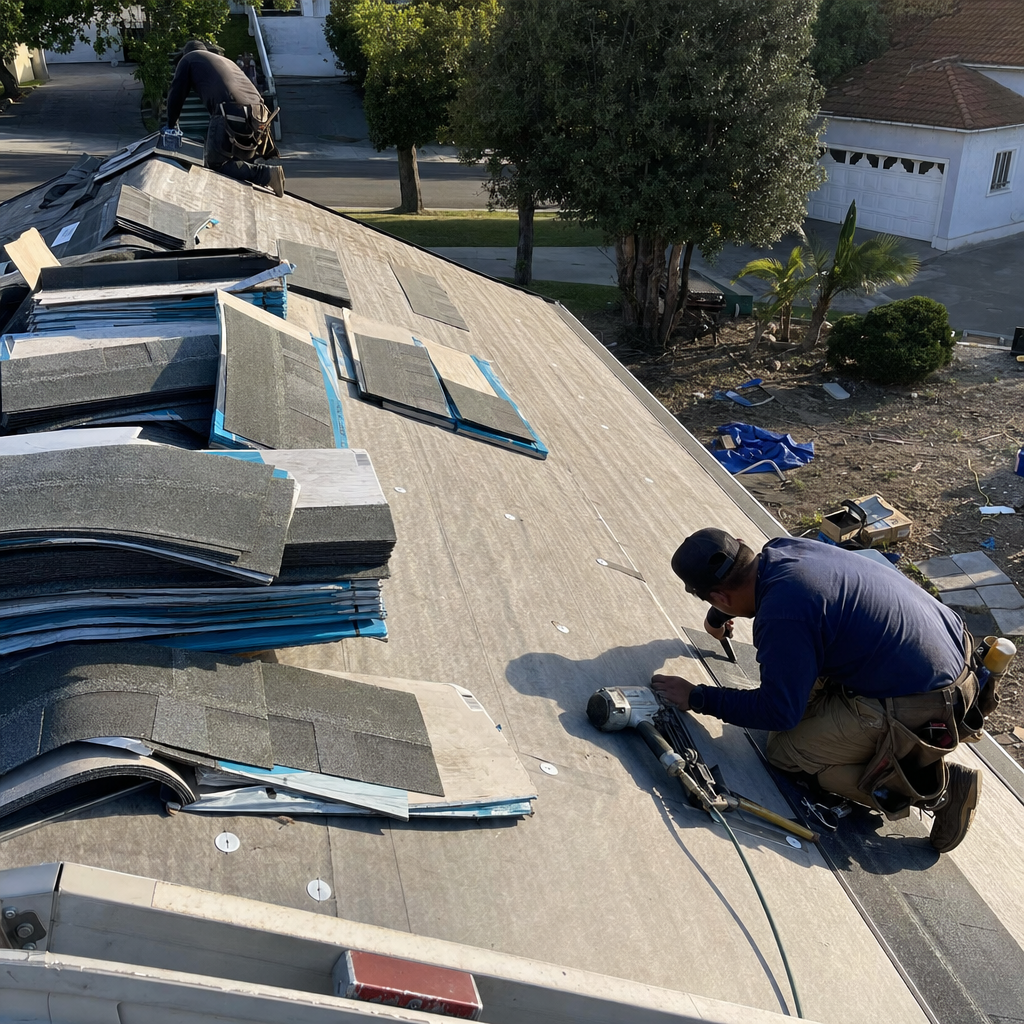
We complete versions of this checklist on every Roof Repair in Los Angeles inspection we perform. Homeowners who run through it themselves twice yearly catch most failure points before they become emergencies.
Before Fire Season (September)
- Clear roof and gutter debris within 10 feet of any structure. Embers travel farther than most homeowners realize, but immediate perimeter clearance eliminates the majority of ignition points.
- Inspect mortar beds on clay tile for cracking or powdering. Tap lightly; hollow sound indicates separation from the underlayment beneath.
- Verify metal flashing at all penetrations. Dormers, vent pipes, and chimney saddles are ember entry points that Class A rating doesn’t protect if the flashing has lifted.
- Check attic ventilation screens. Quarter-inch mesh is required in LA County fire zones; standard half-inch hardware cloth lets embers pass.
- Photograph roof condition from multiple angles. Store with your insurance documents.
Before the First Atmospheric River (December)
- Clean gutters and downspouts completely. In Los Angeles, this means removing not just leaves but the fine silt that accumulates during dry months and dams water during the first heavy rain.
- Inspect valleys and crickets for lifted or cracked material. These collect the most water volume per square inch.
- Check pipe boot seals. Rubber deterioration from UV exposure is the single most common leak source we repair in January.
- Verify attic insulation isn’t blocking soffit vents. Blocked ventilation creates condensation that mimics roof leaks.
- Test your emergency tarp kit. Unfold it, confirm grommets are intact, locate your fasteners.
Store your completed checklist with your insurance policy. If you ever file a claim, documentation of preventive maintenance strengthens your position significantly.
How to Apply Emergency Tarp Protection Without Getting on the Roof
This is where homeowners get injured. Every year in Los Angeles County, emergency rooms treat falls from ladders and roofs during weather events that never should have involved a ladder at all. The following method keeps your feet at or below the ladder’s third rung, never on the roof surface.
What You Need
- Reinforced polyethylene tarp, 10 mil minimum, sized to extend 4 feet beyond damage on all sides
- 1×3 furring strips, 4 feet long (6-8 pieces for a standard patch area)
- 1 1/4-inch exterior deck screws with rubber washers, or spring-loaded tarp clips if fascia access is limited
- Extension ladder with standoff arms
- Work gloves, headlamp, safety glasses
The Method
- Position the ladder at a 75-degree angle, feet on firm ground, standoff arms contacting the wall below the eave line. Never lean the ladder against gutters; they collapse.
- From the ladder’s third rung or below, drape the tarp over the damaged area with 4 feet of overhang on the uphill side. Water flows downward; the uphill seal matters most.
- Roll the tarp edge around a furring strip and fasten through the roll into solid fascia board or roof edge framing. This creates a watertight compression seal without penetrating the tarp membrane itself.
- On the sides, use the same roll-and-fasten method, working from uphill to downhill. Let the tarp hang loose in the field; tension creates wind lift.
- At the downhill edge, allow the tarp to extend past the eave. Weight the overhang with additional furring strips rather than fastening, so water runs clear.
Do not attempt this in active wind above 25 mph or on a roof with visible structural sag. In those conditions, interior water collection and a professional call are the only safe options. We’ve responded to homes in Studio City where a homeowner’s well-intentioned tarp became a sail that tore off gutter sections.
For homes with tile roofs, this method is nearly impossible to execute safely from ladder height. Tile cannot be fastened through, and the weight of furring strips on unsupported tile edges cracks additional pieces. Tile roof emergencies require professional response; temporary interior protection is the only homeowner-applicable solution.
What to Photograph Immediately After Damage (In Sequence)
Insurance adjusters in Los Angeles process hundreds of claims after every major event. The homeowners who receive full, timely settlements provide documentation that tells a complete story without requiring interpretation.
Photograph in this exact sequence, before any emergency repairs begin:
- Wide establishing shots. Stand at the street or property line. Capture the full roof plane, surrounding trees, and adjacent structures. This establishes cause and effect; a neighbor’s fallen branch is visible, or wind direction is apparent from bent vegetation.
- Damage context. Move closer. Photograph the damaged area with identifiable surrounding features. “Third tile from the chimney on the north slope” is a location an adjuster can verify.
- Close detail. Fill the frame with the damage itself. Shingle tear pattern, tile fracture line, hole diameter, water staining pattern on decking.
- Interior evidence. Photograph every water-affected ceiling, wall, and floor area. Include timestamp. Water migration in Los Angeles homes often travels 10-15 feet from entry point along attic ductwork or top plates.
- Personal property damage. Any furniture, electronics, textiles affected by water or debris.
- Emergency mitigation. Photograph your tarp placement, bucket placement, any temporary measures. This demonstrates duty to mitigate, which insurers require.
Store these with automatic cloud backup. We’ve seen phones lost to water damage that contained the only documentation of a $40,000 claim.
For fire-related damage, add one critical step: photograph the undamaged portions of roof adjacent to the affected area. Ember damage is often spotty; proving that intact roofing existed before the event establishes full replacement value versus patch repair.
Emergency Patch vs. Actual Repair: Knowing the Difference
This distinction costs Los Angeles homeowners more money than any other misunderstanding in roofing. An emergency patch buys time. An actual repair restores function. Confusing the two invites hidden mold, structural rot, and denied insurance claims.
Emergency patch characteristics:
- Visible from exterior (tarp, temporary sealant, membrane tape)
- Intended duration: days to two weeks maximum
- Stops active water intrusion but does not address underlying damage
- Does not restore roof system integrity or warranty coverage
Actual repair characteristics:
- Removes damaged material to solid substrate
- Replaces underlayment, flashing, and finish material to match existing
- Restores water-shedding function at the detail and system level
- Documented with photos, permits when required, and warranty restoration
The danger zone is the two-week gap. In Los Angeles, a tarp applied in January can hold through a dry February, and the homeowner forgets. By March, the attic hosts Stachybotrys colonies that require hazmat remediation. We’ve opened ceilings in Encino where a “small leak” patched six months prior had destroyed three rafter bays.
Manufacturer warranties complicate this further. GAF, CertainTeed, and Owens Corning each require repairs by authorized installers using specified components to maintain system coverage. A handyman patch with incompatible underlayment voids the remaining warranty term even if the patch itself holds water.
Our Roof Repair in Los Angeles service distinguishes clearly: emergency response secures the structure, scheduled repair restores the system. The 90-Day Done Right Promise applies to repairs, not patches, because a patch by definition isn’t done right yet.
What to Ask a 24-Hour Roofing Service Before They Touch Your Roof
Storm events in Los Angeles attract operators who materialize from out of state, work under borrowed licenses, and evaporate when callbacks are needed. The CSLB receives more complaints about roofing than any other trade category. Here’s how to verify legitimacy in under five minutes.
The Five-Minute Verification
- CSLB license number. Ask for it outright. Verify at cslb.ca.gov. A valid roofing contractor (C-39) license shows current status, bond, and workers’ compensation coverage. Suspended or expired status is immediate disqualification.
- Insurance certificate. Request a certificate of insurance naming you as additional insured, emailed directly from their broker. Don’t accept a PDF from the contractor’s phone; these are easily altered.
- Local physical address. Ask where their materials are stored, where crews report. Out-of-state plates on the work truck aren’t disqualifying but require additional verification.
- Manufacturer authorization. Ask which brands they’re authorized to install. Verify on manufacturer websites. Unauthorized installers can’t provide manufacturer warranties regardless of material quality.
- Written estimate before work begins. Any pressure to start immediately, with paperwork to follow, is a hallmark of the chase-and-run operator.
Red Flags Specific to Los Angeles
- Claiming to be “FEMA certified” or “FEMA approved.” FEMA does not certify individual contractors.
- Offering to handle your insurance claim for you, including negotiating with the adjuster. This is illegal in California without a public adjuster license.
- Demanding full payment upfront for emergency work. Standard practice is materials deposit plus progress payments.
- No local references from before the current event. A legitimate Los Angeles roofer has customers from 2023, 2022, decades prior.
At Ridgeline Roofing Co., we’ve served this region since 1984. Our CSLB record, insurance certificates, and manufacturer authorizations for GAF, CertainTeed, Owens Corning, IKO, Atlas, Tamko, and Boral are available on request before any work begins. A square deal starts with transparency.
Common Mistakes to Avoid
- Waiting for the rain to stop before calling. In Los Angeles, a December storm often delivers three distinct waves over 48 hours. The second wave hits the same opening and doubles the interior damage. Call at the first sign of active leakage.
- Walking a tile roof to “check” after wind. Clay and concrete tile cannot support concentrated weight at mid-span. We’ve replaced more tile broken by homeowners than by the original wind event.
- Accepting the first emergency bid without verification. Post-disaster pricing varies by 300% or more in Los Angeles. The lowest bid is rarely legitimate; the highest isn’t necessarily competent. Verify first, compare second.
- Failing to distinguish roof leak from condensation. January temperature inversions in the San Fernando Valley create heavy attic condensation that drips through can lights. A $400 ventilation fix solves this; a $4,000 roof replacement does not.
- Neglecting to tarp the uphill side properly. Water flows downhill. A tarp secured only at the damage site channels water directly into the opening. Always secure the uphill edge first, with adequate overlap.
- Discarding damaged materials before adjuster inspection. Insurance requires physical evidence. Photographs supplement but do not replace actual damaged shingles, tiles, or decking samples.
When to Call a Professional
Some situations admit no homeowner solution. Active water intrusion during rainfall, any visible roof deck sagging, fire damage with structural compromise, or tile damage requiring ridge access each require trained response with proper equipment and fall protection.
Ridgeline Roofing Co. staffs live phones 24 hours a day, including nights, weekends, and the middle of a storm. Our background-checked, uniformed technicians document every inspection with photos from your actual roof, not a speech in the driveway. We provide no-hassle upfront pricing: the number on the estimate is the number on the invoice.
If you’re facing active damage now, or if you want a professional pre-season inspection before the next event, Ridgeline Roofing Co. home offers free estimates throughout Los Angeles. Call (844) 563-1816.
Frequently Asked Questions
Emergency response and temporary patching typically range from $350 to $800 depending on roof type, access difficulty, and after-hours timing. Permanent repair of the same damage adds $800 to $2,400 for composite shingle, $1,200 to $4,000 for tile, and $2,000 to $6,000 for specialty materials. Call (844) 563-1816 for an exact quote - estimates are free.
Yes, during active weather events most established Los Angeles roofers maintain emergency crews. Response time varies by location: Valley and basin areas typically see 2-4 hour response, canyon and hillside homes may take longer due to access constraints. Ridgeline Roofing Co. answers live 24/7 and dispatches based on severity and safety.
Repair is cheaper when damage is localized to less than 25% of the roof plane and the remaining roof has adequate service life. Replacement becomes more economical when matching aged material is impossible, when underlayment is degraded, or when repair cost exceeds 40% of replacement value. We assess this honestly - our 90-Day Done Right Promise means we stand behind whichever path you choose.
Standard HO-3 policies cover sudden, accidental damage from wind, fire, and falling objects. They do not cover gradual wear, maintenance failures, or earthquake damage without separate endorsement. Atmospheric river damage is covered as windstorm peril; flooding from ground water is not. Document everything before temporary repairs, and use licensed contractors - unlicensed work can void your coverage.
Maximum safe duration is 90 days, but in Los Angeles sun exposure degrades polyethylene tarps to brittleness in 60 days or less. UV breakdown allows water penetration while creating shingle-adhered plastic residue that’s difficult to remove. Plan permanent repair within 30 days of tarp placement.
Class A rated composite shingle, concrete tile, and standing seam metal each meet LA County fire code for Very High Fire Hazard Severity Zones. In our experience across Pacific Palisades to La Cañada, concrete tile with proper underlayment provides the best balance of ignition resistance, longevity, and repairability. Specialty Roofing in Los Angeles consultations can evaluate whether upgrade makes sense for your specific exposure.
The Bottom Line
Los Angeles roofing emergencies are predictable in type if not in timing. The homeowner who completes pre-season checklists, keeps a ground-deployable tarp kit ready, and knows how to verify contractor legitimacy before allowing roof access will limit damage, protect insurance claims, and avoid the secondary disasters of mold and structural rot. Preparation costs hours. Recovery without preparation costs tens of thousands. For more guides & resources on protecting your home, explore our blog. When you need professional response, Ridgeline Roofing Co. has stood behind Los Angeles roofs since 1984 with live-answered phones, documented inspections, and the 90-Day Done Right Promise - if it’s not right, we make it right, no paperwork, no arguing.
Written by the team at Ridgeline Roofing Co., serving Los Angeles since 2016.