
Daylight Visible Through the Attic Boards
What’s Happening
Daylight coming through your attic boards almost always means there are open gaps in your roof deck – either between boards, at the ridge, around a penetration like a pipe or chimney, or where flashing has separated. Any gap that lets light in also lets in water, cold air, and pests. This is not a cosmetic issue, and it does not resolve on its own.
What you’re seeing is the underside of a roof system that has a break somewhere in its weatherproofing. Sheathing boards can shrink and separate over decades. Shingles or flashing above those boards can crack, curl, or pull away from the surfaces they’re meant to seal. In older homes – especially those built before the 1990s – the gap between board-and-batten style decking was sometimes left intentionally narrow, and age has widened it past the point where the layers above can compensate. Either way, the result is the same: outside air and rain now have a direct route into your attic, and from there, into your home. The longer those routes stay open, the more damage accumulates in the wood structure underneath everything else.
Why It Happens
Sheathing boards have dried, shrunk, and separated
Wood decking loses moisture over time, especially in attics where temperatures swing hard between seasons. When boards shrink lengthwise, the gaps between them widen. If you can see a thin, consistent line of daylight running parallel to the roof slope and it follows the pattern of the boards themselves, this is the most likely culprit. It does not mean the deck is structurally failing – but it does mean the shingles above can no longer bridge the gap reliably.
Shingles are cracked, missing, or have blown off entirely
A shingle that has cracked through or torn away leaves the deck exposed to direct weather. If the light you see is more of a spot or a rough oval rather than a line, look at the shingles on the exterior above that area – you may be able to spot a bare patch, a dark discoloration from moisture, or granules piled in the gutter below. Wind events, hail, and simple age brittleness are the most common causes, and each has a different repair path.
Flashing has lifted, cracked, or pulled away from a penetration
Anywhere something passes through your roof – a plumbing vent, a chimney, a skylight curb – metal flashing is what seals the joint. That flashing is set in caulk or roofing cement that eventually dries out and lets go. If the daylight you see is close to a chimney or a pipe, and the gap looks irregular rather than board-shaped, failed flashing is the most probable source. Water damage in the attic framing directly below that point would confirm it.
Ridge or hip cap has failed or was never fully sealed
The peak of the roof is the most exposed point on the structure – it takes the full force of wind from any direction, and the cap shingles or ridge vent assembly there are under constant stress. If the light appears at the very top of the attic space, near the center peak rather than at the slope, suspect the ridge. Ridge failures often look like a faint, even glow at the highest point of the attic rather than a hard beam of light, because the gap tends to be narrow but runs a significant length.
What to Do Right Now
- Do not go onto the roof yourself. Roofwork at height is genuinely dangerous without the right equipment and footing. What you can see from the attic is enough to describe the problem clearly to a technician – you do not need to inspect from outside to get a useful diagnosis.
- Note the location as precisely as you can. Stand in the attic and use landmarks – a specific rafter bay, distance from the chimney, proximity to the ridge – to mark where the light is coming through. A quick video on your phone, showing the gap and the light, is worth more than any description.
- Check for wet wood, staining, or soft spots nearby. Run your hand along the sheathing and rafters within reach of the gap. Soft or spongy wood means water has been getting in longer than you might expect. Dark staining on the rafters tells a similar story. Document what you find with photos.
- Move anything stored in the attic away from the affected area. Boxes, insulation batts, or stored belongings directly under a gap are likely to be damaged if rain comes before repairs are made. Get them clear now.
- Do not seal the gap yourself with caulk or tape. A DIY patch over a gap this significant typically fails fast, and worse, it can conceal how much structural damage already exists underneath. A technician needs to see the actual condition of the wood before anything goes over it.
How We Fix It
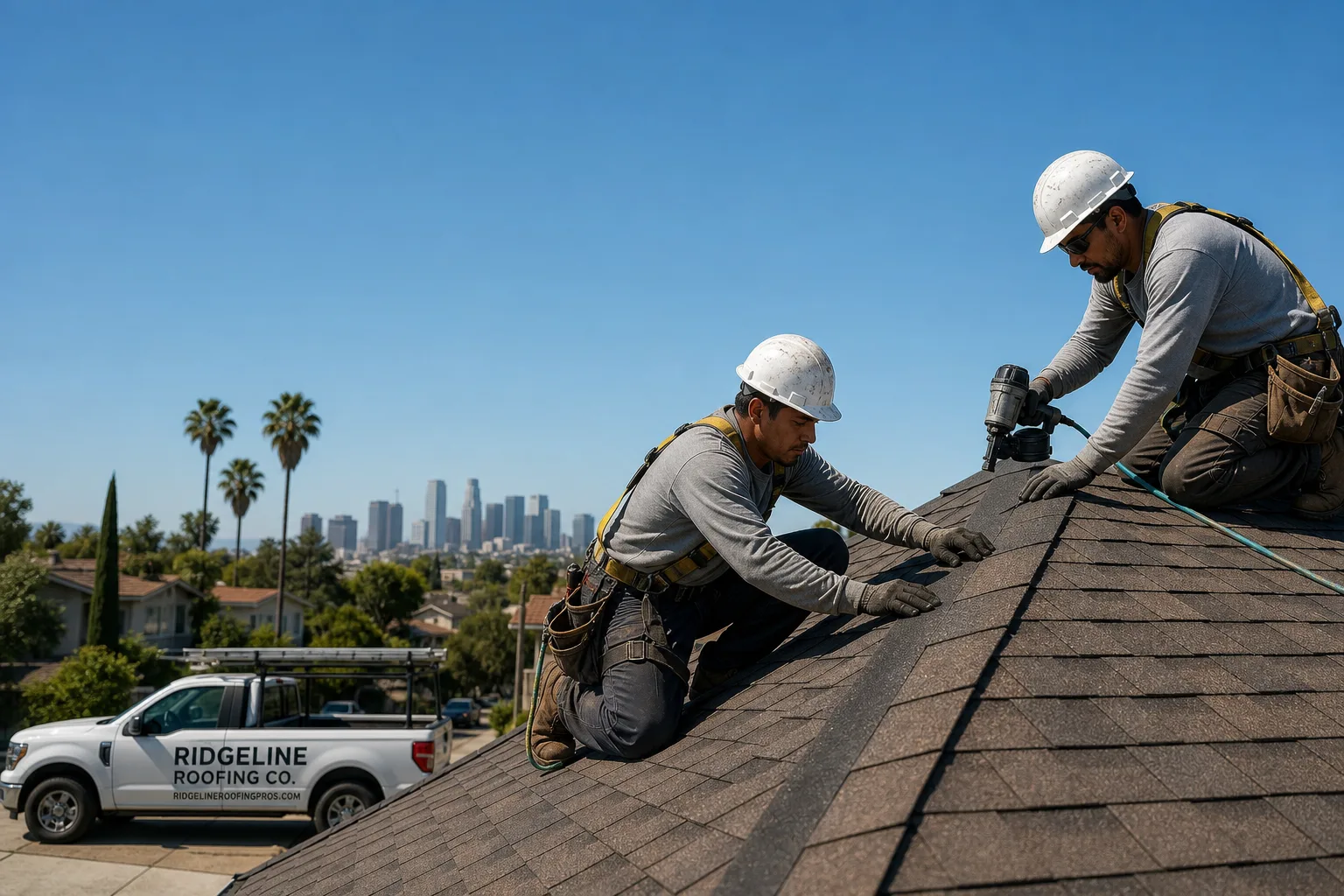
When your local Ridgeline Roofing Co. team arrives, a background-checked, uniformed technician goes up on the actual roof – not just the attic – and photographs every relevant section before touching anything. You get to see what we see. That inspection tells us whether we’re dealing with a localized sheathing repair, shingle replacement, a flashing reset, or some combination of the three.
Most gaps of this type fall under Roof Repair. If the inspection shows that the deck itself has widespread deterioration beneath aging shingles, we’ll say so plainly and walk you through Roof Replacement and Installation as the more durable path. We’re authorized to install materials from GAF, CertainTeed, Owens Corning, IKO, Atlas, Tamko, and Boral – so the right product for your deck type and climate goes on, not whatever happened to arrive on the truck.
Before any work starts, you get a written estimate with a fixed price. The number on that estimate is the number on the invoice – no surprises on the bill. The work itself is backed by our 90-Day Done Right Promise: in writing, no arguing, no paperwork runaround. Most repairs of this scope are completed in a single visit.
Frequently Asked Questions
It should not wait if rain is in your forecast, and frankly it should not wait regardless. An open gap in the roof deck is an active entry point for water, and water in the framing causes rot that compounds every week it sits. What starts as a sheathing repair can become a structural repair if the surrounding wood gets wet enough long enough. Call (844) 563-1816 – a live person answers around the clock, and we can often get a technician out quickly.
Yes, and that’s one of the more underappreciated costs of an unsealed attic. Any gap that admits daylight also admits outdoor air, which works directly against your insulation. Depending on the size and location of the opening, you may be conditioning air that is simply escaping through the roof. Sealing it properly – not with a temporary patch but with a correct repair – typically helps the whole system perform the way it was designed to.
Every job at Ridgeline starts with a free written estimate – the specific price for your specific roof, in writing, before anything begins. We don’t quote ranges over the phone and ask you to decide blind. A technician goes up, documents what’s there, and gives you a number you can count on. That number does not change when the invoice arrives. Call (844) 563-1816 to schedule your free estimate.
Call us at (844) 563-1816 and a live person will answer right now – not a voicemail tree, not a callback window. Your local Ridgeline Roofing Co. team works to get a technician to you as quickly as scheduling allows, and we prioritize situations where weather is a near-term concern. We’ll tell you honestly what we can do and when.
Get It Fixed
Call (844) 563-1816 right now – a live person answers every call, day or night. Your local Ridgeline Roofing Co. team will schedule a free written estimate, put a uniformed technician on your actual roof, and back every repair with the 90-Day Done Right Promise. No surprises, no runaround.
Written by Pete Navarro, Owner at Ridgeline Roofing Co., proudly serving local communities since 1984.