
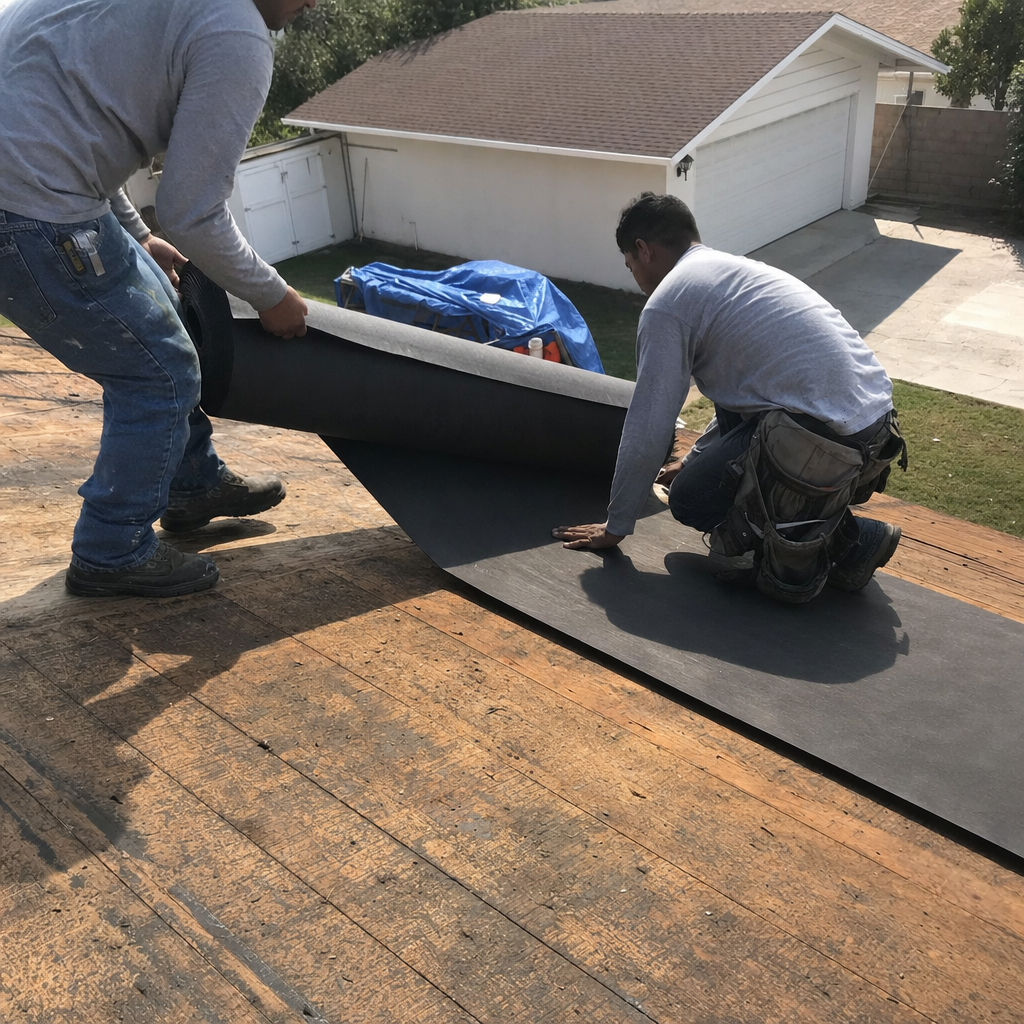
Flat Roof Patch in Los Angeles, CA
A flat roof patch in Los Angeles typically costs between $300 and $900 for a localized repair, and most jobs are completed in a single visit. The right patch – applied correctly to the right membrane – stops the leak at its source and extends the life of the roof without triggering a full replacement.
Flat roofs are common across Los Angeles neighborhoods, from the mid-century homes in Silver Lake to the older Craftsman-era additions in Eagle Rock and the low-slope commercial-style additions throughout the San Fernando Valley. They collect debris, hold standing water after the rare but heavy Southern California rain event, and develop blisters, cracks, and seam failures that a sloped roof simply does not. When those failures happen, water does not announce itself politely. It finds the lowest point in your ceiling and sets up camp.
At Ridgeline Roofing Co., we have been patching and repairing flat roofs across Los Angeles since 2016 – over 10 years of figuring out what holds and what fails on the specific roof types, materials, and micro-climates this city produces. Our technicians arrive background-checked and in uniform, document every inspection with photos taken from your actual roof, and give you a number before any work begins. That number is the number on the invoice. If the repair does not hold, our 90-Day Done Right Promise means we come back and make it right – no paperwork, no runaround.
You can reach a live person at (844) 563-1816 any time of day or night. For a broader picture of how flat roof patching fits into the full range of services we offer, visit our Roof Repair in Los Angeles page. For general information about who we are and what we stand behind, you can also visit our home.
When You Need a Flat Roof Patch
The warning signs on a flat roof are not always dramatic. Sometimes it is a water stain on the ceiling that only shows up after a hard rain. Sometimes it is nothing visible at all – just a quiet, slow deterioration that will become expensive if you wait long enough. Here is what typically brings Los Angeles homeowners to the phone:
- Ceiling stains or soft drywall after rain. Los Angeles averages around 15 inches of rain per year, concentrated mostly between November and March. When that rain falls hard, even a small breach in a flat membrane can push water several feet from the actual entry point before it appears on your ceiling. Do not assume the stain marks the source.
- Visible bubbles or blisters on the roof surface. Blistering is common on built-up roofing (BUR) and modified bitumen systems throughout Los Angeles, especially on south- and west-facing roofs that absorb intense UV from April through October. A blister that has not yet cracked is still a warning – once the surface splits, water gets in.
- Cracked or shrinking membrane around HVAC equipment or skylights. In neighborhoods like Encino, Studio City, and Mar Vista, flat roof additions frequently carry rooftop HVAC units. The flashing around those penetrations expands and contracts with temperature changes and is often the first point of failure.
- Standing water that does not drain within 48 hours. Los Angeles building codes reference the “ponding water” standard: water that remains on a flat roof longer than 48 hours after rain has stopped indicates a drainage problem. That standing water adds structural load and accelerates membrane degradation.
- Seam separation or open laps on modified bitumen or TPO. We regularly see seam failures on flat roofs in coastal areas like Venice and Playa del Rey, where salt-laden marine air accelerates adhesive breakdown. A separated seam is an open door.
- Recent rooftop work by others – a handyman, an HVAC company, or a solar installer. Anyone who cuts through or penetrates a flat membrane without properly flashing and sealing the opening creates a future leak. If someone has been on your roof recently and you are now seeing water intrusion, call us before assuming the membrane itself is old.
Our Flat Roof Patch Process
We do not guess. A flat roof leak can enter at one point and travel under the membrane before dropping through the ceiling somewhere else entirely. Our process is built to find the real source, fix it correctly, and leave you with documentation of exactly what was done.
- Photo-documented inspection from the roof. Our technician climbs to the roof – not your driveway – and photographs the membrane, flashings, penetrations, seams, and drain areas. You get a clear record of the condition before any work begins. This matters if you ever need to file an insurance claim or simply want to know what you paid for.
- Moisture probe or visual tracing to identify the true entry point. On older built-up roofing common in pre-1980s Los Angeles homes, water can travel several feet under saturated felt layers before it finds a path down. We trace the entry point before cutting or applying anything.
- Surface preparation and cleaning. Flat roof patches fail when applied over dirt, debris, loose granules, or wet substrate. We clean and dry the repair zone before any material touches the roof. This step is unglamorous and non-negotiable.
- Compatible patch material applied to match the existing system. We use materials rated for the membrane type: modified bitumen patches for BUR and torch-down systems, TPO or EPDM-compatible membrane pieces and adhesive for single-ply systems, and reinforced flashings for penetrations and edges. We carry Atlas and GAF flat roofing materials on our service vehicles and select the product that matches your existing system – not whatever is cheapest or easiest to carry.
- Sealing, feathering, and edge work. A patch that ends in a sharp edge is a future failure. We feather the edges, seal all perimeters, and address any secondary vulnerabilities we spotted during inspection – minor seam lifts, small blisters, or loose drip edge – while we are already on the roof.
- Final documentation and walkthrough. We photograph the completed repair, walk you through what we did and why, and explain what to watch for in the months ahead. The 90-Day Done Right Promise goes into effect from this point: if the repair site leaks again within 90 days, we come back at no charge.
Flat Roof Patch Pricing in Los Angeles
Flat roof patch work in Los Angeles runs from roughly $300 on the low end for a small, straightforward blister or minor seam repair to $900 or more for larger damaged sections, multiple penetration failures, or roofs that require tear-out of saturated substrate before the patch can be applied. The table below reflects typical ranges we see in the field across the Los Angeles market.
| Repair Type | Typical Range (Los Angeles) |
|---|---|
| Small blister or surface crack (under 2 sq ft) | $300 – $450 |
| Seam separation or open lap repair | $375 – $550 |
| Penetration re-flashing (HVAC, skylight, vent pipe) | $400 – $650 |
| Mid-size patch with substrate damage (2-10 sq ft) | $550 – $900 |
| Multiple repairs in a single visit | Combined pricing – ask for details |
Several things affect where your job lands in those ranges. Roof access matters: a flat addition above a second story in the Hollywood Hills is a different setup than a ground-level garage roof in Culver City. Material compatibility matters too – a torch-applied modified bitumen patch requires more labor and equipment than a cold-adhesive repair on a newer single-ply system. And the condition of the substrate beneath the failing membrane matters most of all: saturated insulation or rotted decking has to come out before anything new goes on, and that adds both materials and time.
What does not change is this: the number we give you before we start is the number on the invoice. We do not add line items at the end of the job.
If your repair comes to more than $250, our $50 Off Any Repair Over $250 offer applies automatically – no coupon required, no hoops. We also offer a 5% discount for seniors and veterans, which we apply to the final invoice without asking you to prove anything twice. And if you have a written estimate from another contractor, we will give you a free second opinion before you commit to anyone.
Call (844) 563-1816 to schedule a free estimate. A live person will answer.
What Makes Los Angeles Flat Roofs Different
Flat roofing in Los Angeles ages differently than it does in wetter climates, and that changes how patches need to be applied.
The UV index in Los Angeles is consistently high – the kind of sustained sun exposure that oxidizes and embrittles modified bitumen surfaces in as few as 10 to 15 years without proper coating maintenance. We see this regularly on the flat roof additions in neighborhoods like Mid-City and Leimert Park, where 1950s-era homes were expanded without the roofing technology that exists today. When we inspect those roofs, the surface granules are gone, the top sheet has lost its flexibility, and any crack that develops opens wider under thermal cycling rather than healing itself.
At the same time, Los Angeles gets its rain in bursts. When a storm system arrives after months of dry weather – as happened across the San Gabriel Valley in January and February in recent years – a compromised flat roof encounters a rapid saturation event it was never asked to handle during the dry season. The result is leaks that feel sudden but were actually months in the making.
We also see a specific problem on flat roofs in hillside communities: debris accumulation. Roofs in areas bordering Griffith Park, the Santa Monica Mountains foothills, and the slopes above Pasadena collect leaves, eucalyptus bark, and organic material that holds moisture against the membrane long after the rain stops. That extended contact degrades adhesives and seals in ways that dry-climate roofing is not built to resist.
None of this is a reason to panic. It is a reason to patch early with proper Leak Repair, before a small seam failure becomes a saturated deck replacement. We have been watching these patterns play out on Los Angeles roofs for over four decades, and the homes that hold up best are the ones whose owners called before the ceiling showed water.
FAQs – Flat Roof Patch in Los Angeles
How much does a flat roof patch cost in Los Angeles?
A flat roof patch in Los Angeles typically costs between $300 and $900, depending on the size of the damaged area, the type of membrane involved, and whether the substrate beneath needs to be dried out or replaced before the patch goes down. Small blisters or seam repairs on accessible roofs tend to land in the $300-$450 range; larger patches or re-flashing work around penetrations runs $550 and up. We give you the exact number before any work starts – call (844) 563-1816 for a free estimate.
Is it better to patch a flat roof or replace it?
Patching makes sense when the damage is localized – a single failed seam, a cracked blister, or a compromised flashing on an otherwise sound membrane. Replacement becomes the better call when more than 25 to 30 percent of the membrane has failed, when the insulation layer is saturated, or when the roof has exceeded the realistic service life of its material type (typically 15 to 25 years for modified bitumen, longer for well-maintained TPO). When we inspect your roof, we will tell you plainly which category you are in, and we will show you the photos so you can see it for yourself.
Can a flat roof patch be done in one day?
Yes, most flat roof patches in Los Angeles are completed in a single visit. Small to mid-size repairs on accessible roofs with dry substrate typically take two to four hours. The exception is a repair that requires removing and replacing saturated insulation or decking – that may take a full day or require a follow-up once the substrate has dried. We will tell you upfront if your job is one of those cases.
What warranty comes with a flat roof patch from Ridgeline Roofing Co.?
Every repair we complete is backed by our 90-Day Done Right Promise: a written workmanship guarantee that means if the patched area leaks again within 90 days, we come back and fix it at no charge. No paperwork, no arguing, no waiting for a callback. Beyond that, the material manufacturers – GAF and Atlas, among others – carry their own product warranties, which we will document for you at the time of the repair so you have a full paper trail.
Why Ridgeline Roofing Co. for Flat Roof Work in Los Angeles
We started doing this in 1984, which means we have patched flat roofs through every wet winter Los Angeles has thrown at us – the El Nino seasons of 1997 and 2016, the atmospheric rivers of recent years, and the long dry spells in between that make roofing materials brittle before the next storm arrives. We are not a storm-chasing operation that shows up after a hard rain and disappears by spring. We hire local crews, we train apprentices into journeymen, and we plan to be answering phones in this city thirty years from now.
Our technicians are background-checked, they arrive in uniform, and they document your roof with photos – not a scary speech in the driveway about everything that might go wrong. We use materials from manufacturers we are authorized to install: GAF, Atlas, and others across our full line, selected to match your existing system rather than whatever is fastest to apply.
And the price we quote is the price you pay. No line items added after the fact, no discovery charges once we are on the roof. If something unexpected changes the scope of work, we stop and explain before we proceed.
Flat roof patching is part of a broader commitment to honest, lasting Roof Repair in Los Angeles – one job done right rather than two jobs done cheap. That is what the 90-Day Done Right Promise is built on, and it is what we have been building toward since the day we opened.
Schedule Your Free Flat Roof Inspection
If your flat roof is showing any of the signs described on this page – stains, blistering, seam separation, or standing water – do not wait for it to get worse. A small patch today costs a fraction of what saturated decking and interior water damage will cost next winter.
Call (844) 563-1816 to reach a live person at Ridgeline Roofing Co. any time, day or night. We serve homeowners throughout Los Angeles – from the hillside neighborhoods above Silver Lake to the flat valleys of Reseda and Van Nuys, from the coastal communities near Playa del Rey to the older residential streets of East Los Angeles. We will schedule a free estimate, send a uniformed technician to document your roof with photos, and give you a straight number before any work begins.
Done right – and if it is not, we make it right.
Written by the team at Ridgeline Roofing Co., serving Los Angeles since 2016.