
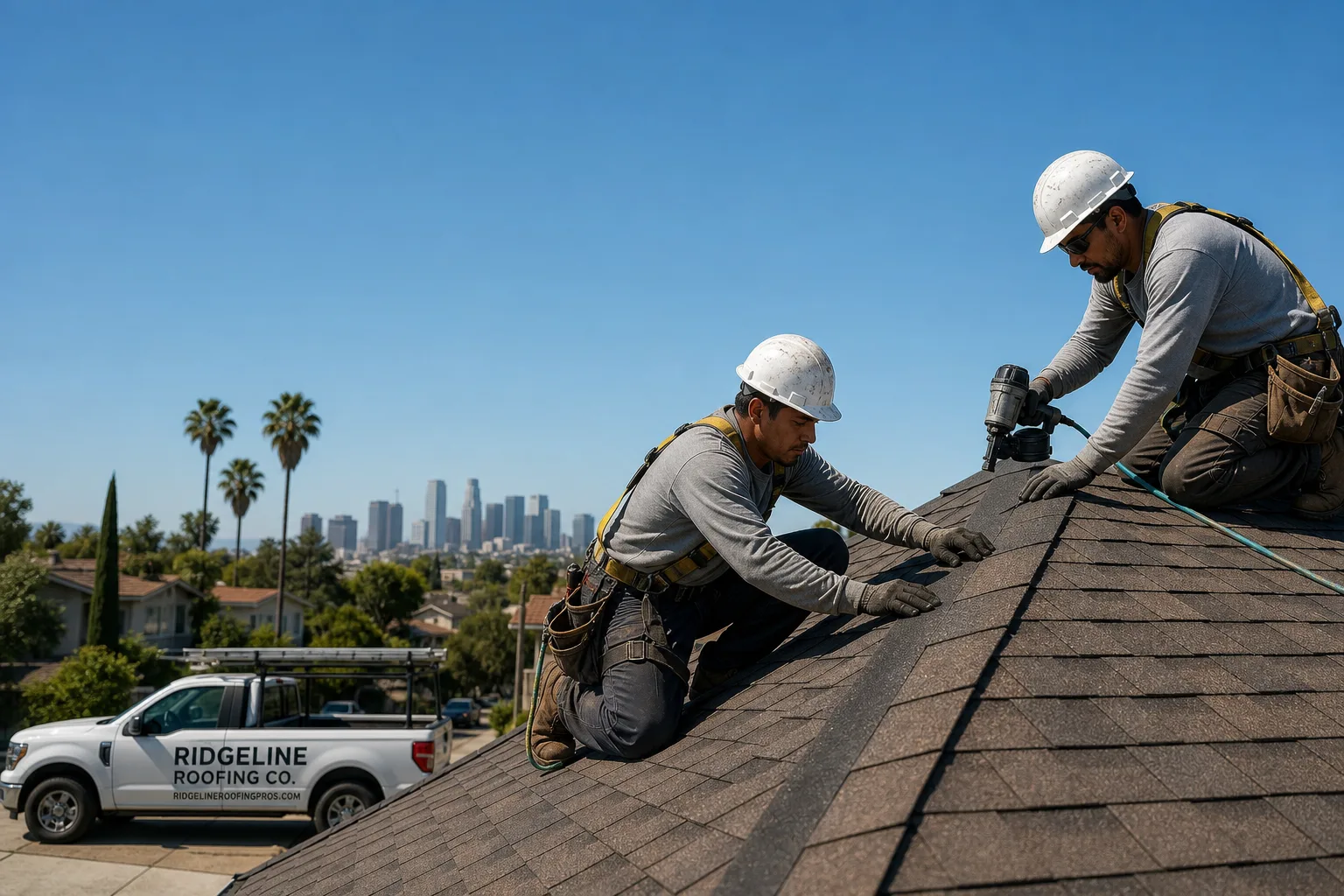
Metal Roof Cost in Los Angeles: What Hillside Homeowners Actually Pay in 2024
A standing-seam metal roof installed on a typical Los Angeles home runs between $24,000 and $48,000 for a complete replacement, with most hillside properties in the $32,000-$42,000 range once fire-rated underlayment and code-compliant ventilation are factored in. For homeowners in Very High Fire Hazard Severity Zones - that’s most of Topanga, Bel Air, Altadena, Tujunga, and large swaths of the Santa Monica Mountains - metal roofing often becomes the practical choice after budget asphalt is eliminated by code. Call (844) 563-1816 and we’ll walk you through what your specific roofline will need; estimates are free and we don’t charge to show up.
We’ve been pricing metal roofs across Los Angeles since 1984, and the spread in those numbers isn’t salesmanship - it’s geography. A simple gable roof on a 1950s Valley tract house in Sherman Oaks is a different animal than a multi-penetration hillside install in Pacific Palisades with crickets behind chimneys, solar conduit runs, and a 6:12 pitch that eats up extra material on every panel. Pete Navarro, our owner, learned this firsthand working roofs from Eagle Rock to Calabasas after coming up through the construction program at Los Angeles Trade-Technical College. A roof doesn’t lie - it just waits until the rain to tell you the truth.
Why Metal Roofing Costs More in Los Angeles Than the National Averages Suggest
Search “metal roof cost” and you’ll find plenty of sites quoting $15,000-$30,000. Those numbers usually come from Midwest or Southeast markets with simpler rooflines, lower material costs, and no wildfire codes rewriting what’s legally allowed on your house. Los Angeles operates under a different set of constraints.
The Very High Fire Hazard Severity Zone designation covers roughly 150,000 parcels in the city and county combined. If your property sits in one of these zones - and you can check on the Los Angeles County Fire Department’s hazard map - any re-roof permit requires a Class A fire-rated assembly. Standard three-tab asphalt shingles don’t qualify without expensive underlying barriers. Many homeowners in these areas discover that the gap between “budget” asphalt and metal narrows once you add the required fire-rated underlayment, upgraded ventilation, and the labor to install it all properly.
Then there’s the housing stock itself. Los Angeles’s residential architecture forces roofers to work across systems that rarely coexist in other markets. We see 1920s Spanish Colonial Revival homes in Los Feliz with original clay tiles that have outlasted three underlayment cycles; mid-century modern flat roofs in the Hollywood Hills with parapets and internal drains; and 1960s Valley tract homes with low-slope composition roofing that was never designed to last forty years. Metal roofing on any of these requires custom flashing details, specialized underlayment transitions, and crews who’ve worked on that specific roof type before - not a crew that learned the trade on ranch houses in Phoenix.
The Santa Ana winds add another variable. Gusts exceeding 60 mph in canyon and hillside areas are the primary seasonal cause of lifted tiles and blown flashing. Metal roofing, properly fastened with concealed clips on a standing-seam system, handles these events differently than tile or composition - but only if the fastening pattern, clip gauge, and edge detail are specified for wind uplift in the 85-110 mph range that LA’s hillside zones experience. Cheaper systems skimp here, and we’ve been called in after storms to fix roofs that rattled themselves loose because someone undersized the clips.
What You’re Actually Paying For: Breaking Down a Los Angeles Metal Roof Quote
Every estimate we write itemizes the work. Here’s what those line items represent on a typical standing-seam job in Los Angeles:
| Component | Typical Range |
|---|---|
| Standing-seam metal panels (26-gauge steel, Kynar 500 finish) | $8.50-$14.00/sq ft installed |
| Fire-rated underlayment system (Class A assembly requirement) | $2.50-$4.50/sq ft |
| Custom flashing, crickets, valley metal | $1,800-$4,200 |
| Penetration details (vents, solar mounts, chimney saddles) | $150-$400 each |
| Roof deck repair/replacement (plywood, found during tear-off) | $85-$145/sheet |
| Permit and inspection fees (City of Los Angeles) | $850-$1,400 |
| Complete removal and disposal of existing roofing | $1.50-$3.00/sq ft |
| Total project range (2,000 sq ft roof, moderate complexity) | $28,000-$46,000 |
The low end of that range assumes a straightforward gable roof with minimal penetrations, sound decking, and easy access. The high end reflects what we regularly encounter in the hills: multiple roof planes, steep pitches that slow production, hidden deck damage from decades of deferred maintenance, and the logistical headache of staging materials on a narrow canyon street where a standard delivery truck won’t fit.
We’re authorized installers for Atlas, Tamko, and Boral among seven manufacturer lines, and we specify metal products from those programs because they carry the wind-uplift and fire ratings that Los Angeles inspectors actually check. Substituting unlisted materials to shave cost is a shortcut we don’t take - it fails inspection, voids the manufacturer’s warranty, and leaves the homeowner holding the bag.
Metal Roofing vs. Tile-Off Re-Underlayment: When Each Makes Sense in LA
Here’s a decision we walk homeowners through several times a month, especially in neighborhoods like Silver Lake, Eagle Rock, and Highland Park where the original 1930s clay tiles are still sound. Those tiles often outlast the felt or synthetic underlayment beneath them by decades. A tile-off re-underlayment - removing, sorting, and re-setting the original tiles over new underlayment - runs $12,000-$22,000 on a typical Spanish Colonial Revival home. It’s labor-intensive, specialized work that most out-of-market roofers have never encountered.
So why would anyone choose metal at roughly double the cost? Three situations push the decision:
- The tile is failing too. Frost damage isn’t an issue in Los Angeles, but decades of Santa Ana wind abrasion, foot traffic from prior repairs, and UV degradation of the clay body itself eventually crack and spall tiles beyond salvage. When more than 15-20% of the field tile needs replacement, matching becomes difficult and the economics shift.
- The roof structure can’t handle the weight. Original clay tile runs 900-1,200 pounds per square. Some mid-century additions and converted garages were framed for lighter composition roofs and never designed for tile loading. Metal at 75-150 pounds per square solves this without structural reinforcement.
- The fire code has changed the property’s requirements. Homes that weren’t in VHFHSZ boundaries when built may have been rezoned as mapping improved. We’ve seen this in parts of Topanga and Altadena where owners planned a simple re-underlayment and learned at permit that Class A assembly is now mandatory - and their existing tile system, as configured, doesn’t qualify without extensive modification.
We don’t sell metal to homeowners who don’t need it. Our 90-Day Done Right Promise means we come back and fix anything that isn’t right, no paperwork, no arguing - and we’d rather not come back because we talked someone into the wrong material. If your tile is sound and your property isn’t fire-zone restricted, we’ll tell you that straight.
How Long Does a Metal Roof Last in Los Angeles Conditions?
This is where the climate math gets interesting. Los Angeles’s near-total lack of freeze-thaw cycles removes one of the major failure modes that shortens roof life in colder markets. What we have instead is intense, year-round UV radiation that degrades organic underlayments and degranulates composition shingles faster than in Portland or Seattle. A standing-seam metal roof with a Kynar 500 or comparable fluoropolymer finish doesn’t degranulate - the finish chalks and fades gradually over 30-40 years, but the substrate remains intact.
The real lifespan variable in Los Angeles is the underlayment beneath the metal. Even with excellent ventilation, the attic temperatures in a Valley summer can exceed 140°F. We specify high-temperature synthetic underlayments rated for sustained heat exposure, not the standard felt that some crews install to save $0.40 a square foot. The metal panels themselves will last 40-70 years; the underlayment and fastening system underneath determines whether you get the full span or a mid-life failure that requires partial disassembly.
Our photo-documented inspections show this clearly. When we climb a metal roof that’s 15-20 years old, the panels usually look fine. What we’re checking is fastener back-out (thermal cycling does this, even without freeze-thaw), sealant degradation at penetrations, and whether the original installer used closure strips that have hardened and cracked. Catching these early is the difference between a $900 maintenance visit and a $15,000 partial re-roof.
What Should You Ask Before Hiring a Metal Roofing Contractor in Los Angeles?
Metal roofing requires different skills than composition or tile. Not every crew that can nail shingles should be bending and seaming metal. Here’s what separates qualified installers from the ones you’ll regret:
Have they fabricated panels on-site or are they ordering pre-cut lengths? Complex rooflines with multiple hips, valleys, and dormers rarely match pre-cut panel dimensions. On-site roll-forming with a portable machine allows custom lengths and reduces the number of end-laps that become future leak points. We roll-form on-site for most Los Angeles jobs because the architecture demands it.
What’s their fastening pattern for wind uplift? LA’s Santa Ana events are predictable. A contractor should specify clip spacing, screw gauge, and edge fastening without you having to ask. If they wave this off with “we’ve never had a problem,” that’s not confidence - it’s inexperience.
Do they carry manufacturer authorization for the metal product they’re proposing? This matters for warranty validation. We’re authorized for multiple lines including IKO systems, and manufacturer certification requires demonstrated installation competency and ongoing training. A contractor buying panels through a distributor without authorization may install a valid product voids the warranty due to improper application.
Who handles the permit and inspection scheduling? Los Angeles Department of Building and Safety inspections for metal roofing include specific checks for fire-rated assembly compliance, especially in VHFHSZ areas. We pull permits and meet inspectors as part of our standard workflow - it’s not an add-on, and it’s not delegated to the homeowner.
Specialty Roofing covers the full range of non-standard systems we install, from metal to tile to low-slope membranes. If you’re weighing options, that page has more detail on how we approach each material family.
FAQs
A standing-seam metal roof typically costs 2.5-3.5 times more than a standard composition shingle roof and roughly 1.5-2 times more than a concrete tile roof, though the gap narrows in Very High Fire Hazard Severity Zones where fire-rated underlayment requirements add cost to all systems. In hillside areas like Topanga or Bel Air where Class A assembly is mandatory, metal often becomes cost-competitive with upgraded asphalt systems once all required components are included. Call (844) 563-1816 for a line-item estimate on your specific roof - we’ll show you exactly how the numbers compare.
Not always cheaper upfront, but often comparable once you factor in structural and code realities. Clay tile requires a roof structure engineered for 900+ pounds per square; if your home wasn’t built for that, structural reinforcement adds $4,000-$12,000. Concrete tile is lighter but still heavy, and both require the same Class A underlayment assembly as metal in VHFHSZ areas. Metal’s 75-150 pounds per square frequently eliminates structural work, and its 40-70 year lifespan spreads the initial investment across more years than composition or even mid-grade tile. For a true comparison on your home, we need to see the structure - our free estimates include that assessment.
We don’t recommend it for Los Angeles homes, and most reputable manufacturers void their warranty if metal is installed over old roofing without proper underlayment and ventilation. The practice saves roughly $2,000-$4,000 in tear-off costs but traps moisture, hides deck damage, and prevents inspection of the substrate that the new system’s fastening integrity depends on. In our climate, where summer attic temperatures exceed 140°F, that trapped moisture becomes steam that degrades everything it touches. We tear off to bare deck on every metal job - it’s the only way to guarantee the fastening pattern and underlayment perform as designed, and it’s the only way our 90-Day Done Right Promise means anything.
Most metal roofing projects begin within 2-4 weeks of estimate approval, though custom color orders or complex hillside staging can extend this to 6 weeks. We keep live phones staffed 24/7, including nights and weekends, because roof decisions rarely arrive on a convenient schedule. Once started, most residential metal roofs take 5-10 working days to complete, depending on size, pitch, and whether deck repair is needed. We complete most jobs in a single continuous push rather than stretching across multiple weeks - your home isn’t a construction zone any longer than necessary. Call (844) 563-1816 to check current lead times; we’ll be straight about where you fit in the schedule.
Getting Your Exact Metal Roof Cost in Los Angeles
Every roof we’ve priced in forty-two years has been different. The online calculators can’t see your deck condition, your access constraints, or the specific code requirements your property falls under. What we can promise is this: when we write you an estimate, the number on the page is the number on the invoice. No surprises, no change orders that should have been foreseeable, no talking you into more than you need.
Our technicians are background-checked, uniformed, and trained to document what they find with photos from your actual roof - not a generic inspection report. We hire local crews, train apprentices into journeymen, and plan to be here in thirty years. That’s how we’ve operated since 1984, and it’s not changing.
Call (844) 563-1816 for a free, no-obligation estimate. We’ll look at your roof, explain what it needs in plain language, and give you a price you can count on. If metal isn’t the right choice for your situation, we’ll tell you that too. A square deal is the only kind we know how to offer.
Written by Pete Navarro, Owner, Ridgeline Roofing Co. at Ridgeline Roofing Co., serving Los Angeles, CA.