
Missing or Curling Shingles
What’s Happening
Missing or curling shingles almost always mean your roof’s protective layer has aged past the point where it can do its job. The shingles themselves – not the deck, not the structure – are failing, and every day they stay that way, water has a clearer path into your home.
Asphalt shingles are designed to lie flat and shed water in one direction: down and off. When they curl at the edges, cup in the middle, or go missing altogether after a storm, they’ve lost the physical shape that makes them work. Rain doesn’t care about a wavy shingle or a bare patch of felt – it finds the low spot and sits there. What starts as a cosmetic problem becomes a rot problem, an insulation problem, and eventually a ceiling problem. The good news is that a trained eye can usually tell you within one inspection exactly how far the damage has spread and whether this is a targeted repair or a conversation about the roof’s overall age.
Why It Happens
Age and Normal Weathering
Most asphalt shingles are rated for somewhere between 20 and 30 years, but that rating assumes average conditions. UV exposure bakes out the asphalt’s natural oils over time, leaving shingles brittle and prone to cracking or curling upward at the tabs. If your roof is more than 15 years old and you’re seeing widespread curling rather than one or two isolated shingles, age is almost certainly the primary driver. Take a look at the granule color in your gutters – heavy granule loss alongside curling is a reliable sign that the shingles have simply run their course.
Poor Ventilation in the Attic
A roof bakes from both sides: the sun above and trapped heat below. When attic ventilation is inadequate, heat and moisture build up under the deck and literally cook the shingles from underneath, causing them to curl inward – what roofers call cupping. You can sometimes detect this problem without getting on the roof: open your attic access hatch on a hot afternoon and feel whether the air is noticeably hotter than the rest of the house, or check whether your attic insulation is damp. Fixing the shingles without addressing ventilation means the replacements will fail early for the same reason.
Storm Damage and Wind Uplift
High winds peel shingles by getting underneath the sealed tabs and breaking the adhesive strip – which is exactly what it sounds like. Missing shingles after a storm almost always mean the seal let go rather than the shingle tearing. You’ll notice this as clean gaps rather than torn or jagged edges. If the missing shingles are concentrated on one slope – typically the side of the house that faces the prevailing wind – storm uplift is the likely cause, and that’s an important distinction for anyone navigating an insurance claim.
Faulty Installation
Shingles that were nailed too high, too low, or with the wrong fastener count will fail years before they should. Improper nailing puts the fastener in the wrong zone of the shingle, which means the tab is only held by a thin strip of asphalt instead of the full nail head, and wind or thermal expansion eventually wins. If your roof is relatively young – under ten years – and you’re already seeing lifted or missing shingles, installation error is worth investigating. A proper inspection will show the nail pattern under the lifted tabs without removing anything that doesn’t need to come off.
What to Do Right Now
- Stay off the roof. A roof with curling or missing shingles has compromised footing in exactly the spots you can’t see, and height work on an uneven surface is genuinely dangerous. Document what you can safely see from the ground or a window.
- Photograph everything from ground level. Use your phone’s zoom rather than getting closer. Get wide shots of each slope plus close-ups of the damaged areas. Date-stamped photos protect you if this becomes an insurance conversation.
- Check your attic right now for daylight, staining, or soft spots. With a flashlight, look along the underside of the roof deck for any pinpricks of daylight, water stains on the rafters, or areas where the wood feels soft or discolored. These tell you whether water has already found its way in.
- Put a bucket under any active drip and move valuables. If you have a ceiling stain that’s spreading or an active drip, protect the floor and anything below it. Don’t assume it will stop on its own.
- Call for an inspection before the next rain. Missing shingles leave the underlayment exposed, and underlayment is not waterproofing – it’s a backup. One good rain on an exposed deck can do more damage than everything that caused the shingles to fail in the first place.
How We Fix It
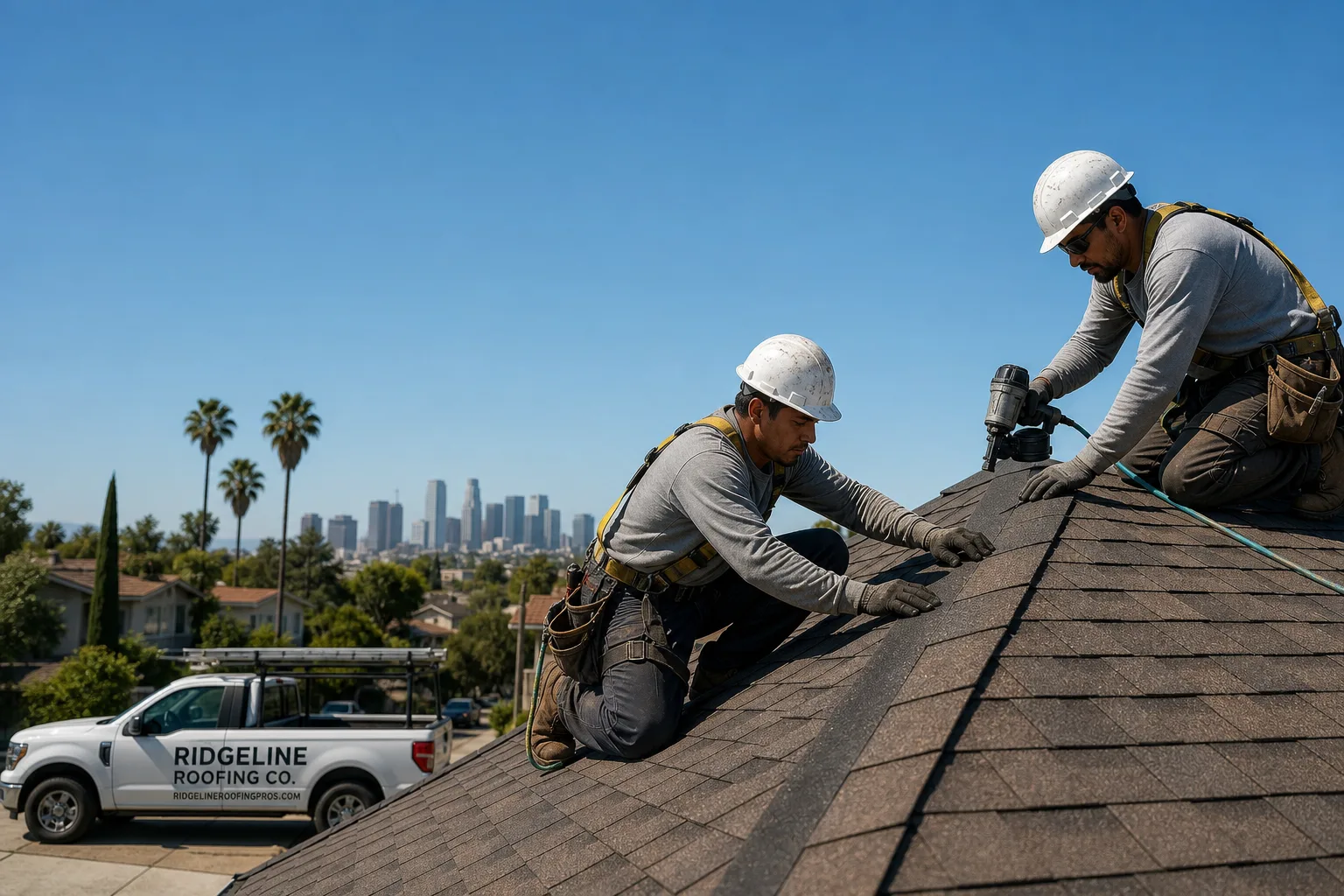
When your local Ridgeline Roofing Co. team arrives, a background-checked, uniformed technician goes up on the roof with a camera – not to give you a speech in the driveway, but to actually look. They document what they find with photos from your roof so you can see exactly what they’re seeing.
From there, the path splits based on what the inspection shows. If the damage is genuinely isolated – a handful of missing tabs, one section of curling on an otherwise sound roof – Roof Repair is the right answer. The technician replaces the affected shingles, re-seals the edges, and checks the flashing in the damaged area for any secondary problems. Most targeted repairs are done in a single visit.
If the inspection reveals widespread granule loss, systemic curling across multiple slopes, or a roof that’s simply past its useful life, that’s a Roof Replacement and Installation conversation. We’re authorized installers of GAF, CertainTeed, Owens Corning, IKO, Atlas, Tamko, and Boral, so the material recommendation will match your home’s specific needs, not whatever happens to be on the truck.
Either way, you get a written estimate with the exact number before anything starts – the same number that appears on the invoice. That’s upfront pricing, and it’s not negotiable on our end. The work is backed by our 90-Day Done Right Promise: if it’s not right, we come back and make it right. No paperwork, no arguing.
Frequently Asked Questions
Probably not without some risk. Every day a shingle is missing or lifted, the underlayment underneath is taking weather it wasn’t designed to handle alone. A week of dry weather buys you time; a week with rain does not. The honest answer is that the right call depends on how many shingles are affected and what the forecast looks like – which is exactly what a quick inspection tells you. Call (844) 563-1816 and get eyes on it before you decide to wait.
Storm-caused shingle loss – wind uplift, hail impact, falling debris – is typically covered by standard homeowner’s policies. Age-related deterioration usually isn’t. The distinction matters, and the documentation from your inspection matters even more: photos from the actual roof surface, dated, showing the pattern of damage, are what a claim needs to move forward. Your local Ridgeline team can walk you through what the inspection found and what’s worth pursuing.
The number of missing shingles is actually less important than the condition of the shingles that are still there. If the rest of the roof is curling, granule-depleted, or within a few years of the end of its rated life, patching in new shingles creates a patchwork that won’t match and won’t behave the same as the aging material around it. A repair makes sense when the surrounding shingles are still in solid shape. The inspection tells you which situation you’re in.
A live person answers our phones 24 hours a day, seven days a week – including tonight, this weekend, and during the storm itself. Call (844) 563-1816 right now and tell them what you’re seeing. Your local Ridgeline Roofing Co. team will get you scheduled as quickly as the situation calls for.
Get It Fixed
Call (844) 563-1816 – a live person answers every call, around the clock. Or book online and your local Ridgeline Roofing Co. team will reach out to confirm. You get a free written estimate before any work starts, and the 90-Day Done Right Promise backs every job.
Written by Pete Navarro, Owner at Ridgeline Roofing Co., serving homeowners across the country since 1984.