
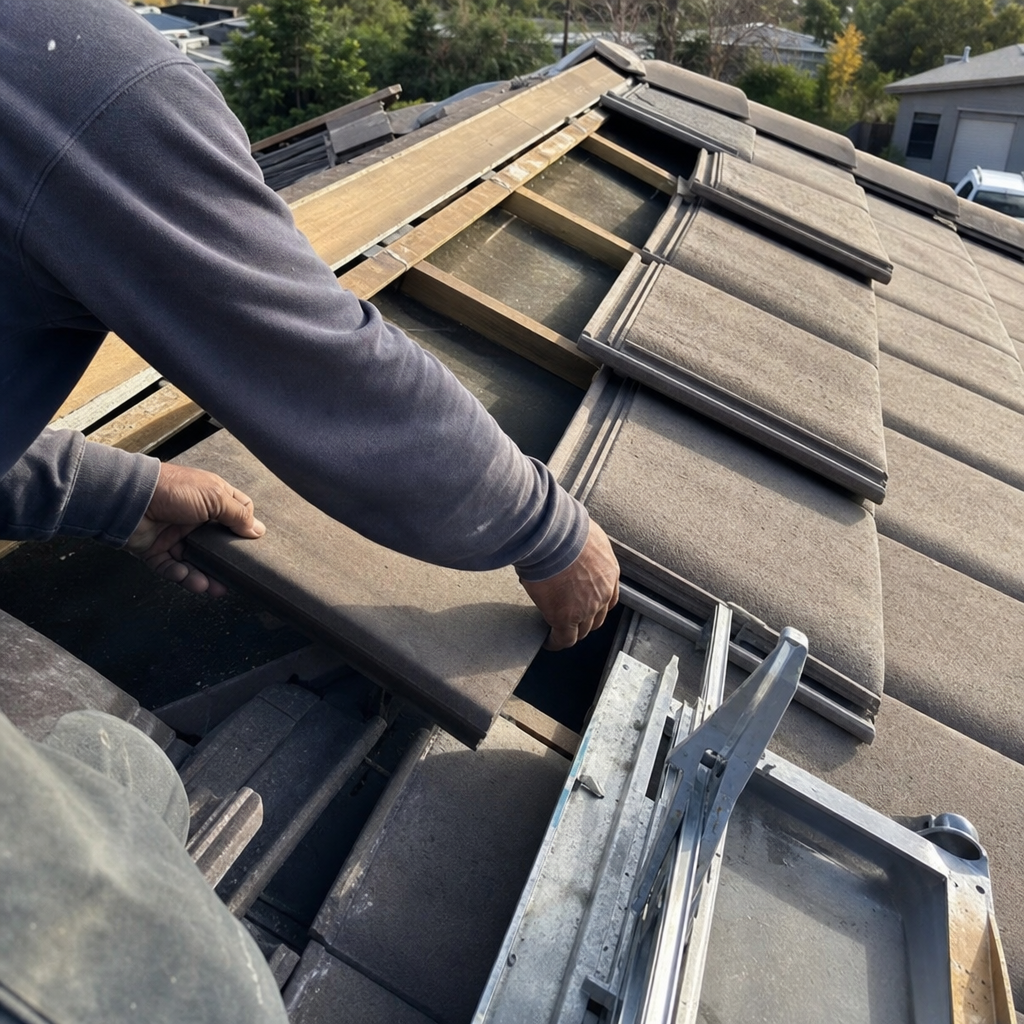
Valley Repair in Los Angeles, CA
Roof valleys – the V-shaped channels where two roof planes meet – carry more water than almost any other part of your roof. In Los Angeles, where a single winter storm can dump two or three inches of rain in an afternoon, a valley that is cracked, corroded, or improperly flashed will funnel water straight into your attic before the storm is even over. Valley repair means removing the failed flashing or worn valley liner, correcting whatever caused the failure, and installing new material that will hold for years. Most valley repairs in Los Angeles run between $350 and $900, and Ridgeline Roofing Co. completes the majority of them in a single visit.
If you have noticed a water stain on your ceiling that follows the roofline, or a dark streak running down the slope above your gutters, the valley is often the first place to look. We have been diagnosing and performing our Roof Repair services across Los Angeles since 2016 – over 42 years of seeing exactly what fails and why – and valley problems account for a significant share of every repair call we take. A live person answers our phone 24 hours a day at (844) 563-1816, including nights and weekends, because water does not wait for business hours.
Valley repair falls under our broader Roof Repair in Los Angeles work, and every job – no matter the size – is backed by our written 90-Day Done Right Promise. If the repair does not hold, we come back and make it right. No paperwork, no arguing, no runaround.
When You Need Valley Repair
Valleys are high-traffic zones for water. They are also some of the most frequently overlooked spots during routine maintenance, because most homeowners cannot see them clearly from the ground. Here are the signs that a valley on your Los Angeles home is failing or close to it:
- Water stains on interior ceilings that track along the roofline. If the stain forms a line rather than a circle, it often traces back to a valley rather than a missing shingle. In older Silver Lake and Echo Park homes with complex roof geometry, this is one of the more common calls we take.
- Visible rust, cracking, or open seams in the metal flashing. Open-metal valleys – where a strip of galvanized or aluminum flashing runs exposed down the center of the valley – corrode over time, especially in hillside neighborhoods like Laurel Canyon and Mount Washington where moisture lingers longer in the morning hours.
- Shingles that are curling or lifting along the valley edge. When the valley flashing shifts or the underlying felt degrades, the shingles beside it lose support and begin to lift. That gap is a direct water entry point.
- Granule loss concentrated along the valley line. Heavy runoff erodes the granule coating on shingles faster in valleys than on flat field areas. Excessive granules in your gutters after a rainstorm, especially concentrated on one side, point to valley wear.
- Debris dams from leaves and organic matter. Los Angeles has more mature tree canopy than most people expect, and valleys collect leaves. In neighborhoods like Hancock Park and Los Feliz, decomposing organic matter holds moisture against the valley material and accelerates deterioration by years.
- A roof older than 15 to 20 years that has never had valley maintenance. Woven and cut valley installations from the 1990s and early 2000s were often laid over a single layer of felt. By now, that felt has dry-rotted in Southern California’s UV exposure. The valley may look fine from the street but be failing underneath.
Our Valley Repair Process
We do not hand a homeowner a scary speech in the driveway and ask them to take our word for it. Our technicians go up on the roof, document what they find with photos taken from your actual roof, and walk you through the findings before we quote a number. Here is how a valley repair unfolds from the first call to the finished job:
- Photo-documented inspection from the roof. A uniformed, background-checked technician climbs to the valley in question and photographs the flashing, the shingle edges, the underlying felt or self-adhering membrane, and any adjacent penetrations like chimneys or skylights that could be contributing to the problem. You see what we see.
- Upfront written estimate before any work begins. We go over the photos with you, explain exactly what failed and why, and give you a written price. The number on the estimate is the number on the invoice – no additions after the fact, no material substitution without your approval. If you have a written estimate from another contractor, our Free Second Opinion offer means we will review it at no charge and tell you honestly whether the scope and price are reasonable.
- Removal of failed materials. We strip out the damaged flashing or worn valley liner – and only the damaged section or run. We do not tear off more than the repair requires, but we also do not patch over material that has failed structurally. The underlying deck boards are checked for rot or delamination at this stage; if we find soft wood, we tell you before we proceed.
- Deck preparation and underlayment. Before new flashing or valley material goes down, we install a self-adhering ice-and-water shield membrane in the valley channel. In Los Angeles, this step is sometimes skipped by less careful contractors because the city does not see freezing rain – but the membrane protects against wind-driven rain, which Los Angeles absolutely does see. We follow manufacturer specs and local building standards on every repair.
- Valley material installation. Depending on your existing roof system and what will perform best in your situation, we install either open-metal flashing or a woven/closed-cut valley using materials from authorized manufacturer lines. For most composition shingle roofs in Los Angeles we commonly use GAF or Atlas components that are warranted to work with the existing shingle system – not generic materials bought off a shelf that morning.
- Final inspection and photo closeout. After the repair is complete, we photograph the finished valley, confirm that all lifted shingles have been re-secured, clear any debris from the repair area, and review the completed job with you before we leave. The 90-Day Done Right Promise starts the day we finish. If anything related to the repair shows a problem within 90 days, one call brings us back – no paperwork, no arguing.
Valley Repair Pricing in Los Angeles
Valley repair in Los Angeles typically runs between $350 and $900 for a single valley run on a standard composition shingle roof. That range covers the most common scenarios: failed open-metal flashing, a deteriorated woven valley on a mid-size residential roof, or a section of damaged valley liner on a flat-to-slope transition. Here is a closer look at what moves the number up or down:
| Repair Scenario | Typical Range (Los Angeles) |
|---|---|
| Single valley re-flash, composition shingle roof | $350 – $550 |
| Woven or closed-cut valley replacement, single run | $450 – $700 |
| Valley repair with minor deck board replacement (1-3 boards) | $600 – $950 |
| Tile roof valley repair (clay or concrete tile) | $700 – $1,400+ |
| Multiple valleys on a complex roofline | Quoted per valley run |
What affects your specific price:
- Roof pitch and access. Steeper roofs in hillside neighborhoods like Glassell Park or Beachwood Canyon require more setup time and safety rigging. That is reflected honestly in the estimate – not added as a surprise on the invoice.
- Roofing material type. Composition shingles are the most straightforward. Concrete or clay tile roofs – common throughout the San Fernando Valley, Pasadena, and many westside neighborhoods – require that tiles be removed, set aside carefully, and re-installed, which adds labor time and increases the cost.
- Deck condition. If the plywood or board sheathing beneath the valley has rotted from years of slow water intrusion, those boards need to be replaced before new flashing goes down. We will not flash over a soft deck – it will fail again within a season.
- Valley length and complexity. A short, straight valley on a simple gable is a different job than a long valley that runs to a dormer, a skylight, or a chimney. Each additional penetration adds scope.
- Number of valleys affected. Some Los Angeles homes – particularly the Spanish Colonial and Craftsman styles common in Pasadena, Highland Park, and the Wilshire corridor – have four, six, or more valleys. If several are failing at the same time, repairing them together is more cost-effective than addressing them one at a time over multiple seasons.
We also offer $50 Off Any Repair Over $250, and a 5% discount for seniors and veterans – no application required, just let us know when you call. Estimates are free, and the price we quote is the price you pay.
Call (844) 563-1816 for a free estimate. A live person will answer and can usually schedule a same-day or next-day inspection for most parts of Los Angeles.
Why Los Angeles Valleys Fail Faster Than Most Homeowners Expect
Southern California’s climate looks gentle on paper – mild temperatures, low average rainfall. But it is genuinely hard on roofs in ways that are easy to underestimate. The UV index in Los Angeles is among the highest in the continental United States. Felt underlayments and valley liners that might last 25 years in Seattle can dry-rot in 12 to 15 years here, particularly on south- and west-facing slopes that take the full afternoon sun. When that underlayment goes, the valley loses its secondary water barrier and a modest rainstorm becomes a leak. That is why understanding What Causes Roof Leaks? (Los Angeles, CA) starts with conditions like these.
Then there is the rain pattern. Los Angeles typically receives most of its annual rainfall in three or four concentrated storm events between November and March. After months of dry heat, those valleys see a sudden, high-volume surge of water – often in combination with debris that has been accumulating on the roof since spring. Clogged or slow-draining valleys back up fast. A valley that is 80% functional on a light drizzle can overflow on a heavy rain event.
In the hillside communities – Silverlake, Eagle Rock, Mount Washington, Altadena – homes often sit under mature eucalyptus and oak canopy. Leaf matter breaks down into a wet, acidic mulch that sits against the valley flashing and accelerates corrosion on galvanized metal far faster than rainfall alone would. We see it consistently in these neighborhoods, and when we do a valley repair in those areas, we talk to the homeowner about a maintenance plan that keeps the valleys cleared between seasons.
None of this is cause for alarm – it is just useful to understand what your roof is actually dealing with. A well-installed valley with good materials and the right underlayment handles all of it. A valley that was installed to a low bid standard, or that has not been looked at in fifteen years, probably cannot.
Valley Repair vs. Valley Replacement: What Is the Difference?
We get this question regularly, and it is a fair one. Valley repair means correcting a specific failure point – re-flashing a section that has lifted, sealing an open seam, replacing a short run of corroded metal, or re-setting shingles that have separated from the valley edge. It addresses a defined problem and preserves the surrounding roofing material.
Valley replacement means removing and reinstalling the entire valley channel from ridge to eave, including new underlayment and new flashing or shingle material throughout the valley run. It is the right call when the existing valley material is at the end of its service life across the full length – not just at one point – or when the deck beneath has taken enough water damage that a spot repair would be building on a compromised base.
We will tell you honestly which one your situation calls for, and we will show you the photos that inform that recommendation. If a repair is the right answer, we are not going to recommend a replacement to run up the invoice. If a replacement is the right answer, we will explain exactly why – because a repair that fails in six months is not a deal for anyone.
For a broader look at how valley work fits into overall roof maintenance and repair, visit our home page for a full overview of what Ridgeline Roofing Co. covers across Los Angeles.
FAQs – Valley Repair in Los Angeles
How much does valley repair cost in Los Angeles?
For homeowners seeking the Best Roof Repair in Los Angeles, CA, valley repair typically costs between $350 and $900 for a single valley on a composition shingle roof. Tile roofs run higher – generally $700 to $1,400 or more – because tiles must be removed and re-set around the valley. The main cost variables are roof pitch, the condition of the deck underneath, the length of the valley, and whether adjacent penetrations like a chimney or skylight are involved. Call (844) 563-1816 for a free estimate; a technician can usually reach you within 24 hours and will give you a firm written price before any work begins.
Can valley repair be done in one visit?
Most valley repairs on composition shingle roofs in Los Angeles are completed in a single visit, typically two to four hours of work. The exceptions are jobs that uncover rotted deck boards (which require material that may need to be sourced) or tile roofs where a large section of tile needs to be carefully removed and re-installed. We will tell you upfront if we expect your repair to take more than one visit, and we will not start a job we cannot finish without giving you a clear schedule.
Is valley repair covered by homeowner’s insurance in Los Angeles?
It depends on the cause. Storm damage – a branch impact, wind that lifted the flashing, or hail – is typically covered under a standard homeowner’s policy, subject to your deductible. Wear and deterioration over time is generally considered maintenance and is not covered. If you believe your valley damage was caused by a recent storm event, document it with photos as soon as it is safe to do so. Our photo-documented inspection report can support an insurance claim; we work with homeowners on this regularly. We do not work directly with insurers as a third-party claims handler, but we can give you a clear, itemized written estimate that your adjuster can review.
How long does a valley repair last?
A properly done valley repair – with new self-adhering underlayment, correct flashing material, and well-seated shingles or tile – should last 15 to 20 years on most Los Angeles roofs, sometimes longer. This includes proper Vent Boot Repair where needed to maintain a watertight system. The honest answer is that longevity depends on what surrounds the repair: if the rest of the roof is aging, the valley may outlast the shingles beside it. We back every repair with our written 90-Day Done Right Promise, and we will tell you at the time of inspection whether the broader roof condition suggests you should be planning for a more complete repair or replacement in the near term.
A Few Words on Safety and What We Ask Homeowners Not to Do
Valley repairs require working at height on sloped surfaces, often with tools near a roof edge. This is not a task we encourage homeowners to attempt themselves. Beyond the fall risk – which is real and serious on any pitched roof, regardless of how modest it looks from the ground – an improperly re-flashed valley can fail in ways that are harder to diagnose and repair than the original problem. The water infiltration path becomes less predictable, and interior damage compounds before anyone realizes the repair did not hold.
If you want to get a closer look at your valleys before calling, binoculars from the ground or a phone camera from a firmly planted ladder at the eave line will show you most of what you need to see. You do not need to walk the roof to know whether a call to us makes sense.
Contact Ridgeline Roofing Co. for Valley Repair in Los Angeles
If you are seeing signs of a valley problem – a ceiling stain, debris buildup along the valley line, or flashing that has lifted after a storm – do not wait to see whether it gets worse on its own. It will. Call (844) 563-1816 to speak with a live person and schedule a free, photo-documented inspection. We serve homeowners throughout Los Angeles, from the Valley floor to the hillside neighborhoods to the westside communities near the coast. The estimate is free, the price we quote is the price you pay, and the 90-Day Done Right Promise means you have our word in writing. We have been standing behind Los Angeles roofs since 2016, and we will be here long after the repair is done.
Written by the team at Ridgeline Roofing Co., serving Los Angeles since 2016.