
Last updated July 26, 2026
Seasonal Roofing Care for Los Angeles: Year-Round Homeowner’s Guide
Most roofing guides written for Los Angeles homeowners are solving the wrong problem. They tell you to “prepare for winter” as if you’re in Cleveland, when the real threat to your roof here isn’t the rain that comes in January. It’s the marine layer that sits on your shingles for six weeks every May and June, breeding algae and softening the adhesive strips that keep asphalt shingles sealed flat. We’ve been up on Los Angeles roofs since 1984, and we’ve watched the same pattern repeat: homeowners who ignore the quiet seasons end up calling us in a panic when the first atmospheric river hits. This guide names the three actual stress periods your roof faces in this climate, what each one does to different roof types, and the specific checks that keep small problems from becoming $20,000 replacements.
Quick Answer
Los Angeles roofs face three distinct stress periods each year: fire-wind season (September through November), rain season (December through March), and marine-layer season (May through June). Year-round care means clearing debris before Santa Ana winds arrive, inspecting drainage before the first heavy rain, and checking for algae and lifted shingles after the marine layer retreats, following a Specialty Roofing Maintenance Schedule: What to Do and When. Most homeowners in neighborhoods like Silver Lake, Pasadena, and the San Fernando Valley should plan two professional inspections annually, one in early October and one in late June.
Table of Contents
- Fire-Wind Season (September-November): The Hidden Damage Period
- Rain Season (December-March): When Small Leaks Become Big Problems
- Marine-Layer Season (May-June): The Overlooked Threat
- How L.A. Dry Heat Degrades Shingles Faster Than Expected
- Why Flat and Low-Slope Roofs Need a Different Schedule
- The Safe Post-Storm Walkthrough You Can Do Yourself
- Gutter and Drainage: Feast-or-Famine Maintenance
- Common Mistakes to Avoid
- When to Call a Professional
- Frequently Asked Questions
- The Bottom Line
Fire-Wind Season (September-November): The Hidden Damage Period
The Santa Ana winds don’t just fan wildfires across Angeles National Forest and the hills above Glendale. They test your roof’s weakest points with sustained gusts of 40 to 60 miles per hour, often without a drop of rain to warn you something’s wrong.
What we’ve seen in 42 years: wind damage in Los Angeles is rarely dramatic. You won’t find shingles in your neighbor’s yard like you might in the Midwest. Instead, the Santa Anas lift the edges of aging shingles just enough to break the seal, then the next wind finishes the job. By December, when the rain arrives, water has a ready path.
Here’s what happens to different materials during fire-wind season:
- Asphalt shingles: The adhesive strip along the bottom edge weakens after years of UV exposure. Once lifted, shingles flap and crack at the bend point.
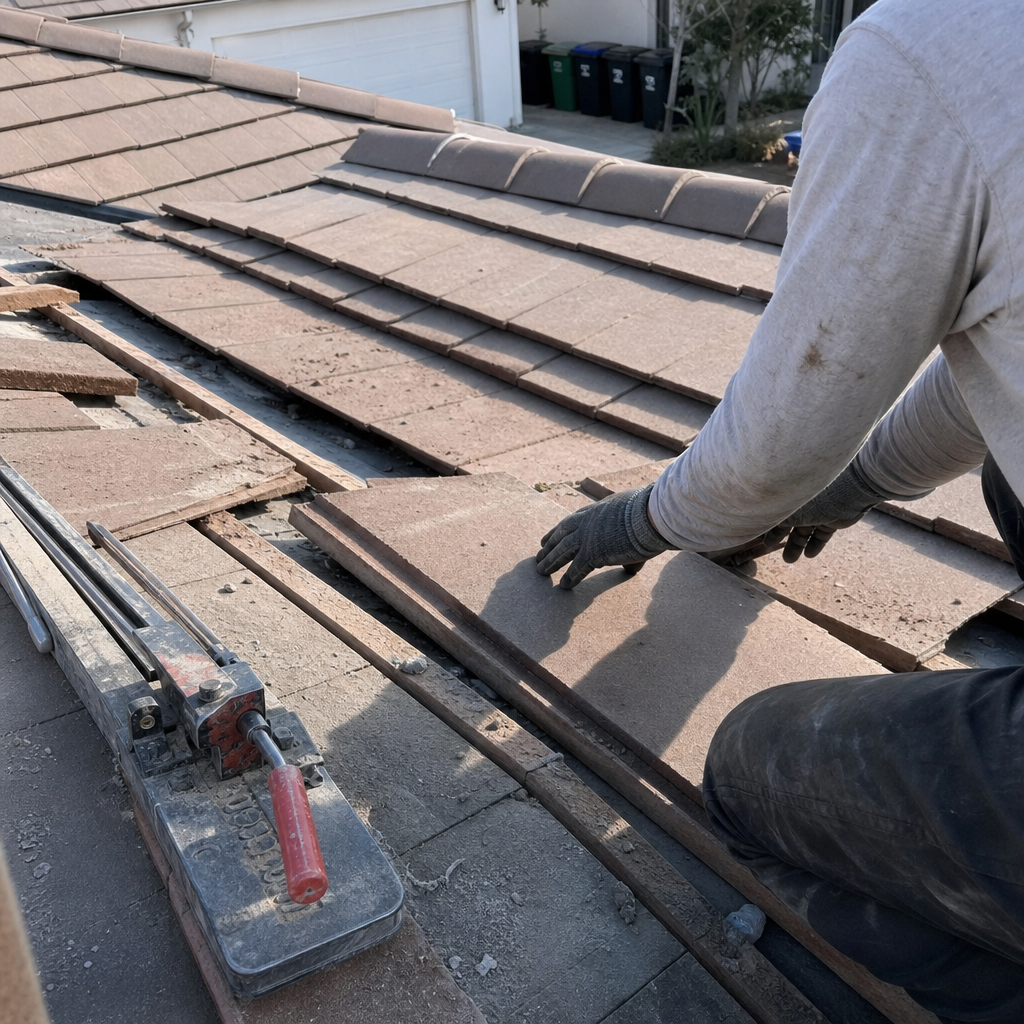
- Clay and concrete tiles: Wind gets under the edge of a loose tile and snaps it at the nail hole, or slides it out of position entirely. We’ve replaced entire sections in Altadena where one missing tile cascaded into a dozen.
- Flat roof membranes: Wind-driven debris punctures TPO and modified bitumen. The puncture is often smaller than a dime and invisible from the ground.
What to do in early October:
- Walk the perimeter and look for granules collected at downspout outlets. Heavy granule loss means shingle adhesive is failing.
- Binocular-scan the ridge line and valleys for lifted or curled edges. Don’t climb up; Santa Ana season is when falls happen to confident homeowners.
- Check attic ventilation screens. Wind forces embers through gaps, and October is peak fire season in the hills above Los Angeles.
- Schedule a professional inspection if your roof is more than 12 years old or if you can’t remember the last time someone walked it.
Our crews document every October inspection with photos from your actual roof, not a drone flyover. You’ll see what we see, and you’ll know whether you’re heading into rain season sealed tight or crossing your fingers.
Rain Season (December-March): When Small Leaks Become Big Problems
Los Angeles doesn’t get much annual rainfall, averaging 14 to 16 inches in most neighborhoods. But we get it in concentrated bursts. Atmospheric rivers in January and February can drop three to four inches in 48 hours on a roof that hasn’t seen meaningful water in eight months. That’s when the leaks call us.
The pattern is predictable. A homeowner in Encino or Studio City notices a water stain on the ceiling in late January. They tell us it’s “sudden,” but when we climb up, we find lifted shingles from October’s winds, cracked flashing from summer’s thermal expansion, or a gutter that’s been overflowing since the previous year-classic issues covered in our Specialty Roofing Troubleshooting: Common Problems and How to Fix Them. The rain didn’t cause the problem. It revealed it.
Critical checks before the first heavy storm:
- Valley drainage: Los Angeles building code requires open valleys or closed-cut valleys with specific width. Debris collects where two roof planes meet, and a blocked valley turns into a river running sideways across your shingles.
- Flashing at penetrations: Skylights, vent pipes, and chimney saddles are where we find 70 percent of winter leaks. The flashing sealant dries and cracks in our heat; rain finds the gap.
- Gutter capacity: A standard 5-inch K-style gutter handles about 5,500 square feet of roof area in moderate rain. During an atmospheric river, that’s not enough if downspouts are clogged with jacaranda blossoms or pine needles from Griffith Park-adjacent lots.
One detail competitors miss: Los Angeles soil shifts. A chimney or vent stack that was plumb in 1995 may have tilted slightly by 2025, cracking the flashing at the base. We check for this on every rain-season inspection, because caulk over a moving joint is a temporary fix at best.
If you do spot an active leak during a storm, containment matters more than heroics. Place a bucket, poke a small hole in the ceiling to relieve water pressure, and call us. Our phones are staffed by a live person 24 hours a day, including the middle of a storm. We’ll talk you through immediate steps and schedule the permanent repair.
Marine-Layer Season (May-June): The Overlooked Threat
This is the stress period no national roofing guide mentions, because it barely exists outside coastal Southern California. From roughly mid-May through late June, a persistent marine layer rolls inland overnight, coating Los Angeles roofs in fine moisture until midday. In neighborhoods from Venice to Long Beach, and even reaching inland to Mid-Wilshire and parts of the Valley on cool mornings, your roof stays damp for six to eight hours daily.
The damage is chronic, not dramatic. Algae and moss colonize asphalt shingles, feeding on the limestone filler. The adhesive strips that seal each shingle to its neighbor soften and lose tack. By July, when the heat returns, those shingles may never reseal properly. We’ve found entire slopes in Mar Vista where every shingle lifted by marine-layer moisture was permanently compromised by August UV.
What marine-layer season does by roof type:
- Dark asphalt shingles: Algae streaks run down the slope, creating unsightly black stripes that also retain heat and accelerate granule loss.
- Wood shakes and shingles: Moisture absorption swells the fibers; repeated wet-dry cycles cause splitting. We see this frequently in historic neighborhoods like Hancock Park.
- Metal roofs: Less vulnerable to biological growth, but fasteners and seam sealants can corrode if the coating is compromised. The marine layer finds every pinhole.
Late June checklist:
- Look for dark streaks or green patches from the ground. These indicate active growth that will worsen through summer.
- Check north-facing slopes specifically. They dry slowest and harbor the most algae.
- Sniff near attic vents for mustiness. Trapped marine-layer moisture in poorly ventilated attics breeds mold on rafters.
- Schedule a professional cleaning and inspection if streaking is visible. Pressure washing destroys shingles; we use manufacturer-approved treatments that kill algae without voiding your warranty.
Products from manufacturers like Atlas and IKO include algae-resistant granules, but no shingle is immune to six weeks of daily moisture. If your roof is approaching replacement age, this is the season that pushes marginal shingles over the edge.
How L.A. Dry Heat Degrades Shingles Faster Than Expected
Between stress periods, Los Angeles roofs bake. Summer temperatures on a dark asphalt shingle surface regularly reach 160 to 180 degrees Fahrenheit. The asphalt expands. At night, when the temperature drops 30 or 40 degrees, it contracts. This thermal cycling happens 300-plus days per year, far more than the climate data in manufacturer warranties assumes.
Most asphalt shingle warranties are written for national averages. They don’t account for a roof that undergoes severe thermal cycling in a near-desert climate with minimal cloud cover. We’ve replaced 20-year shingles in Los Angeles at year 14 that looked fine from the street but had brittle, cracked asphalt and loose granules underfoot.
Specialty Roofing Warning Signs Every Homeowner Should Know-signs your shingles are aging faster than the warranty predicts:
- Granules filling gutters and downspout outlets every few months
- Shingle edges curling upward (cupping) or across the width (clawing)
- Cracks appearing in the exposed asphalt, not just the surface granules
- Neighborhood pattern: if three neighbors with roofs installed the same year are replacing theirs, yours is likely on the same timeline
Proper attic ventilation is the only mitigation that helps. A well-ventilated attic in Los Angeles runs 20 to 30 degrees cooler than a poorly ventilated one, reducing the temperature delta that stresses shingles from below. We specify ridge vent and soffit vent combinations on every replacement, sized to the square footage, not a rule of thumb.
For homeowners in the hottest inland valleys, from the San Fernando Valley to Riverside-adjacent communities, we often recommend lighter-colored shingles or reflective granule products from our authorized lines. Tamko’s Heritage IR and certain Atlas StormMaster Slate colors carry Cool Roof Rating Council certification that can reduce surface temperatures meaningfully. The energy savings are real, but the primary benefit is extended shingle life in a climate that tests them harder than the warranty writers imagined.
Why Flat and Low-Slope Roofs Need a Different Schedule
Mid-century modern homes in Los Angeles, from the Hollywood Hills to Long Beach, often feature flat or low-slope roofs that behave nothing like pitched assemblies. The seasonal threats are the same wind, rain, and marine layer, but the failure modes are entirely different.
On a flat roof, water doesn’t run off. It sits until it evaporates or finds a path through the membrane. That changes everything about maintenance timing.
Flat roof seasonal priorities:
- Pre-rain (November): Check drains and scuppers. A single clogged drain on a 1,500-square-foot flat roof can create a ponding area that exceeds the membrane’s design load. We’ve seen collapsed decks in Los Angeles from water weight, not structural failure.
- Post-rain (March): Walk the roof and mark ponding areas that haven’t drained within 48 hours of dry weather. Persistent ponding means either inadequate slope or compromised insulation beneath.
- Post-marine-layer (July): Inspect membrane seams and flashing. Modified bitumen and TPO both rely on heat-welded or adhesive seams that can degrade with moisture intrusion.
Low-slope tile roofs, common on Spanish Revival homes throughout Los Angeles, present a hybrid challenge. Water moves slowly, so underlayment becomes the primary waterproofing layer. When the underlayment fails, often at 20 to 25 years in our climate, the tiles can look perfect while the roof leaks steadily. We recommend removing a few tiles for underlayment inspection at year 18, or sooner if there’s any interior sign of moisture.
Boral clay tiles, which we install as an authorized dealer, perform well on low slopes when paired with proper underlayment, but no tile roof is maintenance-free in this climate. The underlayment is the roof; the tile is the umbrella.
The Safe Post-Storm Walkthrough You Can Do Yourself
After every significant wind event or heavy rain, you should check your property. Most of this inspection is safely done from the ground. The roof surface itself is for professionals with proper ladders, harnesses, and fall protection.
Ground-level checks (safe for any homeowner):
- Walk the perimeter and look for shingle fragments, tile pieces, or membrane scraps in planting beds and walkways.
- Check downspout outlets for sudden granule deposits. A new pile after a storm means shingle damage somewhere above.
- Examine fascia and soffit from below. Water stains, sagging, or gaps between fascia and gutter indicate overflow or backing.
- Look at chimney and vent pipe flashings with binoculars. Bent, lifted, or missing pieces are visible from the driveway.
- Check attic access after rain for any new water stains on rafters or insulation. Use a flashlight and look for sheathing discoloration.
When to stop and call:
- You see a shingle hanging loose or a tile out of place. Wind can shift these unpredictably; don’t risk a head injury.
- Your roof is more than 15 feet high, has a slope steeper than 6:12, or is surrounded by power lines.
- You smell mustiness in the attic but can’t find the source. Water travels laterally across sheathing before dripping.
- You’re not comfortable on a ladder at your age. We’ve responded to emergencies where the homeowner injury was worse than the roof damage.
Our background-checked, uniformed technicians document every inspection with photos taken from your actual roof. The same standard we’d hold for work done in our own mother’s home. You’ll see what we see, and you’ll get an honest assessment of what’s urgent, what’s watchable, and what’s cosmetic.
Gutter and Drainage: Feast-or-Famine Maintenance
Los Angeles rainfall patterns break gutter systems. Eight months of dryness let debris compact and harden in gutters and downspouts. Then a January atmospheric river dumps two inches in 24 hours, and water overflows because the system can’t clear itself fast enough.
Overflowing gutters don’t just stain fascia. They saturate foundation perimeters, undermine concrete walkways common in older Los Angeles neighborhoods, and back water up under eaves where it rots rafter tails. We’ve repaired roof edges in Koreatown and Echo Park where the leak started at the gutter, not the shingles.
Gutter maintenance matched to our climate:
- October: Clear all debris before fire-wind season. Dry leaves in gutters are ember traps during Santa Ana wind events.
- December: Check flow during the first light rain. Water should move smoothly through downspouts; any overflow indicates a blockage.
- March: Inspect hangers and slope after rain season. Saturated debris weighs gutters down and pulls them away from fascia.
- Year-round: Keep trees trimmed back at least six feet from roof edges. Jacaranda, pine, and eucalyptus are the worst offenders in Los Angeles canopy cover.
For homes with significant roof area or dense tree cover, we install gutter guards as part of our Roof Repair in Los Angeles service. Not the cheap mesh that birds nest under, but proper solid covers that handle our intense, brief rain events without overshooting. The right guard pays for itself in avoided water damage and reduced cleaning frequency.
Common Mistakes to Avoid
- Waiting for visible interior leaks. By the time water stains your ceiling, the roof sheathing has been wet for weeks or months. In Los Angeles, that means mold in insulation and compromised structural integrity. Inspect before you see stains.
- Pressure-washing algae streaks. The high-pressure stream strips granules and voids manufacturer warranties. We’ve replaced roofs prematurely because a homeowner “cleaned” them to death. Use manufacturer-approved treatments only.
- Ignoring the north slope. It gets less sun, dries slower, and harbors all the problems first. Many Los Angeles homeowners never look at it because it faces away from the street.
- Hiring based on the lowest bid after a storm. Storm-chasing outfits appear after every Santa Ana wind event, underbid legitimate contractors, and are gone before the callbacks start. We’ve been in Los Angeles since 1984. We’ll be here when you need us again.
- Assuming flat roofs are “set it and forget it.” They require more frequent professional inspection than pitched roofs, not less. The membrane is your only waterproofing layer.
- Skipping attic ventilation upgrades during replacement. In our climate, poor ventilation shaves years off new shingles. It’s not an upsell; it’s essential to getting the life you paid for from materials by GAF, CertainTeed, Owens Corning, or any manufacturer we install.
- Delaying minor repairs. A $400 lifted-shingle repair in October becomes a $4,000 sheathing repair by March. Our climate accelerates damage once the seal is broken.
When to Call a Professional
Call a roofer when you see lifted or missing shingles, active leaks, sagging gutters, or granule loss heavy enough to notice from the ground. Call immediately if your roof is flat and water stands more than 48 hours after rain. Call if your home is in a Los Angeles hillside zone and you’ve had any earth movement, even minor, that could have shifted chimney or vent flashings.
Don’t climb onto the roof yourself if you’re over 60, if the slope exceeds what you’d walk comfortably, or if the surface is damp from marine layer or recent rain. Falls are the leading cause of serious injury in homeowner maintenance attempts.
Ridgeline Roofing Co. offers free estimates in Los Angeles. Call (844) 563-1816 and a live person will answer, 24 hours a day, including weekends and holidays. We’ll schedule a photo-documented inspection, explain what we find in plain language, and give you upfront pricing with no surprises. The number on the estimate is the number on the invoice. And every repair we make is backed by our 90-Day Done Right Promise: if it’s not right, we come back and make it right, no paperwork, no arguing.
Frequently Asked Questions
Twice yearly is the right interval for most Los Angeles homes: once in early October before fire-wind and rain seasons, and once in late June after marine-layer season retreats. Older roofs, flat roofs, and homes under dense tree canopy benefit from a third check in March after rain season ends. Call (844) 563-1816 to schedule - estimates are free.
Our $89 Seasonal Tune-Up covers full inspection, gutter clearing, minor sealant touch-ups, and photo documentation. Repairs found during inspection are quoted upfront with no obligation. Most maintenance-only visits stay under $400. Major repairs or partial replacements vary by scope; we provide written, itemized estimates before any work begins. Call for exact pricing on your specific roof.
Ground-level checks, gutter clearing from a sturdy ladder, and attic moisture spotting are reasonable homeowner tasks. Anything requiring roof access, ladder work above single story, or flashing repair should be left to professionals. Falls from residential roofs cause serious injury and death every year in Los Angeles County, and homeowner insurance may not cover DIY-related damage. We’re trained, equipped, and insured for this work.
Phoenix has dry heat without our marine-layer moisture cycle. San Diego has milder temperature swings and less severe Santa Ana wind exposure. Los Angeles combines intense thermal cycling, concentrated winter rain, and unique spring moisture that no other major city replicates. Our maintenance schedule reflects all three stressors, not just one.
Repairs make sense when damage is localized, the roof is under 15 years old, and the underlying structure is sound. Replacement becomes the better investment when repairs exceed 30 percent of replacement cost, when multiple slopes show failure, or when the roof has reached 80 percent of its expected life in our climate. We give honest assessments, not sales pitches. Call (844) 563-1816 for a free second opinion on any written estimate you’ve received.
Ask for a local business license, proof of workers’ compensation and general liability insurance, and manufacturer authorization certificates. Check how long they’ve operated at the same address. Ridgeline Roofing Co. has served Los Angeles from the same base since 1984, holds authorization from seven manufacturers including GAF, CertainTeed, and Owens Corning, and answers our own phones live 24/7. Storm chasers use temporary numbers and PO boxes. We have a permanent local presence you can verify.
The Bottom Line
Los Angeles roofs don’t fail because of one catastrophic storm. They fail because three distinct stress periods, each predictable, each ignored by generic maintenance advice, wear them down year after year. For more guides & resources on protecting your roof, see our blog. Fire-wind season lifts and cracks. Rain season finds the openings. Marine-layer season softens what remains. Thermal cycling grinds away in between.
The homeowners we see at year 30 with original roofs in good condition aren’t lucky. They’re methodical. They inspect in October and June. They clear gutters before the first Santa Ana winds. They call at the first sign of granule loss or lifted edges, not after the ceiling stains appear.
We’ve been up on Los Angeles roofs since 1984. We’ve seen what holds and what fails, and we’ve built our company on telling homeowners the truth about both. No lowest-bid competition, no storm-chasing, no fine print. A square deal, done right, with a written promise we stand behind.
Call (844) 563-1816 for a free estimate. A live person answers every call, day or night. We’ll inspect your roof, show you what we find, and give you upfront pricing you can count on. Named for the ridge - the line where a roof proves itself.
Written by the team at Ridgeline Roofing Co., serving Los Angeles since 2016.