
Last updated July 26, 2026
Specialty Roofing Troubleshooting: Common Problems and How to Fix Them
Here’s the truth most homeowners in Los Angeles learn the hard way: the cracked tile you spotted from your driveway is almost never where the water actually got in. In our 42 years at Ridgeline Roofing Co., we’ve inspected thousands of specialty roofs across the San Fernando Valley, Pasadena, and the Westside, and the pattern holds steady. Water travels. On clay tile, concrete tile, metal, or coated low-slope systems, the visible damage sits downstream from the real failure, which usually hides at a valley, a ridge cap, or a fastener line that shifted during the last tremor. This guide walks you through tracing specialty roofing problems to their source, not just their symptom, so you know what you’re actually dealing with before anyone sets foot on a ladder.
Quick Answer
Specialty Roofing Warning Signs Every Homeowner Should Know: problems in Los Angeles most often originate at transitions and flashings, not the visible surface material. Clay tile cracks from seismic shift and fastener fatigue; metal panels lift at seams from thermal cycling; and low-slope coatings fail when ponding from substrate sag goes unaddressed. Correct diagnosis requires checking valleys, ridges, and penetrations first, then matching the repair to the actual failure mode.
Table of Contents
- How Clay and Concrete Tile Fail in Seismic Country
- Metal Roofing: Reading the Seams and Fasteners
- Low-Slope Coatings and the Ponding Problem
- Why Valley Flashing Is the Real Culprit Most Times
- Ridge Cap and Transition Failures
- Synthetic and Composite Specialty Materials
- What You Can Safely Document vs. What Needs a Contractor Now
- Common Mistakes to Avoid
- When to Call a Professional
- Frequently Asked Questions
How Clay and Concrete Tile Fail in Seismic Country
Los Angeles sits on active fault lines, and that ground motion reshapes roofs in ways that static-climate guides never address. Clay and concrete tile roofs weigh 8 to 12 pounds per square foot, and all that mass moves when the earth does. We’ve seen this repeatedly in older neighborhoods like Hancock Park and the hills above Glendale, where original tile installations from the 1970s and 1980s are now showing the cumulative effect of decades of micro-movements.
The failure sequence usually starts at the fastening system, not the tile itself. In older installations, tiles were often secured with a single nail or wire tie at the top, with the bottom courses relying on gravity and interlock. After enough seismic cycles, those fasteners loosen in the sheathing. The tile doesn’t fall immediately; it shifts, creating a gap where wind-driven rain enters. The crack you eventually see is often secondary damage from the tile rocking in its loosened bed, or from a footstep during a later inspection.
Here’s how to tell tile failure types apart before calling anyone:
- Fastener-line failure: Look for a line of tiles sitting slightly higher or lower than their neighbors, especially along ridges and hips. The tiles may not be cracked at all yet. This is a structural attachment problem.
- Point impact or walking damage: Single cracked tiles with clean breaks, no surrounding movement. Often near chimneys or vents where someone stepped. The underlayment beneath may still be intact.
- Seismic shift pattern: Multiple tiles displaced in a diagonal or stair-step pattern following the roof plane. This indicates sheathing or batten movement underneath.
- End-of-life deterioration: Surface spalling, color loss, and through-cracking across many tiles regardless of location. The material itself is spent.
The repair must match the failure. Re-nailing a shifted tile without addressing the loosened sheathing just guarantees a callback. In our experience on homes from Santa Monica to South Pasadena, proper tile repair on seismic-aged roofs often involves re-securing the batten or sheathing, not just swapping the tile. We document every inspection with photos from your actual roof, not a driveway speech, so you see what we see.
Los Angeles building codes now require enhanced fastening in earthquake zones, but many existing roofs predate those standards. If your tile roof is more than 25 years old and you’ve felt even moderate shaking in recent years, the attachment system deserves a close look, not just the surface.
Metal Roofing: Reading the Seams and Fasteners
Standing-seam and exposed-fastener metal roofs have grown popular in Los Angeles for their clean look on modern builds and fire resistance in high-risk zones. But metal fails differently than tile or shingle, and the signs are subtler from the ground.
Thermal cycling drives most metal roof problems in Southern California. A dark metal panel can reach 170°F in August afternoon sun and drop to 60°F by 10 PM. That daily expansion and contraction works on every seam and fastener. Over years, the movement loosens clip attachments on standing-seam systems, or backs out screws on exposed-fastener panels. The gap opens slowly, often at the panel edge or seam, and water enters during our occasional driving winter rains, not the gentle drizzle that most homeowners expect.
Key diagnostic signs for metal roofs:
- Standing-seam lift: The seam itself appears wavy or one panel edge sits slightly proud of its neighbor. This indicates clip failure or seam separation.
- Fastener back-out: On exposed-fastener systems, the screw heads sit above the rubber washer, or the washer itself has cracked and hardened. Common after 12 to 15 years in LA’s UV exposure.
- Panel oil-canning: Visible waviness in the flat panel field. Often cosmetic, but severe cases can indicate improper substrate or thermal stress concentrating at weak points.
- Coating chalking: White residue on the panel surface means the factory finish is degrading. Not immediately a leak risk, but the substrate is now unprotected and will corrode.
Metal roof repair demands material matching. Galvanized steel, aluminum, copper, and zinc each require compatible fasteners and sealants. We’ve encountered too many repairs in the Hollywood Hills and Silver Lake where a well-meaning handyman used the wrong screw alloy, setting up galvanic corrosion that destroyed the panel in three years. Ridgeline Roofing Co. installs metal systems from multiple manufacturers and maintains stock of proper fasteners and color-matched touch-up for the lines we carry; see our Choosing the Right Roofing Brand: A Buyer’s Guide for Los Angeles for details.
One Los Angeles-specific note: metal roofs near the coast, in Malibu or Palos Verdes, face salt-air corrosion that accelerates fastener and edge deterioration. The failure pattern looks like inland thermal cycling but progresses faster, especially on lower-grade steel products. If you’re within two miles of the ocean, the inspection interval should shorten accordingly.
Low-Slope Coatings and the Ponding Problem
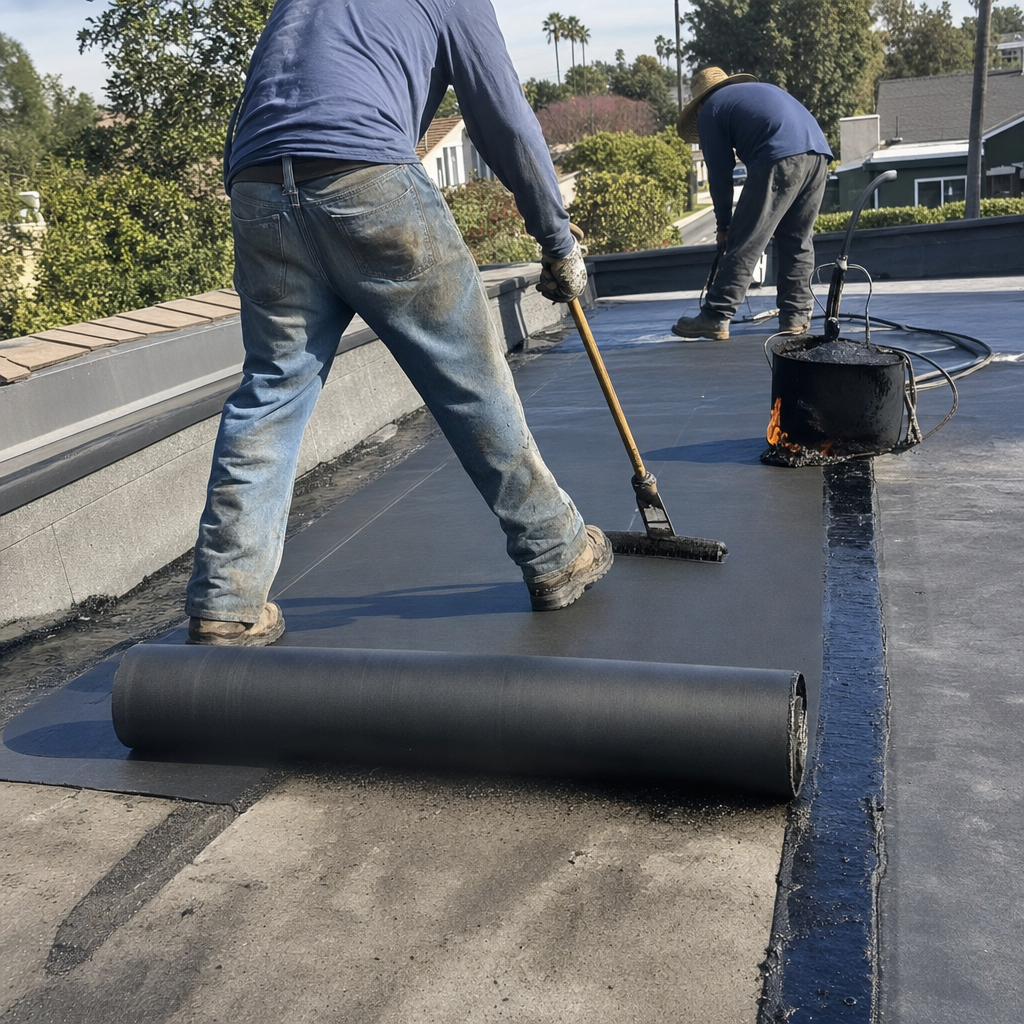
Low-slope specialty roofs, common on modern homes in the Hollywood Hills and contemporary builds throughout Venice and Mar Vista, rely on continuous coating systems: acrylic, silicone, polyurethane foam, or modified bitumen with reflective topcoats. When these leak, the instinct is to recoat. Often, that’s the wrong fix.
Ponding is the critical diagnostic term. It means water that remains on the roof surface more than 48 hours after rainfall. On a properly designed low-slope roof, water drains completely. When it doesn’t, the cause is almost always substrate deflection, the structural deck sagging between supports, creating a depression that coating cannot bridge indefinitely.
Here’s the diagnostic sequence we use:
- Check drainage paths first. Are scuppers or drains blocked? Is the cricket behind a chimney properly sloped? Simple clogs create apparent ponding with simple fixes.
- Measure the pond depth. Less than 1/4 inch that evaporates within 48 hours is typically manageable. Deeper or persistent ponding indicates structural deflection.
- Probe the substrate. From an access point, check if the deck feels solid or spongy beneath the coating. Soft areas mean saturated insulation or deteriorated sheathing.
- Trace coating failure patterns. Blisters that hold water indicate trapped moisture in the substrate, not surface coating failure. Alligatoring (fine surface cracking) usually means UV degradation of the topcoat. Both require different repairs.
Recoat over ponding without addressing the substrate is throwing good money at a structural problem. We’ve torn off systems in Los Angeles where three coating layers had been applied over a sagging deck, each failing within two years because the pond kept reforming. The actual fix involved sistering rafters or adding tapered insulation to restore positive drainage, then applying a proper system. Owens Corning and CertainTeed both manufacture tapered insulation systems we specify for these corrections.
LA’s combination of intense UV and occasional heavy rain creates a harsh cycle for low-slope coatings. The sun bakes them brittle; a January storm then finds every crack. If your coated roof is over 10 years old and you’ve noticed interior stains after recent rains, assume the coating has reached end of life and the substrate condition needs evaluation, not just a fresh topcoat.
Why Valley Flashing Is the Real Culprit Most Times
If we could teach Los Angeles homeowners one diagnostic skill, it would be this: when any specialty roof leaks, check the valleys before you blame the field material. Clay tile, metal, slate, coated systems, it doesn’t matter. Valley flashing handles the highest water volume on any roof, and it’s where installation shortcuts and seismic movement concentrate their damage.
Valleys come in two types: open valleys, where metal flashing is visible and the roofing material stops short; and closed valleys, where the material itself forms the water channel. Each fails differently.
Open valley failure modes:
- Metal flashing corrodes or separates at the seam, especially where two pieces overlap rather than being custom-folded.
- Fasteners at the valley edge loosen, allowing water to bypass the flashing and enter the roof deck.
- Debris accumulation accelerates corrosion and dams water uphill of the flashing edge.
Closed valley failure modes:
- Cutting the material too short at the valley center leaves the underlayment exposed; UV degrades it, then water penetrates.
- On tile roofs, the valley tiles rock loose from seismic shift faster than field tiles because water flow constantly works at them.
- Woven valleys in metal systems create a seam exactly where water runs fastest, a design that invites separation.
From the ground, look for these valley warning signs: staining or discoloration running down the valley line; a visible gap where the valley material meets the field; or, on tile roofs, tiles that sit unevenly along the valley edge. In the San Gabriel Valley and foothill communities, where oak and sycamore debris is heavy, we find valley blockages causing water to back up and enter at the uphill edge, far from where the interior stain appears.
Valley repair on specialty roofs requires matching the original material and often removing significant field material to access the flashing properly. This is not a spot-seal job. Done right, it takes time and proper material. Done wrong, it leaks again the first serious rain. Our 90-Day Done Right Promise covers this work specifically because valley repairs test a contractor’s patience and skill.
Ridge Cap and Transition Failures
Ridge lines are where a roof proves itself, as our company name suggests. They’re also where specialty roofing systems most often fail in ways that are invisible until the damage is extensive.
The ridge cap serves two functions: it covers the structural ridge board and provides ventilation for the attic space beneath. On tile roofs, the cap tiles are mortar-set or foam-adhered; on metal, they’re custom-folded transition pieces; on coated low-slope systems, the ridge is often a change in plane that requires reinforced flashing. Each system fails when the transition seal breaks.
In Los Angeles, seismic activity specifically targets ridges. The ridge is the highest, most exposed structural line, and it flexes with roof diaphragm movement during tremors. We’ve documented this pattern extensively in post-inspection photos from homes in the Santa Monica Mountains and the hills above Studio City: mortar-bonded cap tiles cracked at the joint, not from age but from ridge flex; metal ridge caps with separated end laps where the roof plane shifted; foam-adhered caps debonded from thermal cycling amplified by ridge ventilation airflow.
Diagnostic approach for ridge problems:
- Interior check first: Ridge leaks often show as stains at the ceiling centerline, directly below the peak. This distinguishes them from valley or field leaks.
- Ground observation: Look for missing, shifted, or cracked cap tiles; visible gaps at metal ridge ends; or coating discoloration along the ridge line.
- Ventilation assessment: Blocked ridge vents create heat buildup that accelerates adhesive and sealant failure. Check for bird nests, debris, or painted-over vents.
Ridge repair on specialty systems requires working at the roof’s highest point, often on steep pitches. This is genuinely hazardous work. We do not recommend homeowners attempt ridge inspection themselves; the fall risk combined with the precision required for proper resealing makes this a professional job. Our technicians are trained in steep-slope safety protocols and carry proper harness and anchor equipment.
One detail competitors miss: on many Los Angeles tile roofs installed in the 1980s and 1990s, ridge ventilation was achieved through mortar-set “birdstop” gaps rather than continuous vent strips. These small openings clog with debris and were never designed for modern airtight attic construction. When we replace ridge systems on these homes, we often upgrade to continuous venting that meets current California Title 24 energy standards, solving both the leak risk and the ventilation deficiency.
Synthetic and Composite Specialty Materials
Synthetic slate, composite shake, and recycled-content roofing have gained traction in Los Angeles for their lighter weight and fire ratings, particularly in hillside zones with strict WUI (Wildland-Urban Interface) codes. These materials mimic traditional looks but fail in ways that can confuse homeowners familiar with natural material behavior.
The most common diagnostic error: treating synthetic slate like real slate. Natural slate cracks from impact or freeze-thaw; synthetic slate cracks from UV embrittlement and thermal expansion against rigid fasteners. The crack pattern looks similar, but the cause and cure differ. UV-degraded synthetic material cannot be spot-repaired; the affected area needs replacement with fresh material, and the fastening pattern must allow for thermal movement.
Composite shake products, popular in fire-restricted areas like Topanga and the Santa Monica Mountains, often fail at the fastening line where the composite meets the underlying batten. The material itself holds up, but the fastener pulls through or the batten rots, creating a loose shingle that lifts in wind. From the ground, this looks like a wind-damaged wood shake; up close, it’s a fastener-substrate issue requiring different repair.
Key identification tips for synthetic and composite roofs:
- Uniform surface cracking across many pieces indicates UV degradation, not impact damage.
- Individual pieces that lift at one end but aren’t broken suggest fastener or batten failure beneath.
- Color variation between “same” batches is common with recycled-content products; this is cosmetic, not a failure.
- Edges that curl upward rather than lying flat indicate improper installation tension or thermal stress from dark colors in high-UV exposure.
GAF and CertainTeed both manufacture synthetic slate and composite products we install, and we maintain detailed installation records for warranty support. Because these materials are relatively new compared to clay tile or natural slate, long-term performance data in Los Angeles conditions is still developing. We track our installations and share findings with manufacturers, contributing to the industry’s understanding of how these products age in high-UV, seismic, and occasional high-wind exposure.
What You Can Safely Document vs. What Needs a Contractor Now
Not every roof problem demands immediate professional response, but some do, and knowing the difference saves money and prevents injury. Here’s our practical guidance for Los Angeles homeowners, with more guides & resources available on our blog.
Safely document from the ground or attic:
- Single cracked or displaced tile with no interior staining. Photograph from multiple angles, note the location, and monitor through the next rain.
- Minor coating discoloration or chalking on metal panels. Document with photos; schedule inspection at your convenience.
- Small debris accumulation in valleys or gutters. Safe to clear if you have stable ladder access and proper footwear.
- Interior stains that have dried and not recurred. Indicates a past leak that may have self-sealed; still worth professional evaluation but not emergent.
Call a contractor within 30 days:
- Multiple displaced tiles in a pattern, indicating systemic attachment failure.
- Visible metal seam separation or fastener back-out on any roof pitch.
- Ponding that persists more than 48 hours after rain on low-slope areas.
- Interior stains that appear or enlarge during rain, especially if spreading across ceiling.
- Any ridge cap damage or visible gap at the roof peak.
Call immediately, do not wait:
- Sagging roof deck visible from interior or exterior.
- Water actively dripping into living space during rain.
- Significant debris impact from fallen tree or wind-thrown object.
- Any condition that compromises fire-resistant roofing in active fire weather.
We answer live, 24 hours a day, including nights, weekends, and during storms. A real person, not a voicemail tree. If you’re uncertain which category your situation falls into, call us and describe what you’re seeing. We’ll tell you honestly whether it needs immediate response or scheduled inspection. That’s how we’ve operated since 1984.
Common Mistakes to Avoid
- Matching the repair to the symptom, not the source. Replacing a cracked tile without checking why it cracked means you’ll replace it again. Always trace upstream to the failure origin.
- Applying sealant as a universal fix. Roof sealant has specific applications and temperature ranges. Slathering it over a failed seam or cracked tile often traps moisture and accelerates deterioration, especially in LA’s heat.
- Ignoring seismic history. Los Angeles roofs installed before 1994 may have fastening systems that don’t meet current earthquake standards. A repair that doesn’t address this leaves the roof vulnerable to the next significant shaker.
- Walking the roof to “check” without proper safety. Specialty roofing materials are often installed on steep pitches and are slippery when coated or weathered. Falls from roof height are consistently among the leading causes of home maintenance injuries in California.
- Choosing the lowest bid without verifying material sourcing. Specialty roofing requires manufacturer-authorized materials for warranty validity and proper performance. Substituted products fail faster and void existing coverage.
- Delaying inspection after noticing interior staining. By the time water shows on your ceiling, it’s already traveled through insulation and structural layers. The visible stain is the late signal, not the early warning.
When to Call a Professional
Call a roofing contractor when you cannot confidently identify the failure origin, when the repair requires roof access beyond your safe capability, or when the problem involves structural components like sagging decking or compromised rafters. Specialty roofing systems reward precise diagnosis and exacting repair; general handyman skills rarely suffice.
In Los Angeles, the combination of seismic risk, intense UV exposure, and specific fire-code requirements means that even “simple” repairs often involve decisions about fastening patterns, material compatibility, and ventilation that affect the roof’s long-term performance. A contractor who understands these local conditions, and who has documented experience with your specific roofing material, will save you from repeated callbacks and escalating damage.
Ridgeline Roofing Co. offers free estimates throughout Los Angeles. Our technicians arrive in uniform, background-checked, and equipped to photograph and document your roof’s actual condition. We provide no-hassle upfront pricing, the number on the estimate is the number on the invoice, and every repair is backed by our written 90-Day Done Right Promise. If it’s not right, we make it right, no paperwork, no arguing. Call (844) 563-1816 to schedule.
Frequently Asked Questions
Most specialty roof repairs in Los Angeles range from $450 for isolated tile replacement to $2,800 for valley flashing reconstruction on larger homes. Metal seam repairs typically fall between $650 and $1,400, while low-slope coating system repairs with substrate correction can reach $3,500 or more depending on area. Call (844) 563-1816 for an exact quote, estimates are free.
We complete most specialty roof repairs in a single visit when the problem is accessible and the required materials are in stock. Same-day completion is common for tile replacement, fastener correction, and minor flashing repairs. Complex valley reconstruction or substrate correction requires scheduling, and we always photograph and explain the full scope before beginning work. Call (844) 563-1816 to check same-day availability.
Repair is more economical when the failure is localized and the surrounding system remains sound, typically for roofs under 20 years old with isolated damage. Replacement becomes the better investment when multiple failure modes appear across the roof, the substrate is compromised, or the material has reached end of life, which for many specialty systems in LA’s climate occurs at 25 to 35 years. We provide honest assessment of both options, no pressure either way. Call (844) 563-1816 for a free evaluation.
Specialty roofing materials are heavier and more rigid than asphalt shingles, so seismic forces concentrate at attachment points rather than being absorbed through flexibility. Clay and concrete tile fastener lines loosen; metal panel seams separate from clip fatigue; ridge caps debond from mortar or adhesive. These failures develop gradually from cumulative micro-movements, making regular inspection more important than with lighter, more flexible systems.
Ponding is water that remains on the roof surface more than 48 hours after rainfall. It indicates inadequate drainage, usually from substrate deflection or improper slope design. Ponding is serious because it accelerates coating failure, increases structural load, and in Los Angeles, creates mosquito breeding habitat in violation of local vector control codes. Persistent ponding requires structural correction, not just recoat.
Interior stain location is the best indicator. Stains near the ceiling centerline, directly below the ridge, suggest ridge or field tile failure. Stains that appear at room edges or where roof planes intersect indicate valley or flashing origin. From the exterior, valley problems show as discoloration along the valley line or displaced tiles at the valley edge; field tile problems show as isolated damage away from transitions. When in doubt, trace the water path uphill, water always runs down.
The Bottom Line
Specialty roofing problems in Los Angeles demand diagnostic precision that accounts for local conditions: seismic activity working on heavy tile and metal systems, intense UV degrading coatings and synthetics, and valley flashings that handle concentrated water flow across decades of ground motion. The visible damage is rarely the true origin. Trace the problem to its source, match the repair to the actual failure mode, and verify that your contractor understands the material-specific requirements of your roof system. Done right, a specialty roof repair lasts. Done wrong, you’ll be replacing the same tile, or patching the same seam, again next year. We stand behind our work with a written promise, no paperwork, no arguing. If it’s not right, we make it right.
Written by the team at Ridgeline Roofing Co., serving Los Angeles since 2016.