
Last updated July 26, 2026
Roofing Warning Signs: A Los Angeles Homeowner’s Reference Guide
The warning sign Los Angeles homeowners most consistently miss isn’t a missing tile or a dramatic leak. It’s the dark, blotchy staining on a north-facing roof slope that indicates moisture trapped under the surface, not just algae. In our 42 years serving this city, we’ve learned that most roof failure here builds quietly. Granule loss in gutters, flashing separation at valley intersections, and cracked field tile that’s visible from the right angle if you know what to look for. These are the signals that separate a $400 repair from a $18,000 replacement. This guide will teach you to read them early, before the Santa Ana winds or the first winter rain make them impossible to ignore, and you can explore more guides & resources for year-round roof care.
Quick Answer
The most critical roofing warning signs for Los Angeles homeowners are: dark, blotchy staining on north-facing slopes indicating trapped moisture; granule accumulation in gutters signaling asphalt shingle deterioration; separated or corroded flashing at valleys, chimneys, and wall intersections; cracked, slipped, or broken tiles on Spanish and clay roofs; and interior signs including attic humidity, rafter staining, and compressed insulation that appear before any ceiling leak becomes visible. Most of these conditions develop gradually in L.A.’s sun-dominant climate and become urgent only after wind or rain exposure accelerates the damage.
Table of Contents
- How to Read Granule Loss in Your Gutters
- Flashing Failure Points on L.A.’s Most Common Roof Styles
- Interior Warning Signs That Precede Visible Leaks
- Cosmetic vs. Structural Cracking in Clay and Concrete Tile
- Santa Ana Wind Damage: What the Street Won’t Show You
- The North-Facing Slope: L.A.’s Most Misread Warning Sign
- Common Mistakes to Avoid
- When to Call a Professional
- Frequently Asked Questions
How to Read Granule Loss in Your Gutters
Every Los Angeles homeowner with an asphalt shingle roof should check their downspout outlets after a rain. What you’re looking for is a sediment deposit that looks like coarse sand. Those are ceramic granules, and they tell a precise story about where your roof is in its lifespan.
Granules aren’t decorative. They’re the protective armor that shields the asphalt mat beneath from ultraviolet radiation. In Los Angeles, where we average 284 sunny days annually, that UV exposure is relentless. A new composition shingle, properly installed, sheds a small number of loose granules in its first year. That’s normal. What isn’t normal is a steady accumulation season after season, or gutters that need cleaning twice a year because they’re filling with gritty sediment.
Here’s how to read the rate of loss:
- Light, occasional granules in downspout splash blocks after heavy rain: Normal for shingles under 10 years old, especially if you had recent work done that disturbed the surface.
- Consistent granule deposits every rain, with visible bare patches on the roof where the black asphalt mat shows through: The shingle is past midlife. In Los Angeles’s climate, this typically appears at 12-18 years for standard three-tab shingles, 18-25 years for architectural grades like CertainTeed Landmark or Owens Corning Duration.
- Heavy granule flow with gutters that clog repeatedly, plus shingles that feel soft or flexible when touched: The asphalt binder has degraded. The roof is in failure mode. Rain will soon penetrate.
The neighborhoods we see this most acutely are in the San Fernando Valley, where reflected heat from pavement and longer sun exposure accelerate the chemistry. A roof in Sherman Oaks or Van Nuys at 15 years may show the same granule loss as a comparable roof in Pacific Palisades at 22 years. Orientation matters too. South and west faces degrade faster; north faces hold granules longer but develop other problems we’ll cover shortly.
If you’re seeing bare patches larger than a hand, or if the gutters contain more granules than leaves after a storm, it’s time for a professional inspection. At Roof Repair in Los Angeles, we document granule loss with photos from your actual roof, not from the driveway, so you can see exactly what we’re seeing.
Flashing Failure Points on L.A.’s Most Common Roof Styles
Flashing is the sheet metal or membrane that bridges the gaps where your roof meets something else: a wall, a chimney, a vent pipe, a valley where two slopes intersect. It’s the most failure-prone element on any roof, and in Los Angeles, we see three dominant roof styles with three distinct flashing vulnerability patterns-patterns covered in detail in our Specialty Roofing Troubleshooting: Common Problems and How to Fix Them guide.
Spanish Tile Roofs
The romantic profile of Spanish tile, common from Hancock Park to the hills above Whittier, creates a fundamental flashing challenge. The tiles are curved. The valleys between them are deep. Water flows in channels, and the metal valley flashing beneath must be wide enough, properly lapped, and correctly fastened to handle concentrated flow during our occasional intense downpours.
The failure point we find most often is at the valley intersection where two roof planes meet. The original installer used standard-width valley metal when wide-valley configuration was needed. Or the mortar bedding that secures the tile edges has cracked, allowing water to bypass the tile and reach the underlayment directly. In older Los Angeles neighborhoods like Los Feliz and Eagle Rock, we’ve seen original 1920s tile roofs with modern cement-based mortar repairs that trap moisture instead of shedding it.
Composition Shingle Roofs
On the flat to moderately pitched roofs common in postwar neighborhoods from the Westside to the San Gabriel Valley, flashing failure typically occurs at vertical wall intersections and chimney saddles. The step flashing, which should be woven between each course of shingles where a roof meets a wall, gets buried under subsequent repairs. Or the counterflashing, which covers the top edge of the step flashing, separates from the mortar joint due to thermal cycling.
Los Angeles’s temperature swings, 40°F some nights to 85°F the following afternoon, cause metal to expand and contract. After 20 years, that movement fatigues sealants and mortar. The gap that opens is rarely visible from the ground. It takes a technician on the roof, photographing the intersection up close, to catch it before water enters the wall cavity.
Flat TPO and Modified Bitumen Roofs
On the low-slope sections common on modern additions, ADUs, and commercial-style residential buildings from Silver Lake to Culver City, flashing takes the form of membrane termination bars, pitch pans around penetrations, and sealed seams. The critical failure points are:
- Penetration seals around vent pipes and HVAC lines, where the rubber boot or pitch pan compound dries and cracks in UV exposure
- Termination bars at wall intersections, where wind uplift can loosen the mechanical fastening
- Seam failures in TPO membranes, often from foot traffic during satellite dish or solar panel installation
We’ve been installing and repairing flat roofing in Los Angeles since 1984, and we specify IKO and Atlas membrane products for their heat-welded seam integrity in our climate. The 90-Day Done Right Promise applies to every flashing detail we touch. If it’s not right, we come back and make it right. No paperwork, no arguing.
Interior Warning Signs That Precede Visible Leaks
By the time water stains your ceiling drywall, the roof has been failing for weeks or months. The conditions that precede that stain are detectable if you know where to look and what to measure. We train our technicians to ask homeowners about these interior signs before we ever set a ladder against the house.
Attic Humidity and Ventilation
Los Angeles’s dry climate creates a false sense of security. Homeowners assume attics here don’t have moisture problems. They do. Kitchen and bathroom exhaust fans vented into attic space instead of through the roof dump warm, moist air directly onto the underside of the roof deck. In winter, when nighttime temperatures drop into the 40s, that moisture condenses on the cold sheathing.
Check your attic on a cool morning. The sheathing should look dry and uniform in color. Dark patches, especially on the north side, indicate condensation cycling. Over time, this softens the wood fiber, degrades the underlayment from below, and creates the conditions for mold that doesn’t need a roof leak to propagate. We’ve opened attics in Mid-Wilshire and Koreatown where the sheathing was structurally compromised from decades of condensation, with no exterior roof failure visible at all.
Rafter Staining and Water Marks
Run a flashlight along your rafters or truss chords. You’re looking for dark longitudinal streaks that follow the grain, or drip marks on horizontal members. These indicate water entry points that haven’t yet saturated the insulation below. The stain location, measured from a fixed interior point, helps us trace back to the exact roof penetration when we inspect.
Insulation Compression and Displacement
Fiberglass batt insulation that appears flattened, discolored, or displaced from its friction-fit position has gotten wet and dried, possibly multiple times. The compression reduces R-value and creates a thermal bridge that accelerates future condensation. In Los Angeles’s inland valleys, where summer attic temperatures exceed 140°F, compressed insulation near the eaves also indicates possible ice damming analogs from solar-driven moisture, a phenomenon we see increasingly as homeowners add cooling loads without improving ventilation-a seasonal pattern worth tracking with our Seasonal Roofing Care for Los Angeles: Year-Round Homeowner’s Guide.
Our Roof Replacement & Installation in Los Angeles includes full attic ventilation assessment. We don’t just swap shingles. We diagnose the system.
Cosmetic vs. Structural Cracking in Clay and Concrete Tile
Los Angeles has more clay and concrete tile roofing than any U.S. city west of the Mississippi. The material lasts 50-plus years, but individual tiles fail and need replacement. The critical skill is distinguishing cracks that threaten the waterproofing layer from cracks that don’t.
Cosmetic Cracking: When the Tile Still Sheds Water
Surface crazing, the fine network of cracks that makes old tile look weathered, rarely penetrates to the underside. It’s caused by thermal cycling and carbonate migration in the glaze. The tile still sheds water. In historic neighborhoods like Pasadena and West Adams, we see original 1920s clay tile with heavy crazing that performs perfectly because the underlayment and flashing remain intact.
Similarly, a clean break across the exposed face of a tile, where the pieces remain in place and the overlap with the course below is undisturbed, may not admit water. The tile’s curvature creates multiple drainage paths. Water would have to travel uphill to penetrate.
Structural Cracking: When the Waterproofing Is Compromised
These are the cracks that matter:
- Through-cracks that extend from the exposed face through to the underside of the tile. Water follows gravity through the breach and reaches the underlayment directly.
- Broken nose or head, where the tile’s overlap with the course below is eliminated. Wind-driven rain enters the gap.
- Slipped tile, where the nail or wire tie has failed and the tile has shifted down-slope, exposing the underlayment to UV and mechanical damage.
- Cracks at the fastening point, where the nail hole has fractured, typically from foot traffic or seismic movement. The tile may look intact but is loose and will dislodge in the next Santa Ana event.
Here’s the key: you cannot reliably assess tile cracking from the ground with binoculars. The critical distinction is whether the crack penetrates to the underside, and that requires a close-up view from the roof surface. Our technicians photograph every cracked tile we find and show you the image before recommending replacement. No scary speeches. Just evidence.
For homeowners with specialty tile systems, including the lightweight concrete profiles popular in hillside construction from Hollywood Hills to Pacific Palisades, our Specialty Roofing in Los Angeles service includes manufacturer-authorized repair protocols that preserve system warranties.
Santa Ana Wind Damage: What the Street Won’t Show You
The Santa Ana winds arrive most intensely from October through January, though we’ve seen damaging events as early as September and as late as April. Sustained speeds of 40-60 mph with gusts exceeding 80 mph test every roof in their path. What homeowners miss, repeatedly, is that the most significant damage often looks like nothing from the street.
Here’s what we find when we climb these roofs:
- Ridge cap displacement: The mortar-set or foam-adhered caps along the roof’s apex are the highest point and take the full wind load. A cap that’s shifted even an inch has broken its seal. Water enters the open gap, follows the ridge board, and appears inside as a leak that seems to come from nowhere because there’s no penetration directly above it.
- Hip tile rotation: On Spanish and clay tile roofs, the hip tiles that cover the angled intersections between roof planes rotate slightly in wind, then resettle. The rotation grinds the mortar bed to dust. The next wind event lifts the tile entirely. We’ve replaced hip tiles in Bel Air and Brentwood where the original mortar was reduced to sand, invisible from below.
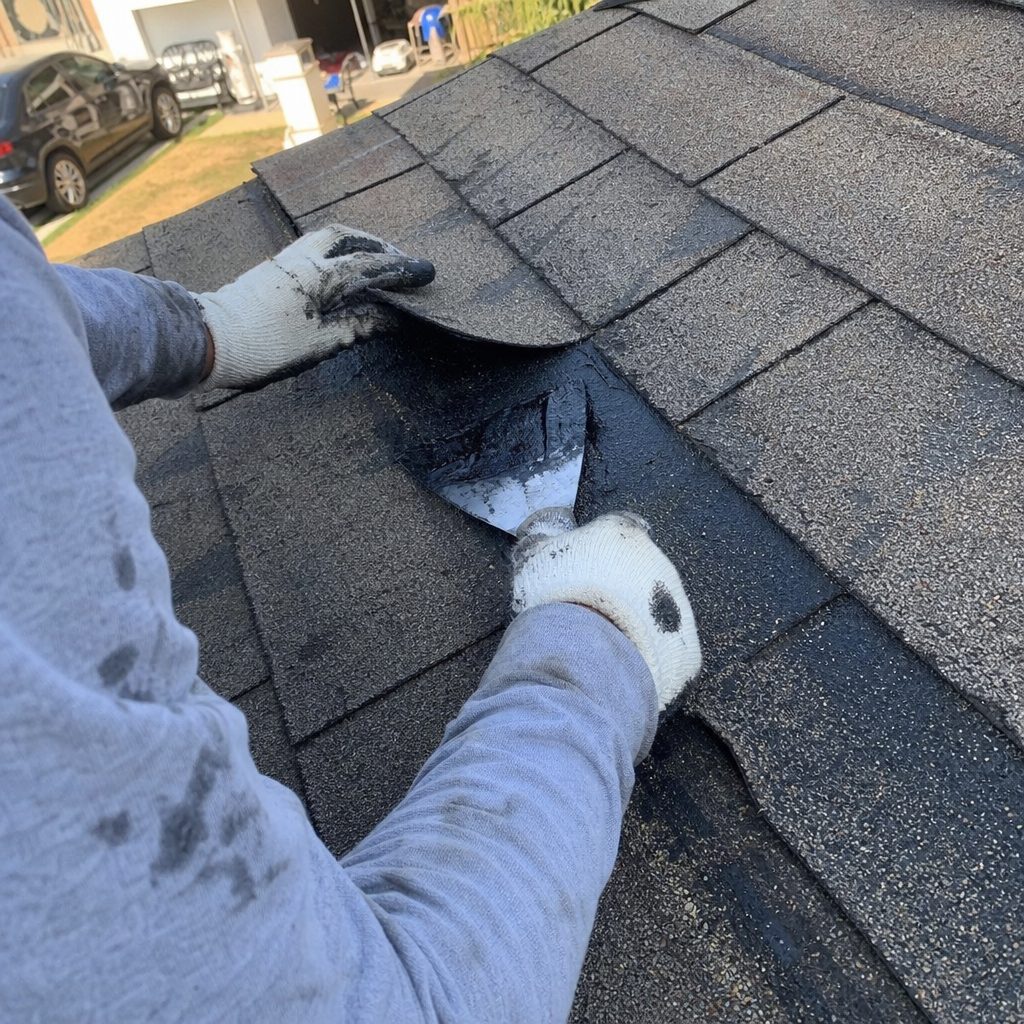
- Shingle tab lifting and re-adhesion: On composition roofs, wind lifts the sealant strip between shingle tabs, sometimes breaking it, sometimes allowing debris to enter the gap. The tab may lie flat again after the wind subsides, but the seal is compromised. The next rain drives under the lifted edge. From the ground, the roof looks fine.
- Flashing seal separation: Wind pressure at roof edges creates a pumping action that flexes metal flashing. Sealant beads crack. The separation is often 1/16 inch, invisible without magnification, sufficient for capillary water entry.
After every major Santa Ana event, our phones stay busy for weeks. Not from the homes with tiles in the front yard, those are obvious. From the homeowners who noticed nothing wrong, then found a stain spreading across their ceiling in February’s first rain. We answer live, 24 hours a day, including the middle of the night when the drip starts. A real person, not a voicemail tree.
Our recommendation: schedule a wind-event inspection within two weeks of any Santa Ana that rattled your windows, following the timing in our Specialty Roofing Maintenance Schedule: What to Do and When. The inspection is photo-documented, the pricing is upfront, and most minor repairs complete in a single visit.
The North-Facing Slope: L.A.’s Most Misread Warning Sign
Remember the opening hook. The dark, blotchy staining on north-facing roof slopes is the warning sign Los Angeles homeowners most consistently misread. They see it, assume it’s algae or mildew, and dismiss it as cosmetic. Often it’s not.
In Los Angeles’s climate, north-facing slopes receive minimal direct sun, especially in winter when the sun angle is low. Moisture that penetrates the roof system, from any source, dries slowly on these slopes. The dark staining is frequently the visible manifestation of water trapped beneath the surface, wicking through the underlayment, and nourishing biological growth at the interface between waterproofing layers.
Here’s how to distinguish cosmetic algae from structural moisture staining:
| Characteristic | Cosmetic Algae | Moisture-Trapped Staining |
|---|---|---|
| Pattern | Uniform, feathery, follows drip lines | Blotchy, irregular, often at flashing or penetration points |
| Color | Dark green to black, consistent tone | Dark brown to black, variable density |
| Texture | Surface growth, can be brushed off | Stains substrate, does not brush off |
| Location | Any shaded slope, including under trees | North-facing primarily, often at valleys or near walls |
| Associated signs | None on interior | Attic humidity, rafter staining possible |
The north-facing slope problem is compounded in neighborhoods with mature tree canopy, like parts of Los Feliz, Hancock Park, and the older Pasadena foothills. Leaf litter holds moisture against the roof surface. Combined with reduced solar drying, the conditions accelerate underlayment degradation even when the tile or shingle itself appears intact.
We inspect north-facing slopes with particular attention. The photos we take document not just the surface condition but the underlayment beneath, accessed by lifting a tile or shingle tab at the suspected area. If the felt or synthetic underlayment is damp, discolored, or degraded, the staining is structural, not cosmetic. The repair involves addressing the water entry point and replacing the compromised waterproofing layer, not just cleaning the surface.
Common Mistakes to Avoid
- Waiting for a visible leak before calling for inspection. By the time water reaches your ceiling, structural damage to sheathing, insulation, and framing has already occurred. In Los Angeles’s dry climate, this hidden damage can progress for years.
- Pressure-washing tile or shingle roofs to remove staining. The high-pressure stream drives water under the roofing material, damages surface coatings, and often voids manufacturer warranties. We see this most in hillside neighborhoods where homeowners prize curb appeal.
- Hiring unlicensed operators after storm events. Los Angeles attracts transient crews following major wind or rain events. They offer quick, cheap repairs with no warranty recourse. Verify CSLB license, demand proof of workers’ compensation insurance, and ask how long the company has maintained a local address.
- Ignoring granule loss because the roof “still looks fine from the street.” The street view shows color and profile, not protective coating thickness. Granule loss is a leading indicator of remaining service life.
- Assuming flat roofs are maintenance-free. TPO, modified bitumen, and built-up roofing systems require periodic seam inspection, penetration seal renewal, and debris clearing. The “out of sight, out of mind” approach to flat roofing is expensive.
- Accepting interior stains as “just old house character” without tracing to source. That stain pattern has a cause, and the cause is getting worse whether you paint over it or not.
When to Call a Professional
Call for a professional roof inspection when you observe any of the following: granule accumulation in gutters that persists across multiple rain events; any tile that sounds hollow when tapped, or that shifts under light foot pressure; dark blotchy staining concentrated on north-facing slopes; interior attic signs of moisture regardless of exterior appearance; or within two weeks of any Santa Ana wind event that produced gusts above 50 mph at your location.
Roof work in Los Angeles requires a CSLB-licensed contractor for projects exceeding $500 in value. The permit and inspection requirements vary by jurisdiction, Los Angeles city proper has different protocols than unincorporated county areas or independent cities like Santa Monica or Pasadena. A qualified local contractor navigates these variations routinely.
Ridgeline Roofing Co. offers free estimates throughout Los Angeles. Our technicians are background-checked, uniformed, and equipped to photo-document every condition they find. Call (844) 563-1816 to schedule. A live person answers, day or night, including weekends and holidays. We’ve been here since 1984, and we plan to be here when your next roof needs attention, thirty years from now.
Frequently Asked Questions
Standard three-tab asphalt shingles typically last 15-20 years in Los Angeles’s climate, while architectural-grade shingles from manufacturers like CertainTeed and Owens Corning often reach 25-30 years with proper ventilation and maintenance. The intense UV exposure and thermal cycling in inland areas like the San Fernando Valley can shorten these ranges by 3-5 years compared to cooler coastal neighborhoods. Call (844) 563-1816 for a free inspection and honest assessment of your roof’s remaining service life.
No. Small stains can originate from plumbing leaks, condensation from poorly insulated ducts, or window and wall penetration failures. However, any ceiling stain that appears or worsens after rain, or that is located on the upper floor directly below a roof plane, warrants professional roof inspection to rule out the most common and consequential source. Our photo-documented inspection distinguishes roof-related moisture from other causes before recommending any work.
We do not recommend homeowner foot traffic on clay or concrete tile roofs. Tile breakage underfoot is common and often invisible until the next rain reveals the new leak. Additionally, steep pitches, loose tiles, and accumulated debris create genuine fall hazards. Our technicians use specialized walk boards and anchoring equipment, and even we move carefully across these surfaces. The inspection is free. The injury risk is not worth the savings.
Most localized repairs in the Los Angeles market range from $350 for simple tile replacement or shingle patching to $1,800 for valley flashing reconstruction or multiple penetration resealing. Full roof replacement on a typical 2,000-square-foot home ranges from $12,000 to $22,000 depending on material selection, deck condition, and access difficulty. Ridgeline Roofing Co. provides no-hassle upfront pricing: the number on the estimate is the number on the invoice. We also offer $50 off any repair over $250, and a permanent 5% senior and veteran discount.
Insurance coverage depends on cause and policy terms. Sudden, accidental damage from wind or falling trees is typically covered. Gradual wear, maintenance neglect, and damage from uncovered perils like earthquakes (without specific rider) are generally excluded. We provide photo documentation and detailed written reports to support legitimate claims, and we offer free second opinions on any written estimate or insurance scope of work. Call (844) 563-1816 to discuss your specific situation.
Most repair visits are scheduled within 24-48 hours of contact, and most repairs complete in a single visit. Emergency tarping and leak mitigation for active water intrusion can often be dispatched same-day. Our live phone answering, 24 hours a day, means you reach a person who can authorize dispatch, not a callback queue. For non-urgent inspections, we work around your schedule, including weekend appointments for homeowners who prefer to be present.
The Bottom Line
Roof failure in Los Angeles rarely arrives as a sudden catastrophe. It accumulates through granule loss, flashing fatigue, tile degradation, and moisture intrusion that builds invisibly until a wind event or winter rain makes it unavoidable. The homeowners who fare best are those who learn to read the early signals: the grit in the gutter, the blotchy north slope, the attic humidity that precedes any ceiling stain. These signs are present months or years before the emergency. Recognizing them requires attention, but not expertise. Responding to them requires a contractor who will document what they find, explain it plainly, and stand behind the repair with something written.
We’ve been that contractor for Los Angeles homeowners since 1984. Named for the ridge, the line where a roof proves itself. Done right, and if it’s not, we make it right.
Ridgeline Roofing Co. home | Call (844) 563-1816 for a free estimate. A live person answers, 24/7.
Written by the team at Ridgeline Roofing Co., serving Los Angeles since 2016.