
Last updated July 26, 2026
DIY vs Professional Roofing: The Los Angeles Homeowner’s Decision Guide
In California, a homeowner who completes a roof repair without a required permit can have their homeowner’s insurance claim denied on the next weather event - a consequence no YouTube tutorial mentions before you pick up a caulk gun. Los Angeles homeowners face a unique intersection of strict building codes, hillside topography, and insurance requirements that make the DIY-vs-professional question less about handyman pride and more about legal exposure. This guide lays out the actual liability, warranty, and permit consequences so you can decide with clear information - not enthusiasm - and our DIY vs Professional Specialty Roofing: What’s Safe to Do Yourself companion piece offers additional guidance.
Quick Answer
Most Los Angeles homeowners can safely handle gutter cleaning, minor skylight resealing, and visual inspections themselves. Anything involving structural decking, waterproofing membranes, or tile replacement requires a C-39 licensed contractor and proper permits to maintain insurance coverage and manufacturer warranty eligibility. The real cost of DIY roofing in Los Angeles is not the materials - it is the claim denial, the failed inspection, and the disclosure obligation when you sell.
Table of Contents
- What California Law Actually Allows Homeowners to Do
- The Insurance Consequences No One Talks About
- Why L.A. Hillside Homes Carry Different Fall Risk
- The Real Cost of a DIY Mistake in Los Angeles
- What a Licensed Roofer Provides Beyond Labor
- Maintenance Tasks Where DIY Genuinely Makes Sense
- Permits, Inspections, and the Los Angeles Department of Building and Safety
- How DIY Work Voids Manufacturer Warranties
What California Law Actually Allows Homeowners to Do
California contractors law draws a sharp line between maintenance and construction. Under the Business and Professions Code, anyone can perform “ordinary repairs” on their own home without a contractor’s license. The trouble is that “ordinary” does not mean what most homeowners assume.
The California Contractors State License Board (CSLB) considers these tasks exempt from C-39 roofing contractor licensing for owner-occupants:
- Gutter cleaning and minor reattachment - provided you are not replacing full gutter runs or altering drainage paths
- Caulking and sealing around vents, skylights, or flashing - using consumer-grade sealants, not hot-mop or torch-down applications
- Removing debris and moss buildup - with plastic tools, not pressure washers that drive water under tiles
- Visual inspection from a ladder or the roof surface - documenting conditions with photos for a professional review
- Replacing individual damaged shingles on a low-slope accessible roof - though this enters a gray area most insurers dislike
What crosses into licensed territory is broader than many realize. In Los Angeles, any work affecting the roof’s waterproofing integrity - replacing underlayment, repairing decking, installing new flashing, or rebedding clay tiles - triggers permit requirements under the Los Angeles Building Code. The L.A. Department of Building and Safety (LADBS) requires permits for “the removal and replacement of more than 25 percent of the roof covering in any 12-month period.” That threshold sounds generous until you realize that wind damage in the San Fernando Valley often scatters tiles across a broad area.
We have inspected homes in Pacific Palisades where a homeowner replaced a dozen wind-torn concrete tiles himself, well under the 25 percent threshold, but used a mismatched batch with different porosity. Two years later, the uneven moisture absorption caused cracking patterns that looked like structural movement. His insurance adjuster flagged the non-uniform repair and reduced the claim payout on a subsequent leak. The CSLB exemption protected him from licensing penalties; it did not protect him from the insurance consequence.
The Insurance Consequences No One Talks About
Every major homeowner’s insurance policy in California contains a version of this clause: coverage applies to “sudden and accidental” damage, excluding losses resulting from “faulty, inadequate, or defective repairs.” The interpretation of what constitutes “faulty” is where DIY roofing becomes expensive.
California courts have upheld claim denials where unpermitted work contributed to the loss, even partially. In Steven v. Allstate (2019), a Central Valley homeowner’s claim was denied after a windstorm because an unpermitted roof repair created a lift point that allowed water intrusion. The court found the insurer had properly invoked the “faulty repair” exclusion. Los Angeles homeowners face heightened scrutiny because our combination of Santa Ana winds, marine moisture, and seismic activity creates multiple failure vectors that adjusters are trained to investigate.
Here is how the insurance calculation actually works for a typical Los Angeles policy:
- Permitted work by licensed contractor: Full coverage for subsequent damage, subject to deductible and policy limits
- Unpermitted work by homeowner, no subsequent damage: No immediate issue, but disclosure required on sale; may affect future premiums
- Unpermitted work by homeowner, subsequent damage occurs: Claim investigation examines causation; partial or full denial likely if DIY repair is implicated
- Work by unlicensed contractor (including handyman): Same risks as DIY, plus potential fraud investigation if contractor misrepresented licensing
The disclosure requirement is the sleeper issue. California Civil Code Section 1102 requires sellers to disclose “any room additions, structural modifications, or other alterations made without necessary permits.” An unpermitted roof repair must be disclosed. In Los Angeles’s competitive real estate market, that disclosure triggers buyer inspections, price reductions, or deal cancellations. The $400 you saved doing it yourself becomes a $15,000 negotiation point a decade later.
Why L.A. Hillside Homes Carry Different Fall Risk
The physics of falling from a roof do not change by ZIP code, but the probability of falling does. Los Angeles has unusual topography for a major American city: we build on slopes that would be considered unbuildable in flatter regions. A two-story home in the Hollywood Hills may sit on a lot with a 30-degree grade, meaning the roof edge on the downhill side is effectively three stories above ground level with hardscaping below. A similar home in the San Fernando Valley on flat terrain presents a different equation entirely.
OSHA fall protection standards apply to workers, not homeowners, but they reveal the actual risk landscape. Residential roof work in California averages 45 fatalities annually, with Los Angeles County consistently leading the state. The critical factors on L.A. hillside homes include:
- Variable roof pitches on the same structure - many hillside homes combine low-slope sections with steep pitches over garages or additions, requiring different equipment and techniques
- Wind exposure amplified by canyon geometry - the same Santa Ana winds that fan wildfires create sudden gusts that destabilize ladders and workers
- Clay and concrete tile surfaces - common in Los Angeles for fire resistance, but significantly more slippery than asphalt shingles, especially with morning marine layer moisture
- Limited staging areas - narrow hillside lots often prevent proper ladder angles and eliminate the possibility of a helper spotting from below
In our experience, the homeowners most at risk are not the unathletic or elderly; they are the capable ones who have done their own maintenance for decades and underestimate how a familiar task changes at height on an unfamiliar surface. We have responded to Emergency & Storm Damage Troubleshooting: Common Problems and How to Fix Them calls in Silver Lake and Los Feliz where a homeowner fell from a roof they had walked dozens of times before. The difference was a morning dew, a shifted ladder, or a tile that cracked underfoot.
Self-assessment is honest or it is useless. If you do not own a harness, have not inspected it recently, and do not have a second person present, you are not prepared for pitched roof work. Full stop.
The Real Cost of a DIY Mistake in Los Angeles
The internet calculates DIY savings by subtracting material costs from contractor bids. This arithmetic omits the Los Angeles-specific costs that actually matter.
Permit correction costs: If LADBS discovers unpermitted work - often through a neighbor complaint, a satellite imagery trigger, or a subsequent sale inspection - the homeowner must obtain a retroactive permit. This requires opening the repair for inspection, which means removing materials you installed. The correction process typically costs 2-3 times the original permit fee, plus the cost of re-doing the work to code. We have seen $800 DIY repairs become $4,000 corrections in Encino and Studio City.
Insurance claim denial: The average water damage claim in Los Angeles County is $18,400. A denied claim due to faulty repair means that cost transfers entirely to the homeowner, plus the cost of repairing the original roof defect that allowed the water intrusion.
Manufacturer warranty voidance: Premium roofing materials - the CertainTeed Landmark PRO shingles, Owens Corning Duration series, or IKO Cambridge architectural lines we install - carry 30- to 50-year warranties. These warranties explicitly require installation by a licensed contractor following manufacturer specifications. DIY installation voids the warranty entirely. On a 2,500 square foot roof, that is $15,000-$25,000 in material value with no recourse if the product fails prematurely.
Home sale disclosure and price impact: In Los Angeles’s current market, a roof with documented professional installation and transferable warranties adds measurable value. The inverse - a roof with undisclosed or unpermitted work - creates liability that buyers’ attorneys exploit. Disclosure of unpermitted work typically reduces sale price by 1-3 percent, or forces a pre-sale professional correction at rush pricing.
Personal injury: A fall from roof height without workers’ compensation coverage means your health insurance pays, subject to deductibles and coverage limits, with no disability income protection. The median hospital charge for a fall from height in California exceeds $95,000 for serious injuries.
What a Licensed Roofer Provides Beyond Labor
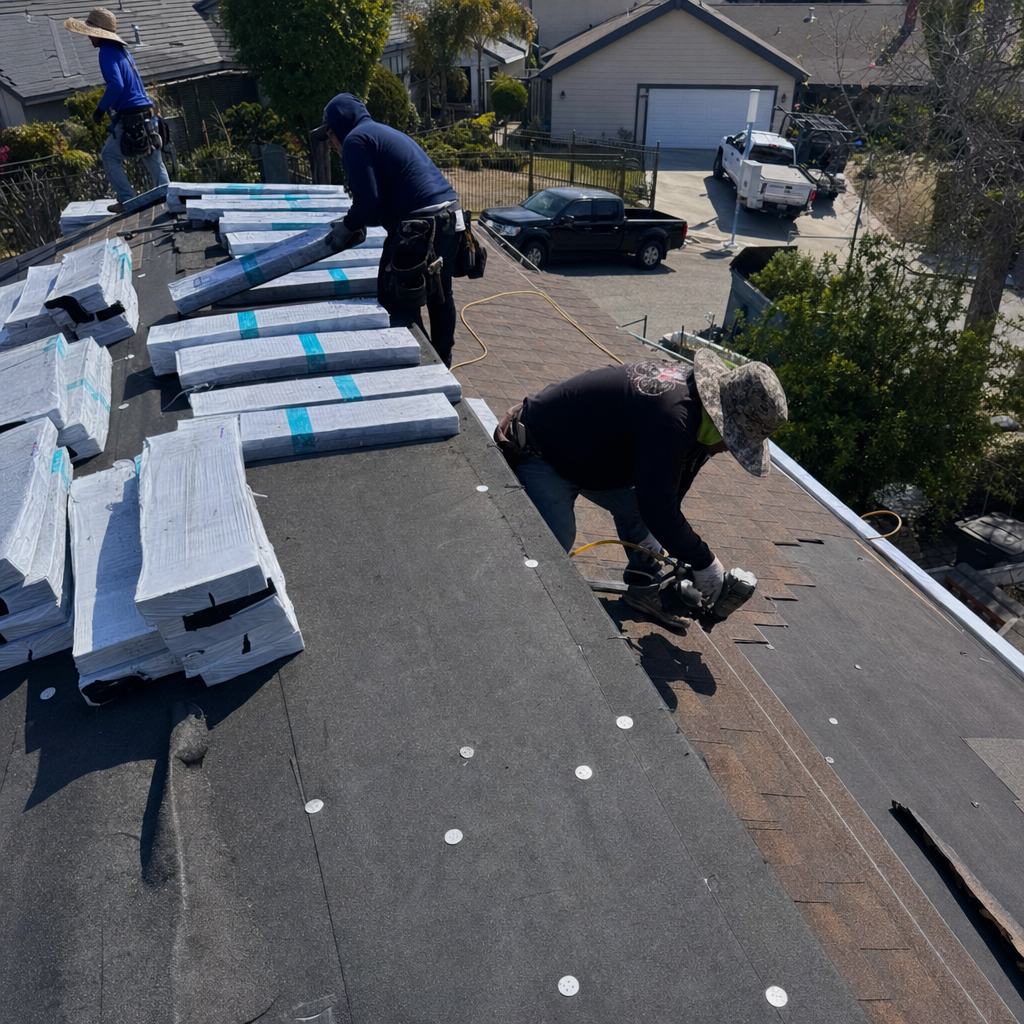
A C-39 licensed roofing contractor in California carries obligations that transfer risk away from the homeowner. Understanding what these actually are helps clarify when professional involvement is essential versus merely convenient.
Liability insurance and workers’ compensation: California requires licensed contractors to carry general liability insurance ($1 million minimum) and workers’ compensation if they employ anyone. This means if a worker is injured on your property, the claim routes through the contractor’s policy, not your homeowner’s insurance. If you hire an unlicensed handyman or do the work yourself, that protection disappears.
Manufacturer authorization and warranty eligibility: Major manufacturers - GAF, CertainTeed, Owens Corning, IKO, Atlas, and others - maintain contractor certification programs. Factory-certified contractors can offer enhanced warranties that cover both materials and installation. These warranties transfer to subsequent owners, adding value at sale. DIY installation offers nothing comparable.
Code compliance and permit management: A licensed contractor knows the LADBS requirements, the inspection schedule, and the common failure points that trigger re-inspection. We have learned through 42 years which inspectors care about nail patterns, which examine valley flashing detail, and how to schedule efficiently. This knowledge saves weeks of delay.
Documented work record: Professional work creates a paper trail - permits, inspection sign-offs, manufacturer warranty registrations, and photo documentation. When we inspect a roof in Los Angeles, we provide dated photos from the roof surface showing conditions before and after. This documentation becomes evidence of proper maintenance if an insurance claim arises, and proof of quality if you sell.
Written workmanship guarantee: Our Ridgeline Roofing Co. home includes the 90-Day Done Right Promise - a written guarantee with no paperwork, no arguing, and no runaround. If it is not right, we come back and make it right. This is not generosity; it is accountability that DIY cannot replicate.
Maintenance Tasks Where DIY Genuinely Makes Sense
Not every roof task requires a contractor. The capable Los Angeles homeowner who understands limits can handle maintenance that prevents larger problems. The key is distinguishing prevention from repair.
Gutter clearing: Los Angeles’s combination of dry summers and sudden winter storms creates ideal conditions for gutter blockages. Eucalyptus leaves, palm fronds, and ash from wildfire season accumulate quickly. Clearing gutters from a secure ladder - not from the roof edge - is appropriate DIY maintenance. Use a plastic scoop, not metal that can damage gutter coating. Flush with a garden hose, checking that downspouts drain away from foundation.
Skylight resealing (accessible only): Interior-access skylights with curb-mounted frames can be resealed from inside using manufacturer-specified sealant. This is maintenance, not replacement. If the skylight frame is damaged, the flashing compromised, or condensation appears between panes, the task has crossed into professional territory.
Visual inspection after weather events: After Santa Ana wind episodes or significant rain, a homeowner can safely inspect from ground level with binoculars, or from a ladder at gutter height, documenting displaced tiles, damaged flashing, or debris accumulation, following the Emergency & Storm Damage Maintenance Schedule: What to Do and When. We encourage this - the photos you take help us assess urgency when you call.
Moss and debris removal from accessible flat sections: Low-slope roof sections over porches or additions, accessible from a stable platform, can be cleared with plastic tools. Avoid pressure washing, which drives water under membranes. Avoid walking on clay or concrete tiles unless you understand their load distribution - they crack from concentrated weight, not distributed load.
What unifies these appropriate DIY tasks: they are maintenance, not repair; they occur at accessible heights; they do not affect waterproofing integrity; and they create documentation that supports, rather than jeopardizes, professional relationships and insurance coverage. For more guides & resources on maintaining your roof safely, see our blog.
Permits, Inspections, and the Los Angeles Department of Building and Safety
LADBS operates under the Los Angeles Building Code, which adopts the California Building Code with local amendments. For roofing work, the critical permit thresholds are:
- No permit required: Cleaning, painting, coating (specific types), and minor repairs not exceeding 25 percent of roof area in 12 months
- Permit required: Re-roofing exceeding 25 percent, structural repairs, sheathing replacement, changes to roof pitch or drainage, solar installation
- Plan check required: Structural modifications, significant alterations to hillside homes with geotechnical considerations
The 25 percent threshold is cumulative, not per-incident. A homeowner who replaces 15 percent of tiles after wind damage, then another 15 percent two seasons later, has triggered the permit requirement. LADBS tracks this through address-based records; the violation appears when a subsequent permit application reveals the pattern.
Inspection scheduling in Los Angeles requires coordination. LADBS offers online scheduling, but inspection windows are typically 8 a.m. to noon or noon to 4 p.m. on business days. A professional contractor has relationships with specific inspectors and understands which items trigger closer scrutiny. In our experience, hillside homes in areas like Bel Air and Brentwood receive more detailed structural examination due to geotechnical history. Homes in older neighborhoods like Highland Park face questions about asbestos-containing materials in original roofing.
The permit fee structure is public: base fees plus valuation-based increments. For a typical residential re-roof in Los Angeles, permit costs range from $400 to $1,200 depending on project value. The cost is not the barrier; the compliance documentation is. A permitted job creates a record that protects you. An unpermitted job creates exposure.
How DIY Work Voids Manufacturer Warranties
Roofing material warranties are not unconditional promises. They are contracts with specific installation requirements, and manufacturers enforce these requirements when claims arise.
A typical shingle warranty - for example, the CertainTeed SureStart or Owens Corning System Protection - requires:
- Installation by a contractor licensed in the jurisdiction where work occurs
- Installation according to manufacturer specifications, including nail type, placement, and quantity
- Use of complete system components (underlayment, starter strips, ridge caps) from the same manufacturer or approved alternatives
- Proper attic ventilation meeting specified ratios
- Registration of warranty within specified timeframe
DIY installation fails condition one automatically. Even if you execute conditions two through five perfectly, the warranty is void. Manufacturers do not negotiate this; it is a binary qualification.
The consequence emerges years later, when thermal cycling, UV exposure, or Santa Ana wind events stress materials to failure point. A 15-year-old shingle with a 30-year warranty should be covered. But if installation records show homeowner installation, the manufacturer denies the claim. You are left with full replacement cost, not prorated material credit.
Atlas and IKO warranties contain similar language. The IKO IronClad warranty, for example, specifies “installation by an IKO-approved contractor” for full coverage. Some coverage tiers are available only through authorized contractors who have completed manufacturer training. These enhanced warranties cover both materials and installation labor - protection that simply does not exist for DIY work.
When we install Roof Replacement & Installation in Los Angeles, we register warranties, document installation with photos, and provide the homeowner with transferable certificate documentation. This is part of what you pay for: not just the labor, but the enforceable promise that lasts decades.
Common Mistakes to Avoid
- Assuming a handyman is equivalent to a licensed roofer. California law allows unlicensed work under $500 in labor and materials, but this exemption does not protect your insurance coverage or warranty eligibility. A handyman who misrepresents his licensing status commits a misdemeanor; you are still left with the repair cost and coverage gap.
- Using interior caulk on roof penetrations. Siliconized acrylic caulk from the hardware store degrades in UV exposure within months. Roof-specific sealants - polyurethane, butyl, or manufacturer-approved products - are formulated for thermal movement and weather exposure. We have re-repaired dozens of DIY “fixes” in Los Angeles where the wrong product turned a small gap into water-damaged decking.
- Walking on clay tiles without understanding load distribution. Clay tiles crack under concentrated point loads, not distributed weight. Stepping on the unsupported center of a tile, rather than near the overlap edge where underlying structure exists, causes fractures that may not leak immediately but create failure points under the next wind event.
- Ignoring the cumulative 25 percent repair threshold. LADBS tracks by address, not by homeowner memory. That “small” repair you did in March plus the one in October may have triggered permit requirements you never considered.
- Pressure washing moss or algae. The force drives water under tiles and into the underlayment, saturating materials designed to shed water, not absorb it. In Los Angeles’s marine-influenced climate, this trapped moisture accelerates plywood decking decay.
- Failing to document conditions before and after any work. Whether DIY or professional, dated photos establish maintenance history. Without documentation, an insurance adjuster has no evidence that a repair was performed properly, only your word.
- Working alone. Every roofing fatality investigation in California for the past decade has identified “no spotter present” as a contributing factor. The person who calls 911 cannot be the person who fell.
When to Call a Professional
Call a licensed roofing contractor when the work affects waterproofing, requires permits, involves structural elements, or occurs at height with fall risk. In Los Angeles, this means most repairs beyond gutter maintenance and visual inspection. Roof Repair in Los Angeles requires understanding local codes, insurance requirements, and the specific challenges of our climate and topography.
Specific scenarios that warrant immediate professional assessment: active leaks or water stains on ceilings; displaced, cracked, or missing tiles after wind events; sagging rooflines or visible deck deflection; damaged or corroded flashing around chimneys, vents, or valleys; and any concern on a hillside home where access itself presents hazard.
Ridgeline Roofing Co. offers free estimates in Los Angeles - call (844) 563-1816. A live person answers every call, 24 hours a day, including nights, weekends, and the middle of a storm. Our background-checked, uniformed technicians document every inspection with photos from your actual roof, and our no-hassle upfront pricing means the number on the estimate is the number on the invoice.
Frequently Asked Questions
California law allows owner-occupants to perform construction on their own home without a contractor’s license, but LADBS still requires permits for work exceeding 25 percent of roof area, and manufacturer warranties require licensed installation. The legal permission to act as your own contractor does not override insurance, warranty, or resale requirements. Call (844) 563-1816 for a free estimate that includes proper permitting - estimates are free.
Professional roof repair in Los Angeles typically ranges from $450 for minor flashing repair to $2,800 for section re-roofing with proper permits and warranty. DIY material costs for the same scope might run $150-$800, but this comparison omits permit fees, tool costs, warranty value, and the financial exposure of claim denial or failed inspection. The meaningful comparison is total cost of ownership, not checkout total at the hardware store. Call (844) 563-1816 for an exact quote on your specific repair.
Insurance covers sudden and accidental damage, but most policies exclude losses resulting from faulty, inadequate, or defective repairs. If your DIY repair is found to have contributed to the damage, even partially, your claim may be denied or reduced. In California, courts have upheld these denials. Properly permitted work by a licensed contractor creates the documentation insurers expect. Call (844) 563-1816 to discuss how professional work protects your coverage.
Repair is cheaper when damage is localized, the roof is under 15 years old, and underlying decking is sound. Replacement becomes more economical when repairs exceed 30 percent of roof area, when multiple failure points indicate systemic issues, or when you want to upgrade to materials with better fire ratings or warranty terms. In Los Angeles, replacement also allows proper ventilation upgrades that reduce cooling costs. We provide both Roof Repair in Los Angeles and Roof Replacement & Installation in Los Angeles with upfront pricing so you can compare actual numbers. Call (844) 563-1816 for a free assessment.
Maintenance tasks - gutter cleaning, debris removal, visual inspection, and minor resealing of accessible skylights - typically do not void manufacturer warranties if performed without damaging materials. However, any maintenance that affects the roofing membrane, shingles, or flashing should be documented and, when in doubt, performed or supervised by a professional. Warranty terms vary by manufacturer; we can review your specific warranty language during a free inspection. Call (844) 563-1816 to schedule.
LADBS requires permits for re-roofing exceeding 25 percent of total roof area in any 12-month period, structural repairs to decking or framing, changes to roof pitch or drainage design, and installation of solar panels or other penetrations. Exempt work includes cleaning, painting with approved coatings, and minor repairs under the 25 percent threshold. The threshold is cumulative across multiple repair events, not per-project. When in doubt, a professional inspection can determine permit requirements before work begins. Call (844) 563-1816 for guidance specific to your property.
The Bottom Line
The DIY-vs-professional roofing question in Los Angeles is not about capability or cost in isolation. It is about risk allocation: who bears the cost if something fails, and what protections exist when it does. California law permits homeowner work, but insurance policies, manufacturer warranties, and real estate disclosure requirements create consequences that legal permission does not prevent. Maintenance is appropriate for capable homeowners who understand limits. Repair and replacement belong with licensed professionals who carry the insurance, maintain the certifications, and document the work that protects your investment for decades. Named for the ridge - the line where a roof proves itself - we stand behind every job with no paperwork, no arguing, and no runaround. Done right, and if it is not, we make it right.
Ready for an honest assessment of your roof? Call (844) 563-1816 for a free estimate. A live person answers every call, 24/7, and our background-checked, uniformed technicians will document your roof’s condition with photos you can see for yourself. The price we quote is the price you pay - a square deal, with no surprises.
Written by the team at Ridgeline Roofing Co., serving Los Angeles since 2016.