
Last updated July 26, 2026
How Long Does Roof Replacement & Installation Take? Timelines and What to Expect
A standard Los Angeles roof replacement takes one to two days on the roof - but the full project, from permit pull to final inspection sign-off, routinely runs two to four weeks. The gap between those numbers is where most homeowner frustration lives. Homeowners aged 55 and up, many of whom have lived in the same house for twenty or thirty years, often plan around the tear-off day and find themselves scrambling when material delays, permit holds, or inspection backlogs stretch the calendar. In this guide, we will walk through every phase of a Los Angeles roof replacement timeline so you can plan your life around the project instead of the other way around.
Quick Answer
Most residential roof replacements in Los Angeles require two to four weeks from signed contract to final inspection, even though the actual tear-off and installation typically finish in one to two days. The hidden time lives in material ordering, Los Angeles Department of Building and Safety permit processing, and scheduled inspections. For larger homes, steep pitches, or specialty materials like clay tile or Boral concrete products, add three to seven days.
Table of Contents
- The Five Phases of a Los Angeles Roof Replacement
- Permit Processing: The Phase That Catches Homeowners Off Guard
- Material Lead Times and What Affects Them
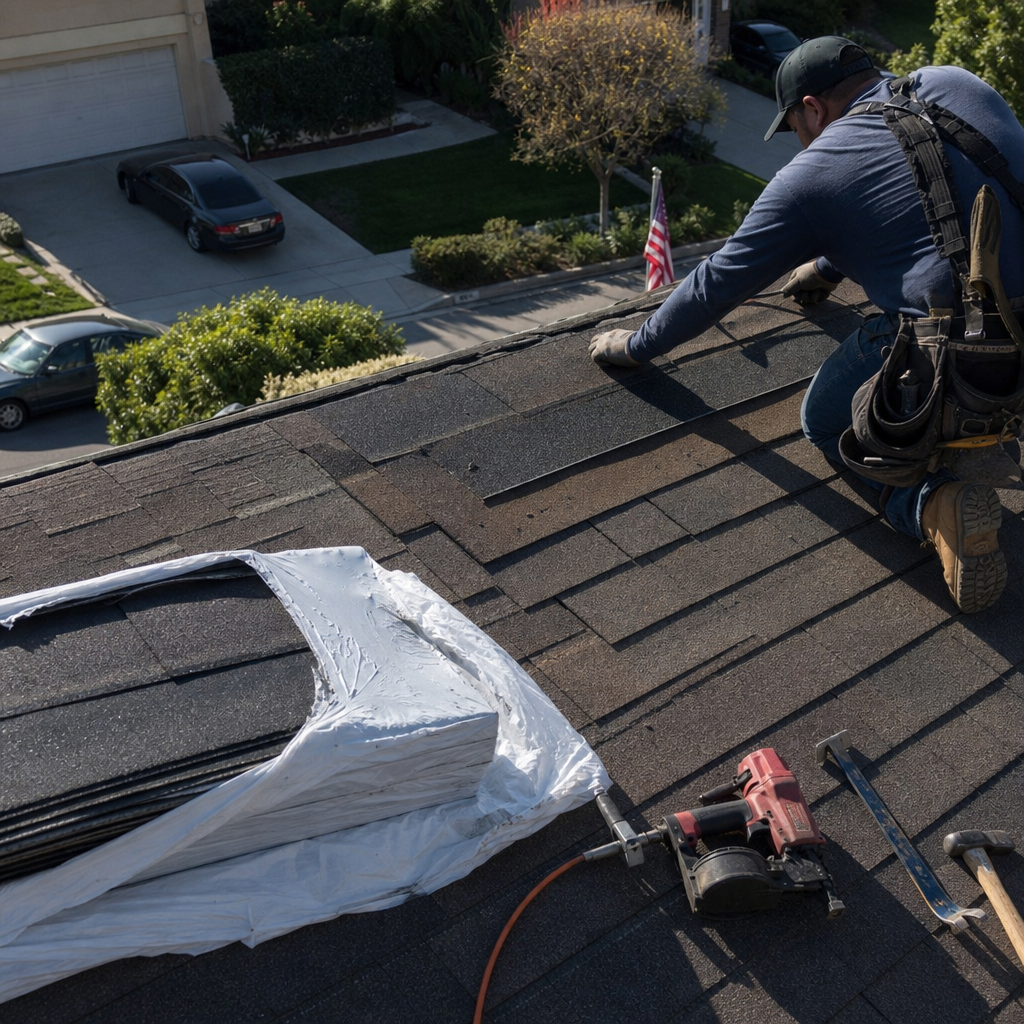
- Tear-Off and Installation: The Days on the Roof
- Weather Holds in Los Angeles: Real or Excuse?
- How Roof Size, Pitch, and Access Add Time
- The One Question That Reveals Contractor Honesty
- Common Mistakes to Avoid
- When to Call a Professional
- Frequently Asked Questions
- The Bottom Line
The Five Phases of a Los Angeles Roof Replacement
Every roof replacement moves through five distinct phases. Understanding each one prevents the surprise of a project that seemed simple suddenly consuming a month of your attention.
Phase 1: Material Lead Time (3-10 days)
Once you sign a contract, your contractor orders materials. Standard asphalt shingles from GAF, Owens Corning, or Atlas usually arrive within three to five business days. Specialty materials - clay tile, concrete tile from Boral, or certain metal profiles - can take seven to fourteen days. In our experience serving Los Angeles since 2016, we have seen Tamko architectural shingle orders delayed when suppliers route through the Inland Empire during peak season. We always confirm stock before we pull permits, because starting the clock on a permit while waiting for materials wastes everyone’s time.
Phase 2: Permit Processing (5-14 days)
The Los Angeles Department of Building and Safety reviews residential re-roof permits. Simple asphalt shingle replacements on single-family homes often clear in five to seven business days. Projects involving structural changes, deck replacement, or hillside lots in neighborhoods like Pacific Palisades or the Hollywood Hills can stretch to two weeks or more. We will cover this in depth in the next section.
Phase 3: Tear-Off (1 day, occasionally 2)
The crew removes old roofing down to the deck. A 2,000-square-foot home with one layer of asphalt shingles typically completes tear-off in a single day. Two layers, or built-up roofing on flat sections, adds time. We photo-document the deck condition during this phase - part of our standard inspection process - so homeowners see exactly what we see.
Phase 4: Installation (1-3 days)
Deck repair, underlayment, flashing, and final roofing material installation. A straightforward asphalt shingle job on a walkable pitch finishes in one day. Complex cut-up roofs with multiple valleys, dormers, or steep pitches common in Los Feliz or Silver Lake homes extend to two or three days.
Phase 5: Final Inspection and Sign-Off (2-7 days)
The Los Angeles DBS requires a final inspection for most re-roof permits. Scheduling availability varies by district. We have seen inspectors available next-day in some San Fernando Valley districts, while downtown-adjacent areas back up to a week during busy seasons.
Total realistic timeline: two to four weeks for standard projects, four to six weeks for complex or specialty jobs.
Permit Processing: The Phase That Catches Homeowners Off Guard
Out-of-state guides rarely mention Los Angeles permitting because they do not know it. The Los Angeles Department of Building and Safety operates multiple district offices, and each handles volume differently. This is not a formality. It is a gate that every legitimate contractor must pass through.
For a standard re-roof with no structural changes, your contractor submits:
- A completed application with property owner information
- Roofing plans showing material type and manufacturer specification
- Deck condition assessment if structural work is anticipated
- Proof of contractor license and workers’ compensation insurance
The DBS reviews for compliance with local fire codes, which matter intensely in Los Angeles hillside zones designated as Very High Fire Hazard Severity Areas. Homes in Topanga, Malibu, or the Santa Monica Mountains face additional requirements for Class A fire-rated materials. Atlas and CertainTeed both manufacture Class A asphalt shingles, but the permit reviewer will verify the specific product designation. Using a non-compliant material means stopping work and re-permitting.
Expedited review exists for an additional fee, but in our experience it rarely saves more than two or three days. The better strategy is submitting complete, accurate paperwork the first time. Incomplete applications cycle to the back of the queue. We have learned this over forty-two years in the trade - our company was founded in 1984, and we have navigated Los Angeles permitting through multiple code cycles.
Homeowners should expect their contractor to handle permitting. If a contractor suggests skipping permits or pulling a homeowner-owner permit to save time, that is a red flag. Unpermitted work must be disclosed in California real estate transactions and can complicate insurance claims after future storms.
Material Lead Times and What Affects Them
Material availability has stabilized since the supply disruptions of 2020-2022, but lead times still vary by product and season. Here is what we currently see in the Los Angeles market:
| Material Type | Typical Lead Time | Seasonal Variation |
|---|---|---|
| Standard asphalt shingles (GAF, Owens Corning, IKO) | 3-5 business days | +2-3 days in March-May peak season |
| Architectural/laminated shingles (Atlas, Tamko) | 5-7 business days | +3-5 days during storm-response periods |
| Concrete tile (Boral) | 7-14 business days | Color-matched orders may extend to 3 weeks |
| Clay tile (specialty import) | 14-21 business days | Minimal seasonal variation; port delays possible |
| Metal roofing (standing seam) | 10-14 business days | Custom fabrication adds 1-2 weeks |
Los Angeles’s mild climate means less seasonal roofing urgency than in snow-belt markets, but March through May remains busy as homeowners address winter damage before summer heat. Ordering materials before permit approval risks storage fees or damage, but waiting until permit-in-hand adds days. Our approach: we confirm material availability at contract signing, place the order when permit submission confirms, and store materials securely if they arrive before the permit clears.
Color availability matters too. Popular neutrals - weathered wood, driftwood, charcoal - move faster. Custom or discontinued colors can add a week while suppliers check warehouse stock across the Southwest.
Tear-Off and Installation: The Days on the Roof
This is the phase homeowners picture when they think “roof replacement.” It is also, paradoxically, the shortest phase. Here is how the days typically unfold:
- Morning arrival and setup: Crew arrives 7:00-7:30 AM, positions dumpsters or trailers, covers landscaping and pool equipment with tarps. For homes in Beverly Hills or Hancock Park with mature gardens, this protective work takes extra care and time.
- Tear-off and deck inspection: Old roofing comes off systematically. We inspect the deck as we go, photographing any soft spots, delamination, or code violations. Homeowners receive these photos - part of our documented inspection standard.
- Deck repair and preparation: Replace damaged plywood, install ice and water shield in valleys and penetrations, apply synthetic underlayment to the field. Los Angeles’s Santa Ana wind exposure makes proper underlayment fastening critical; we have seen corners cut here fail within two years.
- Flashing and detail work: Pipe boots, chimney saddles, wall step flashing. These details outlast the shingles if done right, or leak within months if done wrong.
- Final roofing installation: Shingles, tiles, or panels applied to manufacturer specifications. For asphalt shingles, this means six nails per shingle in wind zones, proper offset patterns, and sealed valleys.
- Cleanup and magnetic sweep: Nails, debris, and material scraps removed. We run a magnetic roller across driveways, walkways, and planting beds - the same standard we hold for work at our own homes.
A 2,500-square-foot home with one layer of asphalt shingles, walkable pitch, and straightforward access typically completes steps 1-6 in a single day. Add a second layer, steep pitches over 6:12, or complex rooflines with multiple dormers, and the timeline extends to two days. Three days is uncommon for residential work but possible for large homes in Brentwood or Bel Air with 4,000+ square feet of roof area and intricate architectural details.
Our Roof Replacement & Installation in Los Angeles page details our specific process for homes in this market.
Weather Holds in Los Angeles: Real or Excuse?
Los Angeles’s reputation for sunshine leads some homeowners to dismiss weather delays as contractor excuses. The reality is more nuanced.
Legitimate weather holds in Los Angeles include:
- Rain during tear-off: An exposed roof deck cannot be left wet overnight. If rain begins mid-tear-off, crews tarp the open area and resume when the deck is dry - typically the next day.
- High Santa Ana winds: Sustained winds above 25 mph make shingle installation unsafe and compromise sealant adhesion. Fall Santa Ana events, particularly October through December, can pause work for one to three days.
- Extreme heat: Asphalt shingles become pliable and easily damaged above 90°F. In San Fernando Valley locations like Woodland Hills or Chatsworth, summer temperatures regularly exceed this threshold. Early morning starts help, but crews may suspend work by early afternoon.
Contractor scheduling problems disguised as weather holds show a different pattern: vague “waiting for a window,” no specific forecast cited, or delays that extend past the weather event without explanation. A trustworthy contractor tells you the specific condition, the forecast that resolves it, and the revised start date.
In our forty-two years, we have learned to build weather contingencies into every timeline we provide. We would rather under-promise and over-deliver than leave a homeowner guessing. Our 90-Day Done Right Promise applies regardless of weather delays - if it is not right, we make it right, with no paperwork runaround.
How Roof Size, Pitch, and Access Add Time
Three physical factors extend every phase of the timeline, and they are especially relevant in Los Angeles’s varied terrain and housing stock.
Roof size: Measured in “squares” - one square equals 100 square feet. A 20-square home takes roughly twice the material handling, installation labor, and cleanup of a 10-square home. Time does not scale perfectly because setup and breakdown are fixed costs, but a 40-square estate home in Hancock Park or Pacific Palisades requires a larger crew or an extra day compared to a standard 15-square tract home in the Valley.
Roof pitch: Pitch is expressed as rise over run - 4:12 means four inches of vertical rise per twelve inches of horizontal run. Walkable pitches are generally 6:12 and below. At 8:12 and steeper, crews require scaffolding, toe boards, or specialized safety equipment. Los Angeles’s hillside neighborhoods - Hollywood Hills, Laurel Canyon, Mount Washington - feature many homes with 10:12 or steeper pitches for architectural drama and drainage. Each step up in pitch adds roughly 15% to installation time.
Site access: Narrow driveways in older Los Angeles neighborhoods like Los Feliz or Silver Lake prevent material delivery trucks from positioning close to the house. Dumpster placement on steep streets requires permits in some areas. Homes with no driveway at all - common in Venice or Santa Monica - mean hand-carrying materials or using conveyor equipment. Each access constraint adds hours or days.
We assess all three factors during our initial inspection and build them into the timeline we provide. No surprises. The number on the estimate reflects the number on the invoice.
The One Question That Reveals Contractor Honesty
Before you sign any contract, ask this exact question: “What is the latest possible completion date if one thing goes wrong?”
The answer reveals more than any reference or review. A contractor who gives you a single date - “We will be done Thursday” - without contingency is either inexperienced or telling you what you want to hear. An honest contractor responds with a range: “If everything goes smoothly, Thursday. If we find deck damage, or if the inspector is backed up, the following Wednesday.” Then they explain what triggers each scenario.
At Ridgeline Roofing Co. home, we provide written timelines with three milestones: earliest completion, expected completion, and latest completion with one moderate complication. We have learned over four decades that homeowners who understand the full range make better decisions and experience less stress. We will be there when we say - and if we are not, we tell you exactly why and exactly when we will arrive.
This question also screens out storm-chasers who carry no inventory, have no local inspector relationships, and disappear when complications arise. Los Angeles sees these operators after every significant weather event. They offer quick starts because they have no permit process, no material orders, and no intention of staying for the finish.
Common Mistakes to Avoid
- Planning only for the tear-off day: Homeowners who block one day on their calendar and schedule everything around it are caught off guard when permitting or materials delay the start. Plan for the full two-to-four-week window.
- Accepting verbal timeline commitments: A contractor who will not put a completion range in writing is a contractor who cannot be held accountable. Our 90-Day Done Right Promise is written, not spoken.
- Ignoring permit requirements for “like-for-like” replacements: Even when replacing the same material, Los Angeles DBS requires permits for most re-roofs. Skipping this step saves days upfront and costs months during a home sale.
- Choosing materials based solely on speed of availability: The shingle in stock today may not be the right shingle for your roof pitch, fire zone, or aesthetic. We carry authorized lines from seven manufacturers including IKO and Atlas specifically to match the right product to each home without forcing a compromise.
- Not asking about inspection scheduling before signing: Some contractors complete installation and then discover a two-week inspection backlog. We confirm inspector availability before we set the installation date.
- Assuming all Los Angeles contractors know local hillside codes: Fire-rated material requirements vary by specific address, not just neighborhood. A contractor unfamiliar with L.A. City Fire Department hillside zones can install non-compliant materials that fail inspection.
- Failing to protect interior belongings: Vibration from tear-off can crack plaster in homes built before 1960, common in Los Angeles historic neighborhoods. Remove wall hangings and protect fragile items before work begins.
When to Call a Professional
Call a roofing professional when you notice interior water stains, missing or curling shingles, granule accumulation in gutters, or daylight visible through the roof deck from inside your attic. In Los Angeles, where mild winters mask gradual deterioration, many homeowners discover roof failure only during the first serious rain after a dry summer.
Call immediately if you suspect structural damage from fallen trees, earthquake-related shifting, or Santa Ana wind uplift. These situations involve safety risks that require trained assessment, not homeowner investigation.
Ridgeline Roofing Co. offers our Roof Replacement & Installation services with free estimates in Los Angeles. A live person answers every call, 24 hours a day, including nights, weekends, and the middle of a storm - no voicemail trees, no callback windows. Our background-checked, uniformed technicians document every inspection with photos from your actual roof, and we provide no-hassle upfront pricing: the number on the estimate is the number on the invoice. Call (844) 563-1816 to schedule.
For repair needs that do not require full replacement, see our Roof Repair in Los Angeles page. For unique materials or architectural requirements, our Specialty Roofing in Los Angeles page outlines our capabilities.
Frequently Asked Questions
Most residential roof replacements in Los Angeles take two to four weeks from signed contract to final inspection, though the actual tear-off and installation typically require only one to two days. The remaining time covers material ordering, Los Angeles Department of Building and Safety permit processing, and scheduled inspections. Call (844) 563-1816 for a free estimate with a written timeline specific to your home.
Yes, a small to medium home with one layer of asphalt shingles, walkable pitch, and straightforward access can complete tear-off and installation in a single day. However, permit approval and final inspection still require additional days before the project is fully complete. We complete most standard asphalt shingle jobs in one visit when permits are pre-cleared.
Standard residential re-roof permits through the Los Angeles Department of Building and Safety typically process in five to seven business days for simple asphalt shingle replacements. Projects with structural changes, deck replacement, or hillside fire-zone requirements can extend to two weeks. Expedited review is available for an additional fee but rarely saves more than two to three days.
Rain during tear-off can pause work because exposed roof decks cannot be left wet overnight. Los Angeles’s Mediterranean climate means rain is concentrated November through March, but El Niño patterns can extend wet periods. Legitimate contractors build weather contingencies into their timelines rather than using rain as a scheduling cover.
Walkable pitches of 6:12 and below allow normal installation speed. Steeper pitches require safety equipment, slower movement, and sometimes scaffolding, adding roughly 15% to installation time per increment. Many Los Angeles hillside homes feature 8:12 to 12:12 pitches for architectural effect and drainage, which extends the installation phase to two or three days.
Repairs cost less upfront but become uneconomical when a roof nears the end of its service life - typically 20-25 years for asphalt shingles in Los Angeles’s sun exposure. Multiple repairs within a five-year period often exceed replacement cost while delivering inferior protection. We provide free second opinions on any written estimate to help homeowners make this calculation with full information. Call (844) 563-1816 to schedule.
The Bottom Line
A Los Angeles roof replacement is not a one-day event. It is a two-to-four-week project with five distinct phases, each carrying its own timeline and potential complications. The homeowners who navigate it smoothly are those who understand the full sequence - material lead time, permit processing, tear-off, installation, and final inspection - and who choose a contractor honest enough to explain where delays can occur. For more guides & resources on roofing projects, visit our blog. At Ridgeline Roofing Co., we have built our reputation since 1984 on exactly that honesty: upfront pricing, written guarantees, and live phones around the clock. Named for the ridge - the line where a roof proves itself - we stand behind every job we complete. Done right, and if it is not, we make it right.
Written by the team at Ridgeline Roofing Co., serving Los Angeles since 2016.