
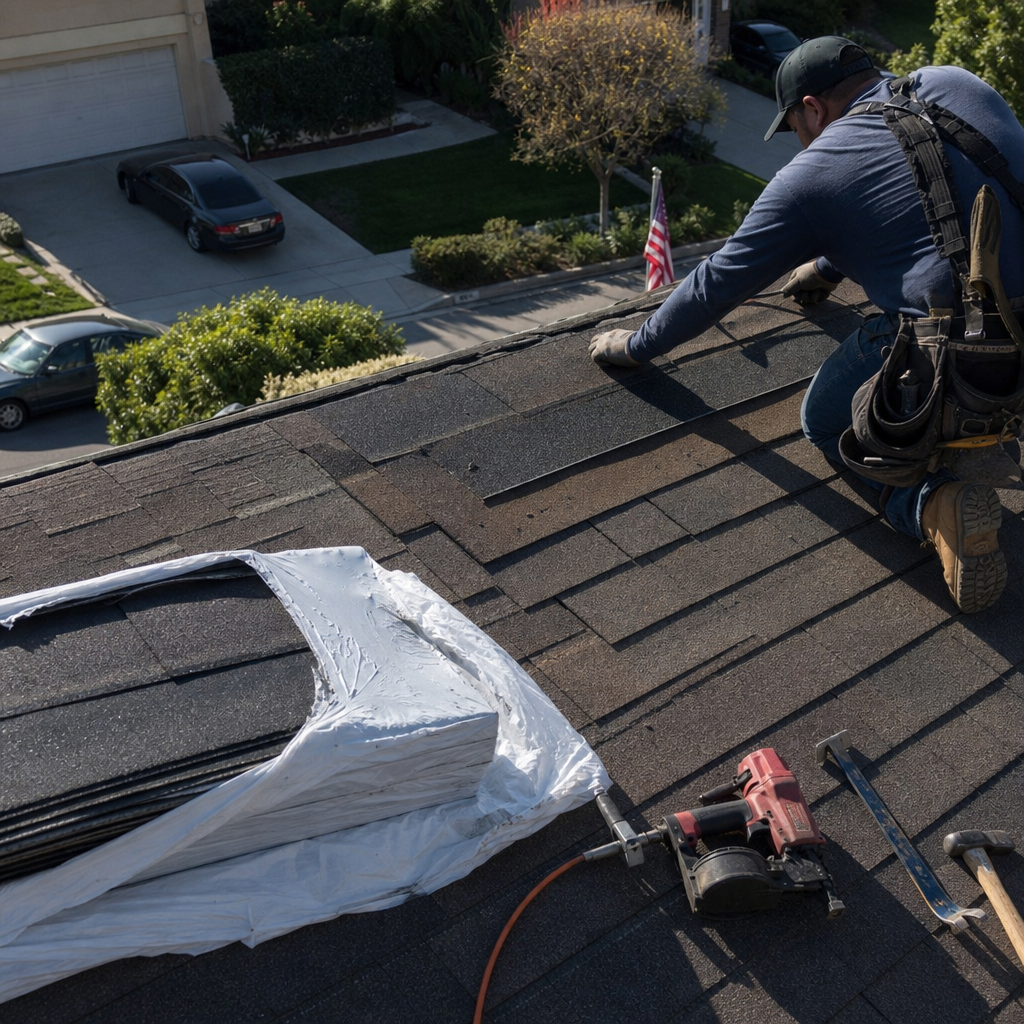
Flashing Repair in Los Angeles, CA
Flashing repair is the work of resealing or replacing the thin metal strips that seal every transition point on your roof – around chimneys, skylights, dormers, vent pipes, and wherever a roof plane meets a wall. When that metal lifts, cracks, or corrodes, water finds its way in fast. Most of the water-stain calls we take in Los Angeles trace back to failed flashing, not a worn-out field of shingles.
If you have noticed a brown ring on your ceiling near a chimney or skylight, or if a recent rain left a damp smell in an attic that stayed dry for years, there is a reasonable chance your flashing is the source. The good news is that isolated flashing failures are among the more straightforward roof repairs we handle – usually diagnosed and resolved in a single visit, without disturbing the rest of your roof.
Ridgeline Roofing Co. has been repairing flashing on Los Angeles roofs since 1984. If you would rather talk through your situation before scheduling anything, a live person answers our phones around the clock at (844) 563-1816. Every job we do is covered by our written 90-Day Done Right Promise – no paperwork, no arguing. If it is not right, we come back and make it right. You can read more about everything we cover under Roof Repair in Los Angeles.
When You Need Flashing Repair
Flashing does not announce its failure with a loud crack or an obvious collapse. It tends to fail quietly, over months or years, until the interior damage makes the problem impossible to ignore. Here are the situations that most often bring Los Angeles homeowners to our phones.
- Water stains on ceilings near a chimney or skylight. These rings almost always mean flashing – not a shingle problem. In older hillside homes in areas like Silver Lake and Eagle Rock, we regularly find that original chimney step-flashing from the 1960s has simply reached the end of its useful life.
- Visible gaps or lifted metal at roof-to-wall junctions. The siding-to-roof transition on a two-story Los Angeles home takes significant thermal stress from summer heat. When the flashing counter pulls away from the wall even slightly, a heavy rain drives water straight behind it.
- Efflorescence or white staining on chimney brick. White mineral deposits on brick are a sign that water has been wicking through the masonry, often because the saddle flashing or chimney cap flashing has failed at the back of the stack.
- Rust streaks running down from vent pipes or exhaust collars. Galvanized pipe collars corrode over time, and the rust itself signals that the collar is no longer sealing cleanly around the pipe. This is common on roofs with original galvanized flashing that has not been updated since the 1980s or 1990s.
- Bubbling or peeling paint on interior walls near exterior penetrations. If a skylight well or an interior wall adjacent to a chimney is showing paint failure, moisture is getting in somewhere above it. We photograph the source from the roof before any repair is proposed.
- A recent inspection or insurance walkthrough flagged flashing as deficient. Lenders and insurers in the Los Angeles market have grown stricter about flashing condition. If you received a written notice citing flashing concerns, we can document the repair with photos that support a clean re-inspection.
Our Flashing Repair Process
We do not repair flashing from the ground or the driveway. Every assessment starts on the roof, with photos, because an honest diagnosis is only possible when someone has actually looked at the problem. Here is how a typical flashing repair proceeds from first call to final sign-off.
- Roof-top inspection with photo documentation. One of our background-checked, uniformed technicians gets onto the roof and photographs every flashing detail that may be contributing to your problem. You receive those photos – not a verbal summary, but the actual images. That way you can see exactly what we are proposing to fix and why.
- Upfront written estimate before any work begins. Once we understand the scope, we put a number in writing. The number on the estimate is the number on the invoice. We do not add charges after the fact, and we do not use “starting at” language to get the job signed and then expand scope mid-project.
- Removal of compromised flashing and sealant. We pull the failing material fully rather than layering new sealant over old. Stacking products on a failed base is one of the most common shortcuts in the industry, and it is exactly why some homeowners call us after a previous contractor’s work failed within a year or two.
- Installation of properly gauged replacement flashing. Depending on the location, we use step flashing, counter flashing, saddle flashing, or pipe collars suited to that specific detail. For chimney work in particular, we size the saddle to your chimney width rather than using an off-the-shelf piece that was not made for your roof pitch. Where a manufacturer-matched product is called for – say, a GAF or Boral-compatible detail on a newer roof system – we use it.
- Sealing and integration with surrounding shingles or roofing material. Flashing repair does not stop at the metal itself. The surrounding shingles need to be re-bedded, the sealant applied in the right sequence, and the water pathway addressed so rain runs over the repair, not under it.
- Post-repair photo set and written documentation. We photograph the finished work before we leave. That photo set is yours to keep, and it supports your records if you sell the home or file a claim. The 90-Day Done Right Promise covers everything we touched: if anything we repaired leaks or fails within 90 days, we come back at no charge, no questions asked.
Flashing Repair Pricing in Los Angeles
Flashing repair in Los Angeles typically runs between $250 and $1,400, depending on the type of flashing involved, how accessible the location is, and how much of the surrounding roofing material needs to be disturbed to complete the repair correctly. The table below reflects the ranges we most commonly see in the Los Angeles market – these are not bait-and-switch “starting at” figures; they reflect real job costs for each category.
| Repair Type | Typical Los Angeles Range |
|---|---|
| Pipe collar / vent pipe flashing | $250 – $425 |
| Skylight flashing (reseal or partial re-flash) | $350 – $650 |
| Step flashing at a single wall-to-roof joint | $325 – $600 |
| Chimney counter and step flashing (partial) | $450 – $850 |
| Chimney saddle / cricket flashing | $550 – $1,100 |
| Full chimney re-flash (all four sides) | $750 – $1,400 |
| Valley flashing replacement (per section) | $400 – $900 |
A few things push costs toward the higher end in Los Angeles specifically. Steep-pitch roofs – common in the hillside neighborhoods of Glassell Park, Mount Washington, and parts of the Hollywood Hills – take longer and require more safety rigging. Older homes with original brick chimneys sometimes need mortar repair or tuckpointing as part of the counter-flashing work, which adds material and labor. And if your flat roof was installed with a less common material like a Boral tile or a specialty underlayment, the surrounding work requires more care to avoid damaging what is already in good shape.
If your repair comes to $250 or more, our standing offer of $50 Off Any Repair Over $250 applies automatically – no coupon needed, no asking. Seniors and veterans receive a permanent 5% discount on all work. And if another contractor has already given you a written estimate, we will give you a free second opinion on that estimate at no charge, no obligation.
Call (844) 563-1816 for an exact quote. The estimate costs nothing, and you will have a written number before any work begins.
What Los Angeles Conditions Do to Flashing
Flashing in Los Angeles takes a different kind of punishment than it does in a wet climate. Here the stress is mostly thermal. Summers in the San Fernando Valley regularly push attic temperatures past 150 degrees, and the metal expands and contracts accordingly. Over several years, that repeated movement works at the sealant bond and the fasteners holding step flashing in place. By the time the first real El Nino rain arrives, the seal may already be compromised – you just did not know it yet because the dry season gave it nothing to do.
The combination of long dry spells followed by heavy atmospheric river events is particularly hard on older galvanized flashing. The metal oxidizes slowly during dry months, and then the first prolonged rain of the season finds every weak point at once. We have been tracking this pattern on Los Angeles roofs since the mid-1980s, and it is one reason we recommend having flashing checked in October, before the rainy season, rather than waiting for a leak to declare itself.
Hillside homes face a second pressure: the roof geometry tends to be more complex, with multiple intersecting planes, dormers, and irregular penetrations. More transitions mean more flashing details, and more details mean more places for something to go wrong. In neighborhoods like Laurel Canyon or Beachwood Canyon, we rarely see a roof with just one flashing issue – the work tends to cluster.
A Note on Safety and Scope
Chimney flashing repair on a steep-pitch roof is not a safe DIY project. The combination of height, sloped surface, and the need to work at the chimney base – where you have no good anchor point – creates real fall risk. We say this not to talk you out of anything, but because we have been in this business long enough to know what goes wrong. If you are curious about the condition of your flashing, the right first step is to have someone qualified look at it. Call us; we will come out and show you exactly what is there.
Why Homeowners in Los Angeles Choose Ridgeline Roofing Co.
Ridgeline Roofing Co. started in 1984 – which means we were repairing Los Angeles roofs before the Northridge earthquake, before the 1992 storms, and before most of the storm-chaser operations that cycle through this market today. Our crews are local. Our apprentices train under our journeymen and stay with us. We are not bringing in outside labor for a big season and then leaving town.
We are an authorized installer of GAF, CertainTeed, Owens Corning, IKO, Atlas, Tamko, and Boral products. For flashing work, that authorization matters because it means we use the correct product for each manufacturer’s system rather than substituting generic material that voids a warranty. On a newer GAF or Atlas roof, we spec the matching flashing components. On older construction, we match what the roof calls for.
Our phones are staffed by a live person 24 hours a day, seven days a week. If a storm rolls through Los Angeles on a Saturday night and you are watching a water stain spread across your ceiling, you can call (844) 563-1816 for leak repair and reach a person – not a voicemail box, not an after-hours answering service that takes a message for Monday. Someone who can help you figure out what to do right now.
Every technician we send to your home has passed a background check and arrives in uniform. We photograph your roof and show you what we found. The estimate is in writing, and the number does not change. Our home and every service we offer operate on the same principle: a square deal, done right, backed by a written guarantee.
FAQs – Flashing Repair in Los Angeles
How long does flashing repair take?
Most flashing repairs in Los Angeles are completed in a single visit of two to four hours, depending on the location and the extent of the damage. A straightforward pipe collar replacement is usually done in under two hours. A full chimney re-flash – all four sides, new counter flashing set into recut mortar joints – may take the better part of a day. We give you a realistic time estimate before we start, not after. Call (844) 563-1816 and we can give you a rough sense of scope based on your description before we even schedule a visit.
Can damaged flashing be patched, or does it need to be replaced?
It depends on the condition of the base metal and the surrounding material. Flashing that has a small separation at a seam but is otherwise sound can sometimes be resealed cleanly and will hold for years. Flashing that is corroded, bent out of shape, or was never correctly lapped in the first place needs to come out. We will tell you honestly which situation you are in – with photos to back it up – and we will not recommend replacement when a repair will do the job. That is what it means to give someone a square deal.
Does Ridgeline Roofing Co. guarantee flashing repairs?
Yes. Every flashing repair we complete is covered by our written 90-Day Done Right Promise. If anything we repaired leaks or fails within 90 days of the work, we come back and fix it at no charge. No paperwork, no arguing, no waiting. We stand behind what we do because we plan to be in Los Angeles for another 42 years, and a reputation built since 1984 is not something we are willing to trade away on a single job.
My roof is still under a manufacturer warranty. Will flashing repair affect it?
As long as the repair is done with compatible materials and by a contractor authorized to work with that manufacturer’s products, it should not affect your warranty. We are authorized installers of GAF, CertainTeed, Owens Corning, IKO, Atlas, Tamko, and Boral – which covers the majority of roofing systems installed in Los Angeles over the past two decades. If you are uncertain about your specific warranty terms, we can review the documentation with you before any work begins. Call (844) 563-1816 and we will help you sort it out before anything is touched.
What is the difference between flashing repair and roof repair more broadly?
Flashing repair is a focused subset of Roof Repair in Los Angeles – it addresses specifically the metal transition details at penetrations and intersections rather than the field of shingles or the decking underneath. Many leak calls that look like shingle problems turn out to be flashing problems, and vice versa. That is one reason we always inspect from the roof itself before diagnosing anything. Getting that distinction right from the start is the difference between a repair that solves the problem and one that treats the wrong thing entirely.
- Flashing repair covers: chimney step and counter flashing, skylight flashing, pipe collars, dormer flashing, valley metal, and wall-to-roof transitions.
- General roof repair covers: shingle replacement, decking repair, ridge cap work, underlayment, and soffit or fascia issues.
- The two often overlap – a failed piece of step flashing sometimes lifts adjacent shingles that need to be reset as part of the same repair.
Schedule a Flashing Inspection in Los Angeles
If you are seeing water stains, smelling damp in your attic after rain, or simply have not had your flashing looked at in five or more years, now is a reasonable time to do it. A problem caught before the rainy season costs less than the same problem caught after water has worked its way into the sheathing.
Call Ridgeline Roofing Co. at (844) 563-1816 – a live person will answer, any time of day or night. We will schedule a roof-top inspection, photograph what we find, and give you a written estimate before any work begins. The estimate is free. The number we quote is the number you pay. And if the work is not right, we come back and make it right – that is the 90-Day Done Right Promise, in writing, on every job we do in Los Angeles.
Written by the team at Ridgeline Roofing Co., serving Los Angeles since 1984.