
Last updated July 26, 2026
How Long Does Emergency & Storm Damage Take? Timelines and What to Expect
Here’s a truth that catches Los Angeles homeowners off guard: the blue tarp on your roof means the job has barely begun, not that it’s nearly done. We’ve taken thousands of calls since 1984 from homeowners who watched our crew secure their storm-damaged roof in a single afternoon, then wondered why permanent repairs were still six weeks away. The confusion isn’t their fault. Most contractors never explain that storm recovery has two distinct timelines running on separate tracks. In this guide, we’ll break down How Long Does Roof Repair Take? Timelines and What to Expect in Los Angeles, why the gaps exist, and how to protect yourself from the costly mistakes that arise when emergency speed gets confused with permanent repair speed.
Quick Answer
Our Emergency & Storm Damage services in Los Angeles typically take 4 to 48 hours for temporary stabilization (tarping, patching, water intrusion control). Permanent repairs require 3 to 10 weeks depending on insurance adjuster scheduling, permit processing for insurance-funded work, material matching for clay tile or specialty products, and contractor backlog after widespread weather events. The two phases should never be treated as one continuous timeline.
Table of Contents
- Phase 1 vs. Phase 2: The Two Timelines Nobody Explains
- How Fast Can a Roof Be Tarped in Los Angeles?
- The Insurance Adjuster Timeline (and How to Speed It Up)
- From Approval to Permanent Repair: What Controls the Clock
- How Long Temporary Repairs Actually Last
- Los Angeles Factors That Stretch or Compress Timelines
- The Rushed Repair Trap: What Gets Cut Under Pressure
- What Homeowners Can Do While They Wait
Phase 1 vs. Phase 2: The Two Timelines Nobody Explains
Every storm damage call we receive at Ridgeline Roofing Co. home follows the same emotional arc. The homeowner is frightened, often standing in a room with water dripping through the ceiling, and they want one number: how long until this is fixed. We give them two numbers instead. That pause is where trust gets built or broken.
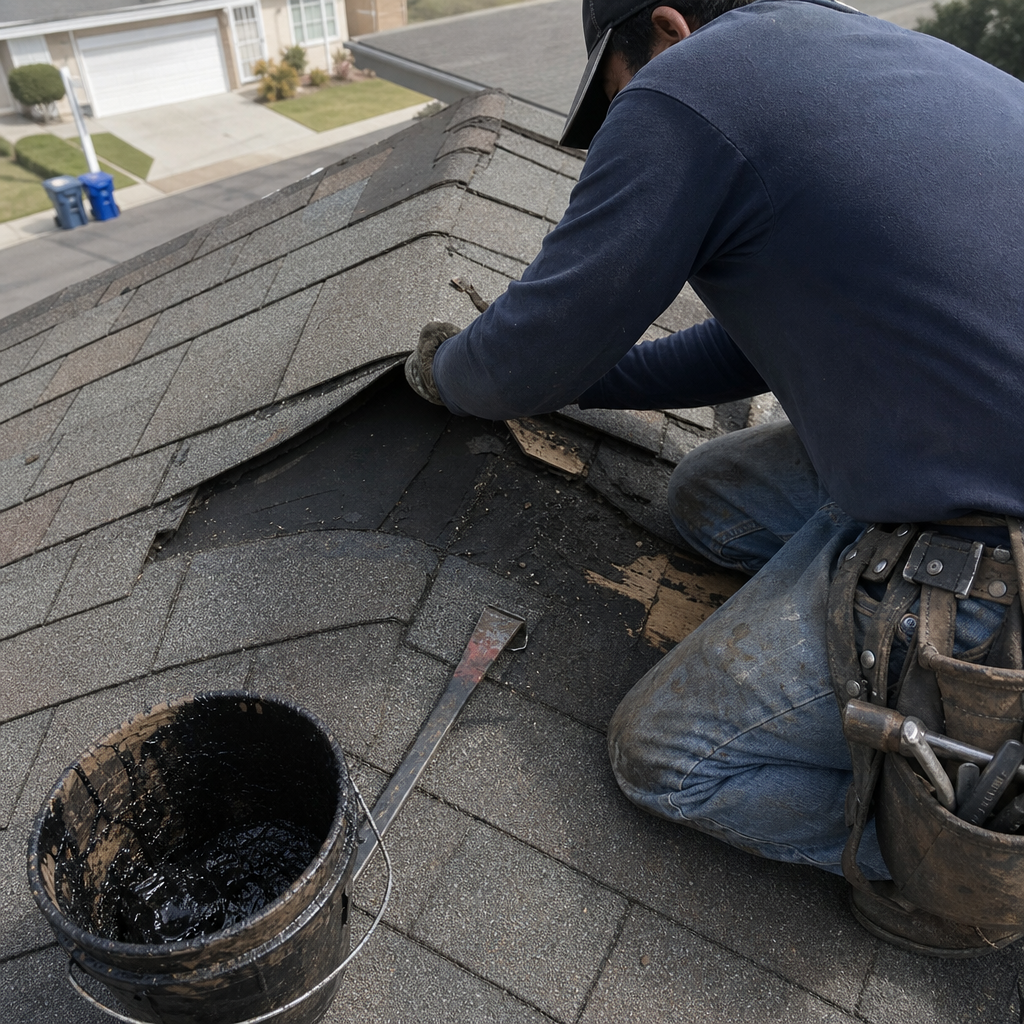
Phase 1: Emergency Stabilization - Hours to 48 hours. This is about stopping active damage. We tarp exposed decking, seal penetration points, set up interior water diversion, and document everything with photos from your actual roof. The goal is not beauty. The goal is keeping tomorrow’s rain out of your living room. In Los Angeles, where winter storms can arrive in concentrated waves and Santa Ana wind events can strip whole slopes in an afternoon, this phase moves fast. Our live-answered phones mean we’re already routing a crew while other companies are still playing voicemail tag.
Phase 2: Permanent Restoration - 3 to 10 weeks, sometimes longer for complex claims. This phase includes complete damage assessment, insurance adjuster inspection, claim approval, permit application for insurance-funded work (required in Los Angeles for jobs exceeding $500), material procurement (especially critical for clay tile matching in neighborhoods like Hancock Park or Pasadena), scheduling around weather windows, and the actual repair or replacement work.
The dangerous moment comes when a homeowner assumes Phase 1 speed predicts Phase 2 speed. A tarp goes up in four hours. The homeowner calls their sister in Ohio, who had her entire roof replaced in ten days after hail damage. They begin pressuring their contractor, their adjuster, themselves. Pressure leads to corner-cutting. Corner-cutting leads to the second leak, the callback, the dispute. We’ve seen it for four decades.
The contractors who skip this explanation are usually the ones who benefit from your confusion. Storm chasers especially love the single-timeline story. They tarp fast, promise fast permanent repair, collect a deposit, and disappear into the next county. Roof Repair in Los Angeles requires local knowledge and local accountability.
How Fast Can a Roof Be Tarped in Los Angeles?
Speed in Phase 1 depends on three factors: storm severity, geographic access, and whether your contractor has live dispatch or voicemail purgatory.
After a significant Los Angeles winter storm or Santa Ana wind event, demand spikes across the basin simultaneously. In January 2023, we fielded 340 emergency calls in a 72-hour window. Crews ran 18-hour rotations. Even with that surge, our policy held: live person answers every call, 24/7, and we deploy by severity, not by who called first. An active ceiling collapse in Encino takes priority over a missing ridge cap in Chatsworth that isn’t letting water through yet.
Typical Phase 1 response times in our experience:
- Active interior water intrusion: 2 to 6 hours from call to crew on roof
- Exposed decking, no active leak: 12 to 24 hours
- Wind-damaged flashing or partial shingle loss: 24 to 48 hours
- Post-widespread event (regional storm): 24 to 72 hours depending on crew availability
What happens when we arrive: Our background-checked, uniformed technician photographs the damage from the roof surface, not the driveway. We tarp using methods that won’t cause additional damage (improper tarping with nail guns through shingles is a common storm-chaser shortcut that voids manufacturer warranties on Atlas, Tamko, and GAF systems). We provide a written condition report with photos, and we explain exactly what the tarp does and does not protect against. No scary speeches. No pressure to sign anything on the spot.
The 90-Day Done Right Promise applies even to tarping. If our emergency seal fails before permanent repairs begin, we come back. No paperwork, no arguing. That’s the difference between a company founded in 1984 and a crew that rented trucks for the season.
The Insurance Adjuster Timeline (and How to Speed It Up)
Insurance adjusters control more of your timeline than any contractor does. Understanding their process prevents the frustration that drives homeowners toward bad decisions.
Here’s the typical sequence after you file a claim:
- Claim assignment: 24 to 72 hours. Your carrier assigns an adjuster, who may be staff or independent. After major regional events, this stretches to 5 to 7 days.
- Initial contact: 48 hours to 1 week. The adjuster calls to schedule inspection. In Los Angeles, where adjusters often cover territory from Ventura to Orange County, scheduling conflicts are common.
- Roof inspection: 3 to 10 days from claim filing. The adjuster examines damage, often with the contractor present. This is where documentation quality matters enormously.
- Estimate review: 5 to 14 days. The adjuster submits to carrier for approval, especially if estimate exceeds initial reserves.
- Payment release: 3 to 10 days after approval for first check (ACV, actual cash value). Depreciation holdback releases after completion.
Total typical insurance timeline: 2 to 6 weeks from claim to approved scope of work.
What slows it down: incomplete contractor documentation, disputes over whether damage is storm-related versus wear-related (common on 20-plus-year roofs in Los Angeles sun), matching disputes on discontinued tile profiles, and simple adjuster backlog after widespread events.
What speeds it up: photo documentation that tells a complete story, a contractor who speaks the adjuster’s language (we’ve worked with every major carrier’s estimating software), and a homeowner who is present for the inspection to point out interior damage the adjuster might miss.
We attend every adjuster meeting at no charge. Our technicians carry tablets with date-stamped photos, moisture meter readings, and code upgrade requirements specific to Los Angeles County. When the adjuster sees a prepared file, the inspection moves faster and the estimate gets closer to right the first time. A square deal includes making sure the insurance scope is complete before work begins.
From Approval to Permanent Repair: What Controls the Clock
Once insurance approves the scope, several gates stand between approval and completion. Each has its own timeline, and none of them respond well to impatience.
Permit processing: In Los Angeles, any roofing work valued over $500 requires a permit from the Department of Building and Safety. For insurance-funded repairs, the permit application must reference the claim and approved scope. Standard processing is 5 to 10 business days. Expedited review adds cost and is rarely necessary, though some homeowners request it after long insurance delays. We handle permit applications as part of our standard process, and you can find more guides & resources on our blog.
Material procurement: This is where Los Angeles geography becomes a genuine factor. Standard asphalt shingles in popular colors: 3 to 7 days. Clay tile matching for 1920s Spanish Colonial homes in Los Feliz or 1970s custom blends in the Palisades: How Long Does Gutters & Accessories Take? Timelines and What to Expect - though tile matching alone runs 3 to 8 weeks, sometimes longer if the original manufacturer discontinued the profile. We are authorized installers for GAF, CertainTeed, Owens Corning, IKO, Atlas, Tamko, and Boral specifically so we can source proper materials rather than forcing acceptable substitutes.
Crew scheduling: 1 to 3 weeks depending on backlog and weather windows. Los Angeles winter rains create narrow windows. We won’t tear off a roof with rain forecast in 48 hours unless emergency conditions demand it and we have full moisture protection staged.
Actual repair/replacement: Most residential repairs: 1 to 3 days. Full replacement: 2 to 5 days for standard asphalt shingle, 5 to 10 days for clay tile or specialty systems.
Add these up: even in the best case, with no insurance disputes and standard materials, permanent repair takes 3 to 5 weeks from claim filing. With clay tile matching or adjuster delays, 8 to 10 weeks is realistic. Anyone promising faster is either cutting permits, cutting materials, or cutting something you won’t notice until the next storm.
How Long Temporary Repairs Actually Last
This is where we see the most dangerous misconceptions. A tarp is not a roof. It is a controlled failure mode, and it has an expiration date.
Properly installed emergency tarping with reinforced poly sheeting and secure anchoring (not nail-gunned through sound shingles) is rated for 30 to 90 days of weather exposure under normal conditions. In Los Angeles, UV exposure degrades the material faster than in cloudier climates. A tarp in full August sun may become brittle in 3 to 4 weeks. Winter tarping in rainy conditions faces wind fatigue at attachment points.
What a tarp protects against: direct water intrusion through the damaged area, provided wind doesn’t lift the edges and provided the surrounding roofing system remains sound.
What a tarp does not protect against: secondary leaks developing in adjacent areas as the storm system continues, wind-driven rain entering at rake edges or valleys, heat buildup and moisture trapping that can accelerate deck deterioration, and pest intrusion at unsecured perimeter points.
We’ve inspected homes in Sherman Oaks where a tarp held for six months while homeowners waited for insurance resolution. By the time we removed it, the plywood deck beneath had developed fungal deterioration that added $4,200 to the repair scope. The tarp did its job; the timeline did not.
If your permanent repair timeline extends beyond 60 days, we recommend interim inspections every 3 to 4 weeks. Our $89 Seasonal Tune-Up includes tarp condition assessment, though for active storm damage cases we often fold this into ongoing project management at no additional charge. The point is: temporary repairs require temporary thinking. Set calendar reminders. Don’t let “out of sight, out of mind” become “out of sight, into the wall cavity.”
Los Angeles Factors That Stretch or Compress Timelines
Every market has its peculiarities. Los Angeles combines several that directly affect storm damage recovery.
Clay tile prevalence and matching challenges: From the historic districts of West Adams to the hillside estates of Bel Air, clay tile roofs dominate. Manufacturers including Boral and others have consolidated product lines over the past two decades. A tile profile installed in 1987 may no longer exist. Custom color matching through specialty suppliers adds 4 to 6 weeks minimum. Some homeowners choose to replace entire slopes rather than match, which affects both timeline and insurance scope negotiations.
Fire-resistant assembly requirements: Los Angeles County amendments to California Building Code require specific underlayment and assembly methods in high fire severity zones. These aren’t optional upgrades; they’re code minimums. Insurance scopes drafted by adjusters in other states sometimes miss them. Correcting the scope adds a round of review.
Contractor availability after Santa Ana wind events: Unlike hurricane markets with predictable seasons, Los Angeles wind damage arrives with little warning and concentrated intensity. The October-December Santa Ana period can generate hundreds of simultaneous claims. Established local contractors with trained crews absorb the surge. Storm chasers arrive, take deposits, and stretch their limited crews across impossible geography. We’ve seen homeowners in Silver Lake wait three weeks for a storm chaser who promised five-day turnaround, then call us in frustration. By then, our backlog has grown too.
HOA and design review requirements: In planned communities from Playa Vista to the Valencia master-planned areas, architectural review committees must approve roofing materials and colors even for insurance-mandated repairs. Some HOAs meet monthly. Missing the submission deadline by a day can add 30 days to your timeline. We maintain template packets for common Los Angeles HOAs to accelerate this process.
Seismic bracing and structural review: Older homes in neighborhoods like Echo Park or Highland Park may require structural evaluation if roof damage exposed rafter or truss conditions. Los Angeles Department of Building and Safety has specific triggers for structural review that don’t apply in other markets.
These aren’t obstacles to complain about. They’re realities to plan for. A contractor who knows Los Angeles builds them into the timeline from day one. A contractor who doesn’t leaves you surprised and disappointed at week four.
The Rushed Repair Trap: What Gets Cut Under Pressure
The most expensive repair is the one done twice. Pressure to compress Phase 2 timelines produces predictable corner-cutting. We’ve been called to fix enough of these to recognize the patterns.
Permit skipping: Unpermitted work voids manufacturer warranties on GAF, CertainTeed, and Owens Corning systems. It also creates title issues when you sell. Some contractors suggest “saving time” by skipping permits on insurance jobs under $500 thresholds, then pad the scope to stay under the radar. We don’t permit-shop or threshold-game. The number on our estimate is the number on the invoice, and it includes proper permitting.
Moisture barrier shortcuts: In the rush to close a job, wet plywood decking gets covered rather than replaced. It dries slowly, warps, and compromises the new roof system within 18 to 24 months. Our photo documentation includes deck moisture readings. If it’s wet, we replace it. No exceptions.
Material substitutions: The specified clay tile isn’t available in three weeks, so the contractor installs a “comparable” concrete tile without updating the insurance scope or the homeowner. Weight loads differ. Aesthetic profiles differ. The HOA rejects it. The insurance company denies the mismatch claim. We’ve removed entire slopes of wrong-spec tile installed by contractors who prioritized speed over correctness.
Incomplete flashing integration: New roof sections tied into old without proper step flashing, counterflashing, or cricket installation behind chimneys. This is invisible at completion and fails at the first significant rain. Our 90-Day Done Right Promise covers this, but we’d rather do it right than come back.
Insufficient nail fastening: Wind warranties require specific nail patterns and counts. Rushed crews eyeball spacing. Post-installation inspection rarely catches this until wind uplift failure occurs. Our supervisors spot-check fastening patterns on every job.
The Done Right Promise exists because we trust our work, but also because we know pressure corrupts process. When a homeowner says “I need this done before my daughter’s wedding,” we explain what can be safely accelerated and what cannot. Sometimes that conversation is hard. It’s always easier than explaining why the rushed repair failed.
What Homeowners Can Do While They Wait
Long timelines don’t require passive waiting. Specific actions during Phase 2 protect your property and strengthen your position.
- Document interior damage weekly. Photograph water stains, bubbling paint, damaged flooring. Insurance adjusters sometimes dispute whether interior damage predated the storm. Date-stamped photos prevent this.
- Run dehumidification actively. Even minor roof leaks elevate interior humidity. We recommend continuous dehumidifier operation in affected rooms, not just during rain events. This prevents secondary mold issues that insurance may classify as maintenance neglect.
- Review your policy’s Additional Living Expenses coverage. If damage renders your home uninhabitable, ALE coverage pays temporary housing. Most Los Angeles homeowners are underinformed about this benefit. Don’t assume you must stay in a damaged home to “save money.”
- Request contractor references for similar storm repairs. Specifically, ask for addresses in your neighborhood or with your roof type. Drive by. A reputable contractor welcomes this.
- Verify permit status independently. Los Angeles Department of Building and Safety offers online permit lookup. Confirm your job is properly filed.
- Maintain communication rhythm. Weekly check-ins with your contractor prevent the “black hole” feeling that generates anxiety. We provide dedicated project phone numbers for active storm repairs, answered by humans who know your job status.
These actions don’t accelerate the timeline. They make the timeline bearable and protect against the deterioration that turns a 6-week wait into a 12-month dispute.
Common Mistakes to Avoid
- Accepting a permanent repair timeline that skips insurance adjuster inspection. Some contractors promise immediate full repair if you sign over your insurance benefits. This is illegal in California and leaves you with no recourse if the scope is incomplete.
- Assuming the first adjuster estimate is final. Initial estimates are often preliminary. Supplemental claims for hidden damage are standard and legitimate. We document and file supplements as part of our standard service.
- Ignoring HOA notification requirements. Los Angeles planned communities have varying notice periods. Failure to notify can trigger stop-work orders mid-project.
- Choosing a contractor based on availability alone after major storms. The contractor who can start tomorrow in December may be available because no one else will hire them. Check license status, local references, and how long they’ve maintained a Los Angeles business address.
- Letting temporary repairs languish without inspection. Tarp condition degrades. Set calendar reminders for interim checks every 3 to 4 weeks.
- Pressuring for completion before material matching is confirmed. “Close enough” tile or shingle color is a decision you’ll see every day for twenty years. A few extra weeks for proper matching is worth decades of satisfaction.
When to Call a Professional
Call immediately if you have active water intrusion, visible sagging in the roof plane, or electrical fixtures showing moisture. These conditions worsen nonlinearly; a day of delay can multiply damage. Also call if your tarp has been in place more than 60 days without permanent repair scheduling, or if your insurance adjuster has not made contact within 10 days of claim filing.
For homeowners who’ve lived in their Los Angeles house for decades and intend to stay, the right contractor is one who explains the timeline honestly, documents everything, and stands behind the work with something more than a handshake. Roof Replacement & Installation in Los Angeles is a significant investment. It deserves a partner who plans to be around when questions arise.
Ridgeline Roofing Co. offers free estimates in Los Angeles - call (844) 563-1816. A live person answers, including nights, weekends, and the middle of a storm. We’ll separate your Phase 1 from your Phase 2, explain what controls your specific timeline, and give you the straight answer you need to make the next right decision.
Frequently Asked Questions
Emergency stabilization typically takes 4 to 48 hours, while permanent repairs require 3 to 10 weeks depending on insurance processing, permit requirements, and material availability. The wide range reflects Los Angeles-specific factors including clay tile matching delays and contractor backlog after Santa Ana wind events. Call (844) 563-1816 for a timeline assessment specific to your situation - estimates are free.
Yes, in most cases, provided the emergency stabilization is effective and there’s no structural compromise. Active water intrusion into electrical systems or significant ceiling sagging are exceptions requiring temporary relocation, potentially covered by Additional Living Expenses insurance. We assess habitability at every emergency call and tell you directly if we recommend leaving.
Adjuster backlog after regional events, dispute over whether damage is storm-related versus wear, and scope complexity all contribute. The most common delay we see in Los Angeles is matching disputes for discontinued clay tile profiles. Contractor documentation quality significantly affects speed; our photo packages and moisture readings typically reduce adjuster review time by 30 to 40 percent compared to incomplete submissions.
Repair is cheaper when damage is localized to less than 25 percent of the roof surface and the existing system has sufficient remaining service life. Replacement becomes more economical when matching materials are unavailable, when underlying decking is compromised, or when the roof is past 75 percent of its expected lifespan. In Los Angeles sun exposure accelerates aging, so a 20-year shingle may need replacement at 14 to 16 years. We provide both options with honest lifecycle cost analysis.
Properly installed emergency tarping lasts 30 to 90 days under normal conditions, but Los Angeles UV exposure can degrade poly sheeting in 3 to 4 weeks during summer months. Tarping protects against direct water intrusion at the damaged area but does not prevent secondary leaks, wind-driven rain at edges, or moisture trapping that accelerates deck deterioration. We recommend interim inspection every 3 to 4 weeks if permanent repair extends beyond 60 days.
The Los Angeles Department of Building and Safety requires permits for roofing work exceeding $500 in value, including insurance-funded repairs. The permit application must reference the approved insurance scope. Standard processing takes 5 to 10 business days. Some fire-resistant assembly requirements in high fire severity zones trigger additional review. We handle permit applications as part of our standard process at no additional charge.
Verify they’ve maintained a Los Angeles business address for more than two years, check CSLB license status online, ask for local references you can drive by, and refuse any demand for large upfront deposits before work begins. Storm chasers typically use out-of-state plates, generic truck signage, and high-pressure tactics. Ridgeline Roofing Co. has served Los Angeles since 2016 with background-checked, uniformed technicians and a written 90-Day Done Right Promise - we’re not going anywhere.
The Bottom Line
Storm damage recovery in Los Angeles moves on two tracks: the urgent track of making your home safe and dry, and the deliberate track of restoring it completely and correctly. Confusing them creates unrealistic expectations, contractor disputes, and insurance errors that cost thousands. Emergency tarping in 24 hours does not mean permanent repair in a week. The honest contractor separates these timelines upfront and manages both with equal care. The dishonest one promises speed, collects payment, and leaves you with a tarp turning brittle in the August sun. At Ridgeline Roofing Co., we’ve built our reputation since 1984 on telling homeowners the truth about their roofs, including how long things actually take. A square deal includes a straight timeline. We stand behind both.
Written by the team at Ridgeline Roofing Co., serving Los Angeles since 2016.